Facts
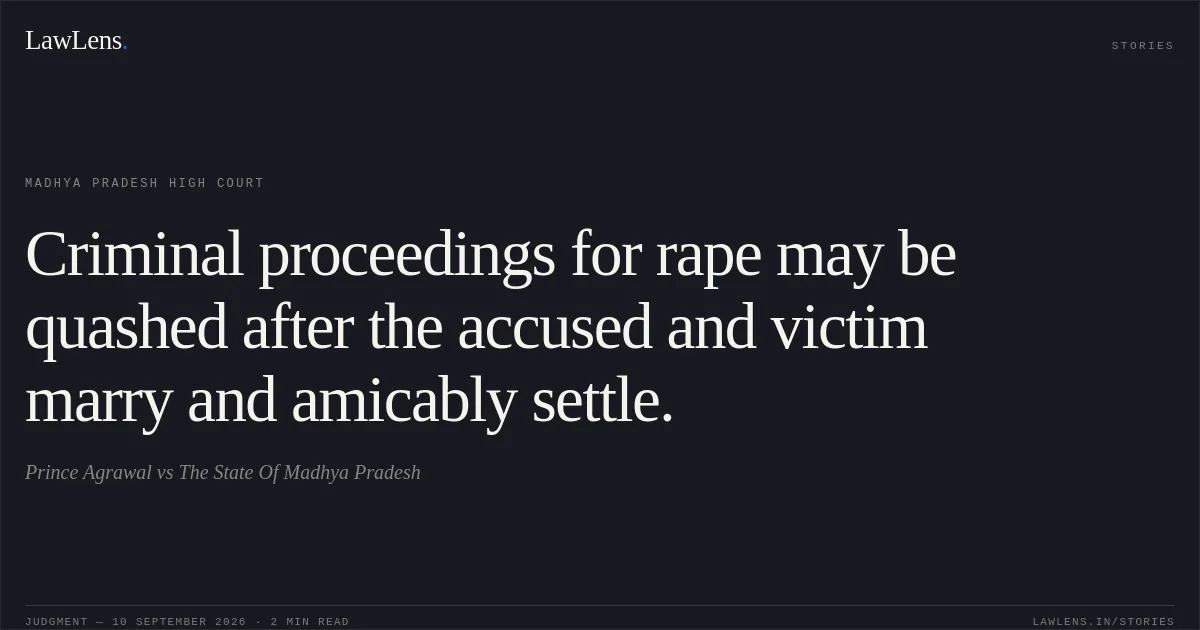
The petitioner invoked Section 528 of the Bharatiya Nagarik Suraksha Sanhita, 2023, seeking quashing of FIR/charge-sheet in Crime No. 1745 of 2023, registered at Police Station Lasudiya, District Indore, for offences under Sections 376, 376(2)(n), 323 and 506 of the Indian Penal Code, 1860, along with consequential criminal proceedings
Source reference: para. 1The prosecution alleged that the petitioner had subjected respondent No. 2 to sexual intercourse/harassment on the pretext of marriage
Source reference: para. 2During the proceedings, the petitioner submitted that the parties had amicably settled their dispute and had subsequently married each other. Applications seeking recognition of the compromise and recording of the victim’s no-objection were also filed
Source reference: para. 3The Court personally heard both parties, who stated that they had solemnised their marriage on 29 November 2025; photographs of the marriage were placed on record
Source reference: para. 5Issues
Whether the High Court could exercise its inherent jurisdiction under Section 528 of the Bharatiya Nagarik Suraksha Sanhita, 2023, to quash proceedings for alleged offences under Sections 376, 376(2)(n), 323 and 506 IPC on the basis of a settlement between the parties?
Source reference: paras. 1, 6–7Whether the subsequent marriage between the petitioner and the victim, together with the victim’s consent to the compromise, justified quashing the FIR and all consequential proceedings in the interests of justice?
Source reference: paras. 3, 5, 7Law Applied
The Court exercised its inherent jurisdiction under Section 528 of the Bharatiya Nagarik Suraksha Sanhita, 2023, to consider quashing of the FIR and subsequent proceedings.
Source reference: paras. 1, 6It relied on Gian Singh v. State of Punjab and Another, (2012) 10 SCC 303, which distinguishes statutory compounding under Section 320 of the Code of Criminal Procedure, 1973, from quashing by the High Court in exercise of inherent powers.
Source reference: para. 6Under the Gian Singh principle, the High Court may quash even non-compoundable offences where the dispute is settled, continuation of the prosecution would be futile, and quashing is necessary to secure the ends of justice; however, serious offences such as rape ordinarily cannot be quashed merely because the offender and victim have settled the matter.
Source reference: para. 6The relevant criminal allegations were under Sections 376, 376(2)(n), 323 and 506 IPC
Source reference: para. 1Reasoning
The Court verified the compromise by personally hearing both parties and noting their assertion that they had married on 29 November 2025, supported by photographs
Source reference: para. 5It concluded that the settlement had been entered into voluntarily and without undue pressure
Source reference: para. 5Applying the inherent-power principles stated in Gian Singh, the Court treated the subsequent marriage and the victim’s consent as demonstrating an amicable resolution of the dispute.
Source reference: paras. 6–7It further held that, in these circumstances, continuation of the criminal proceedings would serve no useful purpose and that refusing to recognise the compromise would not advance the ends of justice
Source reference: paras. 6–7Holding
The High Court allowed the petition and quashed FIR/Crime No. 1745 of 2023 dated 29 December 2023, registered at Police Station Lasudiya, Indore, for offences under Sections 376, 376(2)(n), 323 and 506 IPC, together with all subsequent proceedings arising from that crime and pending against the petitioner
The petition was accordingly disposed of on the terms of the compromise
Source reference: para. 8Acts & Sections Cited
6 provisions across 3 statutes referred to in this judgment. Each provision opens on LawLens.
Bharatiya Nagarik Suraksha Sanhita, 20231
Indian Penal Code, 18603
Code of Criminal Procedure, 19732
Original Court PDF
Prince AgrawalvsThe State Of Madhya Pradesh
Click to open original judgment
Original judgment, available to read, download and summarize on LawLens.in