Facts
The applicants (a retired Police Sub-Inspector and his son) sought the quashing of FIR C.R. No. I-13/2017 registered at Ranip Police Station under Sections 365, 294(b), 506(2), and 114 of the IPC, and Sections 10 and 33 of the Gujarat Money Lending Act.
Source reference: p. 2The de facto complainant alleged that after failing to repay a loan, Applicant No. 1 abused, threatened, and kidnapped him in an Alto car on 18.03.2017, though the complainant allegedly escaped an hour later.
Source reference: p. 2-3The applicants contended the FIR was a pressure tactic to avoid repaying a Rs. 2 lakh loan, noting that they had previously filed cheque bounce cases against the complainant.
Source reference: p. 3Despite a Memorandum of Understanding (MoU) signed in 2019 where the complainant agreed to withdraw the FIR, he later retracted his consent because the applicants did not withdraw the NIA cases against him.
Source reference: p. 5, 8Issues
1. Whether the allegations in the FIR, taken at face value, disclose a bona fide criminal offence or are an abuse of the process of law intended to settle a civil/monetary dispute.
Source reference: p. 72. Whether the high court should exercise its inherent powers under Section 482 of the CrPC to quash the proceedings to prevent the abuse of the court's process.
Source reference: p. 11Law Applied
Section 482 of the CrPC regarding the inherent powers of the High Court to prevent abuse of process.
Source reference: p. 2Landmark categories established in State of Haryana v. Bhajan Lal [AIR 1992 SC 604], specifically categories 1, 3, 5, and 7 concerning improbable allegations and proceedings initiated with ulterior motives.
Source reference: p. 5-7The "reading between the lines" doctrine from Salib @ Shalu @ Salim v. State of Uttar Pradesh [2023 (0) AIJEL-SC 72166] to identify vexatious litigation.
Source reference: p. 10The four-step verification test from Pradeep Kumar Kesarwani v. State of Uttar Pradesh [2025 AIROnline SC 956] to determine if the material relied upon by the accused is of "sterling quality" enough to overrule the factual assertions in the FIR.
Source reference: p. 11-12Reasoning
The Court observed that the complainant admitted to borrowing money and had initially signed a 2019 MoU stating he did not wish to pursue the FIR.
Source reference: p. 8The court found the narrative of the kidnapping—where the complainant allegedly escaped after an hour and returned home by rickshaw—to be inherently improbable and lacking in credibility.
Source reference: p. 9Upon "reading between the lines," the court determined that the FIR was lodged as a retaliatory measure following the applicants' legal action for dishoured cheques.
Source reference: p. 9-11Applying the Kesarwani test, the court held that the evidence of the existing financial dispute and the complainant's conditional compromise proved that the criminal machinery was being used for the "oblique purpose" of avoiding debt repayment rather than seeking justice for a genuine crime.
Source reference: p. 11-13Holding
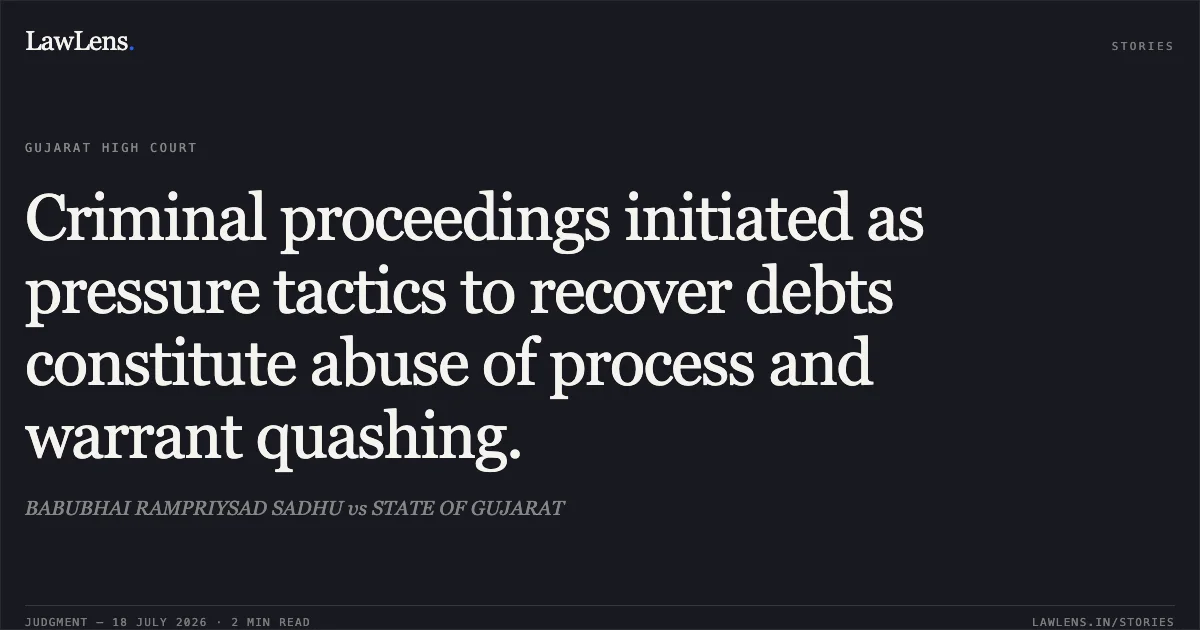
The court held that the case was a manifest abuse of the process of law, falling under the Bhajan Lal parameters, as the allegations were improbable and attended with mala fides.
The Court allowed the application and quashed FIR C.R. No. I-13/2017 and all consequential proceedings against the applicants.
Source reference: p. 13-14Acts & Sections Cited
7 provisions across 2 statutes referred to in this judgment. Each provision opens on LawLens.
Code of Criminal Procedure, 19733
Indian Penal Code, 18604
Original Court PDF
BABUBHAI RAMPRIYSAD SADHUvsSTATE OF GUJARAT
Click to open original judgment
Original judgment, available to read, download and summarize on LawLens.in


