Facts
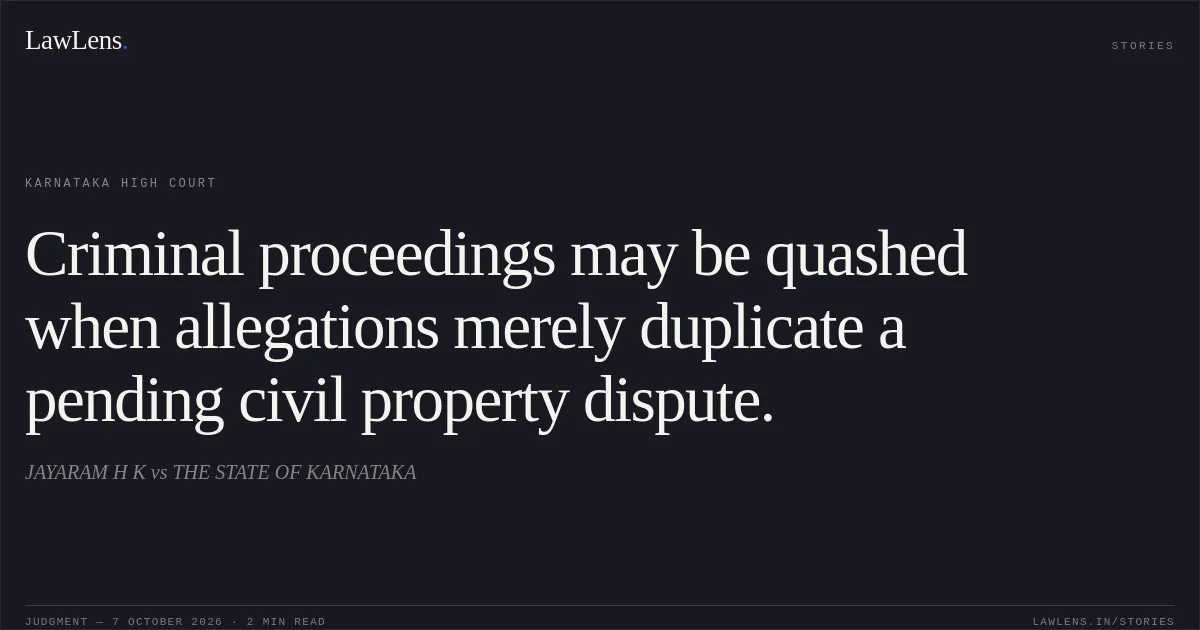
Respondent No. 2 alleged that Petitioner No. 1 forged a 1997 General Power of Attorney (GPA) concerning land at Heggondahalli and, relying on it, executed a sale deed in favour of Petitioner No. 2 on 4 March 2023.
Source reference: para. 2; para. 8The complainant claimed an interest in the property under a will and alleged offences under Sections 465, 468, 471 and 420 read with Section 34 of the IPC.
Source reference: para. 2; para. 8Before the criminal complaint, he had filed a civil suit seeking, among other reliefs, declarations that the GPA and sale deed were void and not binding on him.
Source reference: para. 4; para. 7The petitioners sought to quash the FIR under Section 482 of the CrPC, arguing that the criminal case replicated the pending civil dispute; the State opposed the petition, submitting that the forgery allegations required investigation.
Source reference: para. 1; para. 4; para. 5Issues
Whether the FIR and criminal proceedings should be quashed under Section 482 of the CrPC because the allegations arose from a property dispute already before the civil court.
Source reference: para. 4; para. 7; para. 8; para. 9Whether, at the nascent stage of the investigation, the allegations of forgery and use of the GPA warranted continuation of the criminal proceedings.
Source reference: para. 5Law Applied
Section 482 of the CrPC preserves the High Court’s inherent power to prevent abuse of court process.
Source reference: p. 7; p. 8; para. 8The judgment applied the principle that, although courts ordinarily should not interfere at the threshold of an investigation, quashing may be warranted where allegations do not disclose cognizable offences or the proceedings manifestly amount to an abuse of process; it relied on Neeharika Infrastructure Pvt. Ltd. v. State of Maharashtra for that qualification and on State of Haryana v. Bhajan Lal for categories of cases warranting quashing, including allegations that fail to disclose the ingredients of the alleged offences, mala fide proceedings, and abuse of process.
Source reference: p. 7; p. 8; para. 8The court also relied on Bikku Bhai Govinda Bhai v. State of Gujarat, which cautioned against using criminal proceedings as a means of harassment or coercion in civil property disputes.
Source reference: p. 6; p. 7; p. 8; para. 8The alleged offences were under Sections 465, 468, 471 and 420 read with Section 34 of the IPC.
Source reference: para. 1; para. 2Reasoning
The court noted that the civil suit, filed before the criminal complaint, challenged the same GPA and sale deed and sought substantially overlapping relief.
Source reference: para. 7; para. 8It also recorded the petitioners’ submission that the GPA was registered and that Petitioner No. 1 executed the sale deed as its registered holder.
Source reference: para. 8In the court’s view, the pending civil proceedings would determine the genuineness and effect of those documents, and the criminal case, on the facts presented, amounted to an attempt to give a criminal colour to that dispute.
Source reference: para. 8; para. 9It therefore considered continuation of the prosecution an abuse of process, notwithstanding the State’s submission that the forgery allegations required investigation.
Source reference: para. 5; para. 8; para. 9Holding
The High Court allowed the petition and quashed the proceedings against both petitioners in Crime No. 328/2023 of Sarjapura Police Station for offences under Sections 465, 468, 471 and 420 read with Section 34 of the IPC, pending before the Principal Civil Judge and JMFC, Anekal.
Acts & Sections Cited
6 provisions across 2 statutes referred to in this judgment. Each provision opens on LawLens.
Code of Criminal Procedure, 19731
Indian Penal Code, 18605
Original Court PDF
JAYARAM H KvsTHE STATE OF KARNATAKA
Click to open original judgment
Original judgment, available to read, download and summarize on LawLens.in