Facts
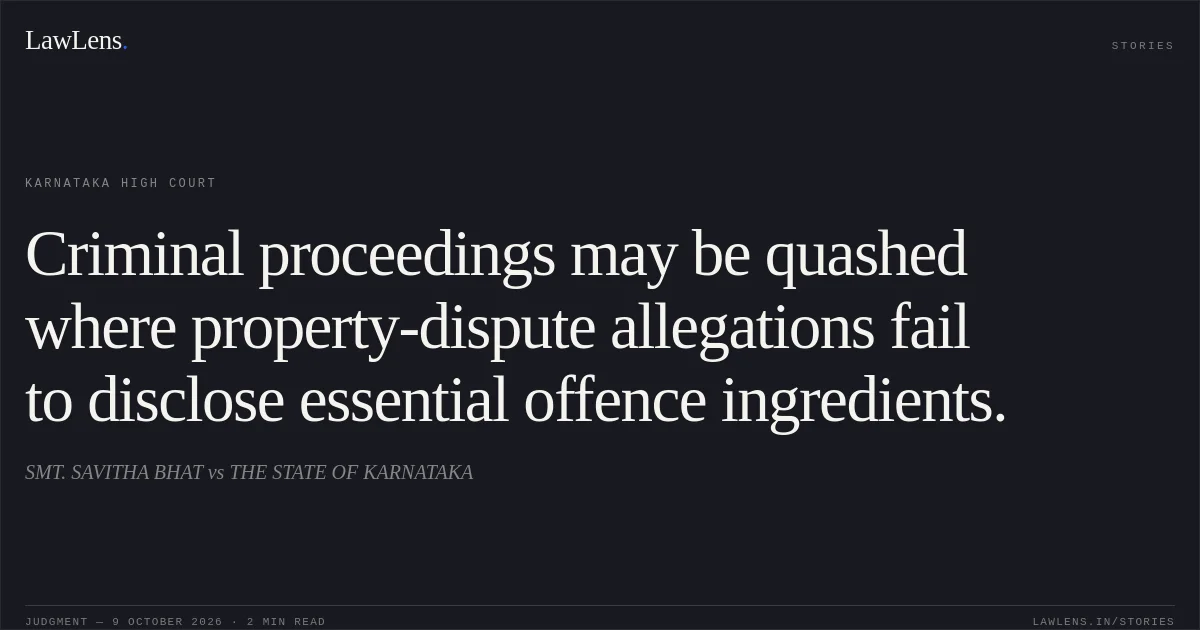
Respondent No. 2 alleged that the petitioners entered her property during work, used abusive language and assaulted her workmen with a steel rod.
Source reference: paras. 2–3After investigation, police filed a charge-sheet under Sections 324, 504 and 34 of the IPC; proceedings were pending as C.C. No. 426/2024 before the Principal Civil Judge and ACJM, Puttur
Source reference: paras. 2–3The petitioners sought to quash the proceedings, relying on multiple pending civil and revenue disputes concerning the adjoining properties, boundaries and Kumki rights
Source reference: paras. 4.1–4.7They also relied on wound certificates recording simple injuries and disputed that the medical material supported an assault with a steel rod.
Source reference: para. 4.8Respondent No. 2, though served, did not appear
Source reference: para. 5Issues
1. Whether the complaint and investigation material disclosed the essential ingredients of offences under Sections 324 and 504 of the IPC, read with Section 34.
Source reference: paras. 11–19, 222. Whether continuation of the criminal proceedings, in the context of the pending civil and revenue disputes, would amount to an abuse of process warranting the High Court’s inherent jurisdiction.
Source reference: paras. 20–24Law Applied
Section 504 IPC requires intentional insult accompanied by an intention or knowledge that the provocation is likely to cause the person insulted to break the public peace or commit another offence; mere abusive language is insufficient.
Source reference: para. 13Section 324 IPC concerns voluntarily causing hurt by a dangerous weapon or means; the fact that an injury is simple does not, by itself, exclude the offence.
Source reference: para. 17Section 34 IPC requires material indicating common intention and cannot, merely from the accused being present together, establish vicarious liability.
Source reference: para. 19A civil dispute does not by itself bar criminal proceedings if the allegations independently disclose an offence, but the High Court may intervene where the ingredients are absent and continuation would abuse the process of law or defeat the ends of justice.
Source reference: paras. 11, 23The Court exercised its inherent jurisdiction under Section 528 of the BNSS.
Source reference: para. 23Reasoning
The Court found that the complaint did not describe circumstances showing that the alleged abuse was intended, or known to be likely, to provoke a breach of the peace or another offence, and therefore did not satisfy Section 504 IPC.
Source reference: para. 14Although the wound certificates recorded injuries, the Court considered that the medical material did not specifically connect them to a steel rod or otherwise independently support the allegation of assault with that weapon.
Source reference: paras. 15–17It also found no distinct material establishing common intention under Section 34.
Source reference: para. 19In reaching its conclusion, the Court considered the pending property litigation as context—not as an automatic bar to prosecution—and held that the allegations and material, viewed together, did not disclose the necessary offences.
Source reference: paras. 11, 18, 20–22Holding
The Court allowed the petition and quashed the proceedings in C.C. No. 426/2024, arising from Crime No. 0011/2024, insofar as the petitioners were concerned.
It directed that its observations would not prejudice the pending civil and revenue proceedings, which were to be decided on their own merits and in accordance with law.
Source reference: Order (iii)Acts & Sections Cited
5 provisions across 3 statutes referred to in this judgment. Each provision opens on LawLens.
Code of Criminal Procedure, 19731
Bharatiya Nagarik Suraksha Sanhita, 20231
Indian Penal Code, 18603
Original Court PDF
SMT. SAVITHA BHATvsTHE STATE OF KARNATAKA
Click to open original judgment
Original judgment, available to read, download and summarize on LawLens.in