01Facts
The petitioner sought quashing of FIR/Case Crime No. 100 of 2018, registered at Police Station Rajpur, Dehradun, under Sections 386, 388 and 120-B of the Indian Penal Code (“IPC”).
¶ 2The FIR was lodged by a reporter of Samachar Plus, who alleged that the channel’s CEO had assigned him to conduct a sting operation on the then Chief Minister.
¶ 3The informant stated that the CEO had told him that the petitioner could assist in securing an appointment with the Chief Minister.
¶ 3After the informant failed to conduct the sting operation, the CEO and another person allegedly threatened him with professional ruin and death.
¶ 3The investigation culminated in a charge-sheet against the CEO and Rahul Bhatia on 25 March 2019, but the petitioner was neither charge-sheeted nor found to be connected with any incriminating material.
¶ 4The State confirmed that ten Investigating Officers had been changed during the investigation and fairly conceded that no incriminating material had been found against the petitioner.
¶ 502Issues
i.Whether the allegations in the FIR, taken at face value, disclosed the commission by the petitioner of offences under Sections 386 or 388 IPC, or participation in a criminal conspiracy under Section 120-B IPC.
¶ 6, 8ii.Whether continuation of the criminal proceedings against the petitioner, despite completion of investigation, his non-inclusion in the charge-sheet and the absence of incriminating material, would constitute an abuse of the process of law.
¶ 6–9iii.Whether the prolonged pendency of the criminal proceedings, in the absence of supporting material, offended the petitioner’s right to a fair and expeditious criminal process under Article 21 of the Constitution.
¶ 4, 7–803Law Applied
The Court applied Sections 386 and 388 IPC, which require, respectively, extortion by putting a person in fear of death or grievous hurt and extortion by threatening an accusation of a serious offence; a mere reference to a person’s name, without allegations of threat, extortion, fear of injury or participation in the conspiracy, does not satisfy their ingredients.
¶ 6Section 120-B IPC requires material indicating an agreement or participation in a criminal conspiracy; no such material was found against the petitioner.
¶ 6, 8The Court exercised its jurisdiction under Article 226 of the Constitution, consistently with the principles governing inherent jurisdiction to prevent abuse of the process of law, where the allegations do not disclose an offence or continuation of proceedings lacks a prima facie evidentiary basis.
¶ 7–8It further relied on Robert Lalchungnunga Chongthu alias R.L. Chongthu v. State of Bihar, 2025 SCC OnLine SC 2511, for the principle that unjustifiably prolonged investigation or criminal proceedings may violate the accused’s right to speedy trial under Article 21, particularly where the State cannot justify the delay.
¶ 4Provisions in the judgment · 2 · Linked ones open on LawLens
Indian Penal Code, 1860 Section 386Section 388
04Reasoning
The FIR attributed to the petitioner only the alleged ability to assist the informant in securing an appointment with the then Chief Minister.
¶ 6It did not allege that the petitioner threatened the informant, demanded money, put him in fear of injury, extorted him, or agreed with the other accused to commit the alleged offences.
¶ 6Since the investigation had concluded and the State had filed a charge-sheet against two other persons while conceding that no incriminating material existed against the petitioner, there was no prima facie basis for continuing the prosecution merely because his name appeared in the FIR.
¶ 6, 8The FIR dated from 2018, and the charge-sheet had been filed on 25 March 2019; continuing the proceedings thereafter would subject the petitioner to indefinite criminal uncertainty and harassment, contrary to the fairness principles under Article 21.
¶ 7The Court therefore held that the case fell within the category in which constitutional jurisdiction may be exercised to prevent abuse of process.
¶ 7–905Holding
The Court answered the issues in favour of the petitioner.
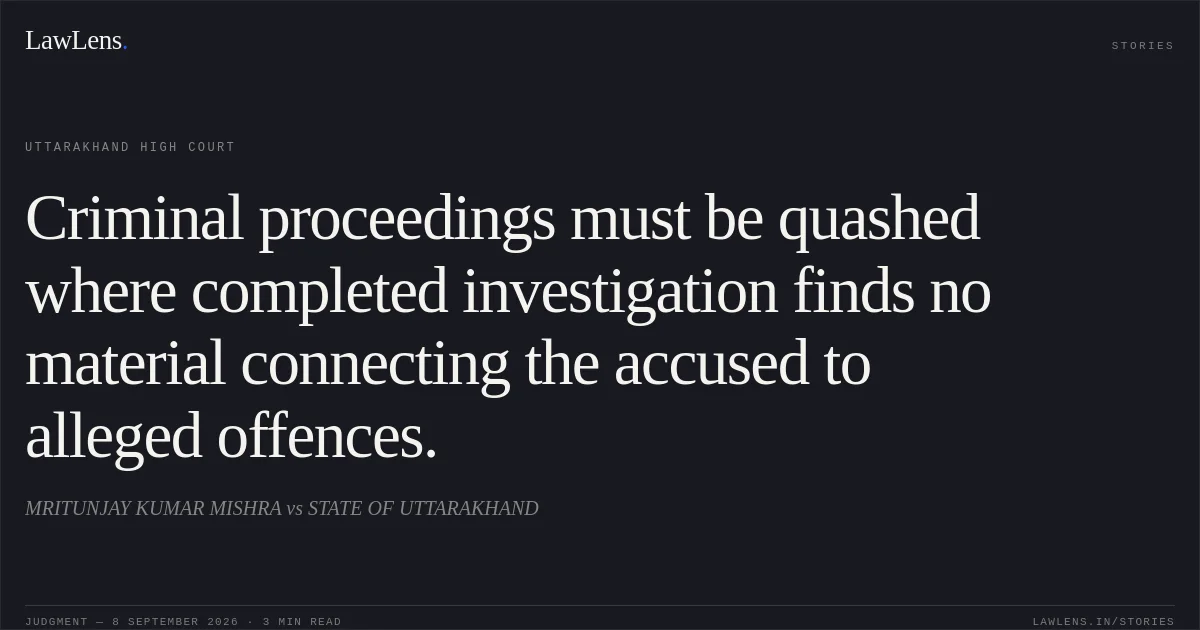
¶ 6–9It held that the FIR did not disclose any specific overt act or prima facie material connecting him with offences under Sections 386, 388 or 120-B IPC, and that continuation of the proceedings would amount to an abuse of the process of law.
¶ 6–9The writ petition was allowed, and FIR/Case Crime No. 100 of 2018, along with all consequential proceedings, was quashed qua the petitioner.
¶ 10Original Court PDF
MRITUNJAY KUMAR MISHRAvsSTATE OF UTTARAKHAND
Click to open original judgment
Original judgment, available to read, download and summarize on LawLens.in