Facts
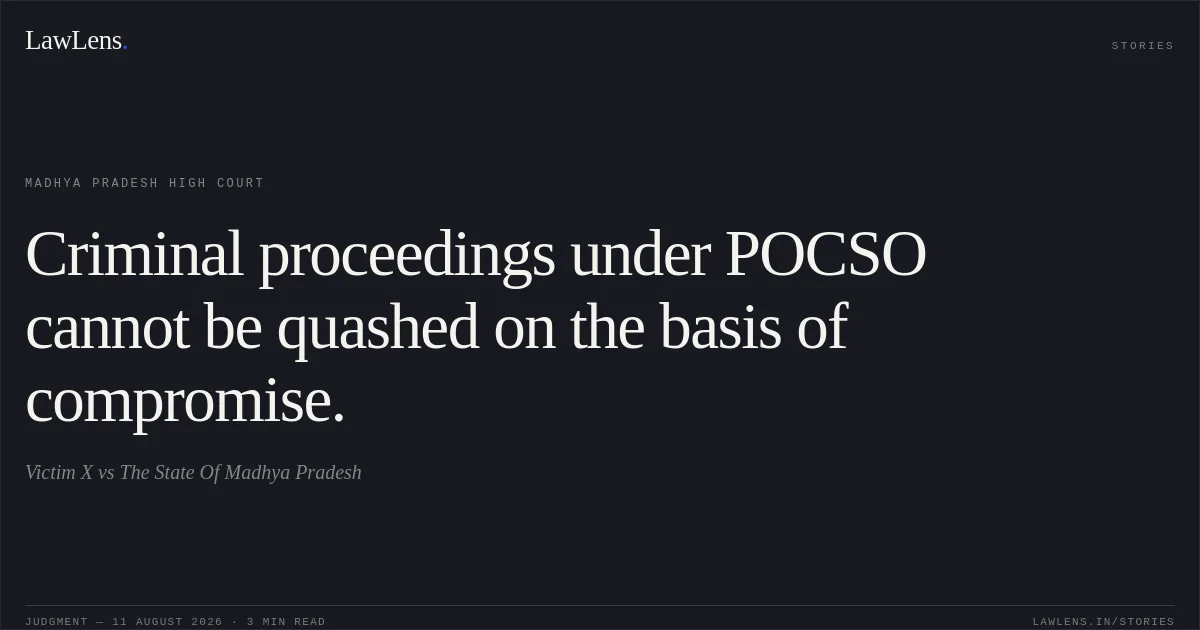
The petitioners invoked Section 528 of the Bharatiya Nagarik Suraksha Sanhita, 2023, seeking quashing of criminal proceedings arising from Crime No. 703/2024 registered at Police Station Bahari, District Sidhi, for offences under Sections 65(1), 70(2) and 351(3) of the Bharatiya Nyaya Sanhita, 2023, read with the relevant provisions of the Protection of Children from Sexual Offences Act, 2012.
Source reference: paras. 1–3; pp. 1–2The proceedings were pending as Sessions Trial No. 02/2025 before the Special Judge (POCSO), Sidhi. The petitioners relied upon an alleged compromise between the prosecutrix and the accused, asserting that the relationship was consensual and that the prosecutrix no longer wished to pursue the case.
Source reference: paras. 1–3; pp. 1–2The Trial Court had rejected the compromise application.
Source reference: para. 2; p. 1The State opposed quashing, contending that the prosecutrix was a minor and that POCSO offences were grave, non-compoundable offences affecting society at large.
Source reference: para. 4; p. 2Issues
Whether the High Court should exercise its inherent jurisdiction under Section 528 BNSS to quash criminal proceedings for alleged POCSO and serious sexual offences on the basis of a subsequent compromise between the parties.
Source reference: paras. 1, 5–12; pp. 1–5Whether the alleged consent of the prosecutrix, her subsequent unwillingness to pursue the prosecution, or an affidavit/compromise executed through her mother could override the statutory protection afforded to a minor under the POCSO Act.
Source reference: paras. 5–9; pp. 2–4Whether the Trial Court’s refusal to act upon the compromise suffered from any illegality warranting interference by the High Court.
Source reference: para. 12; p. 4Law Applied
The Court applied Section 528 BNSS, which preserves the High Court’s inherent power to prevent abuse of process and secure the ends of justice, but held that this power must be exercised consistently with the nature and societal impact of the offence.
Source reference: paras. 6–10; pp. 3–4It relied on Gian Singh v. State of Punjab, (2012) 10 SCC 303, and Narinder Singh v. State of Punjab, (2014) 6 SCC 466, for the principle that compromise-based quashing may be permissible in appropriate cases involving private disputes, but not ordinarily in heinous or serious offences.
Source reference: paras. 6–10; pp. 3–4It further relied on State of Madhya Pradesh v. Laxmi Narayan, (2019) 5 SCC 688, and Parbatbhai Aahir v. State of Gujarat, (2017) 9 SCC 641, which restrict quashing where the offence involves moral depravity, sexual violence, offences against children, or a serious societal impact.
Source reference: paras. 6–10; pp. 3–4The Court applied the POCSO Act’s protective statutory scheme, under which a child below eighteen years cannot legally consent to sexual acts and POCSO offences are not matters capable of being privately compounded.
Source reference: paras. 5, 8–9; pp. 2–4Reasoning
The Court found from the FIR and record that the prosecutrix was below eighteen years of age at the time of the alleged occurrence, thereby attracting the POCSO Act.
Source reference: para. 5; p. 2Since the allegations concerned sexual offences against a child, the case was not a purely private dispute capable of being terminated through compromise.
Source reference: no citationThe Court held that the alleged consensual nature of the relationship was legally irrelevant because a minor’s consent cannot validate sexual acts under the POCSO framework.
Source reference: para. 8; p. 3The subsequent compromise and the prosecutrix’s unwillingness to continue could not defeat the State’s prosecution of offences against society.
Source reference: no citationThe Court also noted that the petition was supported by an affidavit of the prosecutrix’s mother rather than by the prosecutrix herself after attaining majority, and held that the mother had no legal authority to compound such offences on her daughter’s behalf.
Source reference: para. 9; p. 4Accordingly, the principles in Gian Singh and Narinder Singh were held inapplicable because the present case involved serious sexual offences against a child.
Source reference: para. 10; p. 4Holding
The High Court held that a compromise cannot constitute a lawful basis for quashing proceedings involving offences under the POCSO Act, particularly where the prosecutrix was a minor at the time of the incident.
It found no illegality in the Trial Court’s order rejecting the compromise application and dismissed the petition.
Source reference: paras. 11–12; p. 4The Trial Court was directed to proceed with Sessions Trial No. 02/2025 in accordance with law and decide it on its own merits, uninfluenced by the observations in the High Court’s order.
Source reference: para. 13; pp. 4–5Acts & Sections Cited
7 provisions across 3 statutes referred to in this judgment. Each provision opens on LawLens.
Bharatiya Nagarik Suraksha Sanhita, 20231
Bharatiya Nyaya Sanhita, 20233
Original Court PDF
Victim XvsThe State Of Madhya Pradesh
Click to open original judgment
Original judgment, available to read, download and summarize on LawLens.in