Facts
An audit of Kolabira LAMPS Ltd. for the years 2009–10 to 2014–15 allegedly revealed embezzlement and misuse of approximately ₹2,06,32,286.70.
Source reference: pp.1–2A subsequent joint enquiry confirmed the alleged irregularities, following which the District Co-operative Officer lodged Seraikella P.S. Case No. 34 of 2018 against several persons, including the petitioner, for offences under Sections 409, 420, 467, 468, 471/34 IPC and the Prevention of Corruption Act, 2018.
Source reference: pp.1–2An amount of ₹2,20,672 was allegedly recoverable from the petitioner.
Source reference: p.2The allegations against the petitioner concerned: withdrawal of ₹30,000 without recording it in the cash register; transfer of ₹41,500 received from sale of stock into his personal account; and withdrawal of ₹42,057 for purchase of fertilisers without proper entries or deposit of sale proceeds into the society’s account.
Source reference: pp.2, 6–7A surcharge proceeding under Section 40 of the Jharkhand Co-operative Societies Act, 1935 was initiated against him.
Source reference: p.2By order dated 16.02.2019, the Joint Registrar, Co-operative Societies, exonerated the petitioner on merits, finding that the relevant transactions had been entered in the cash register.
Source reference: pp.2–3, 7–9Despite the exoneration, a charge-sheet was submitted against the petitioner.
Source reference: p.3The learned Chief Judicial Magistrate, Seraikella took cognizance on 29.09.2022 and issued summons on 28.01.2023.
Source reference: pp.3, 5–6The petitioner consequently invoked the High Court’s inherent jurisdiction to quash those orders.
Source reference: no citationIssues
1. Whether the criminal proceedings against the petitioner could continue when the allegations in the criminal case and the surcharge proceeding were identical and the petitioner had been exonerated on merits in the surcharge proceeding?
Source reference: pp.6–92. Whether the orders dated 29.09.2022 taking cognizance and 28.01.2023 issuing summons constituted an abuse of the process of court warranting interference under the inherent jurisdiction of the High Court?
Source reference: pp.5–6, 9–10Law Applied
The Court exercised its inherent jurisdiction under Section 482 of the Code of Criminal Procedure, described in the judgment as Section 528 of the BNSS, to prevent abuse of the process of court.
Source reference: pp.4–5Relying on Radheshyam Kejriwal v. State of West Bengal, (2011) 3 SCC 581, the Court held that criminal prosecution may continue after departmental or adjudicatory exoneration if the exoneration is technical, but where the allegations are identical and the accused is exonerated on merits, continuation of the criminal prosecution is impermissible.
Source reference: pp.7–8The Court further relied on P.S. Rajya v. State of Bihar, (1996) 9 SCC 1, Lokesh Kumar Jain v. State of Rajasthan, (2013) 11 SCC 130, and Ashoo Surendranath Tewari v. Deputy Superintendent of Police, EOW, CBI, (2020) 9 SCC 636, applying the principle that a criminal proceeding should not continue where the identical allegations have failed on merits in the departmental or adjudicatory proceeding and the prosecution’s case is thereby rendered unsustainable.
Source reference: pp.7–8Although departmental and criminal proceedings may ordinarily proceed simultaneously, that principle does not apply where the exoneration is on merits and relates to the same factual allegations.
Source reference: pp.4–5Reasoning
The Court compared the allegations in the FIR with those in Surcharge Case No. 10 of 2016 and found them to be identical: the three alleged withdrawals, the alleged transfer of sale proceeds, and the alleged failure to record or deposit transactions.
Source reference: pp.6–7The Joint Registrar had examined the relevant material and specifically found that the disputed withdrawals and fertiliser transactions were recorded in the cash register, thereby exonerating the petitioner on merits rather than on a technical ground.
Source reference: p.9The relevant cash-register pages were also produced before the High Court, and the State failed to controvert those entries.
Source reference: p.9Since the cash register formed the evidentiary foundation of the criminal allegations, the finding that the transactions had in fact been recorded removed the factual basis of the prosecution.
Source reference: p.9The Court therefore held that continuation of the criminal case would amount to an abuse of the process of court.
Source reference: p.9Holding
The High Court answered the issues in favour of the petitioner.
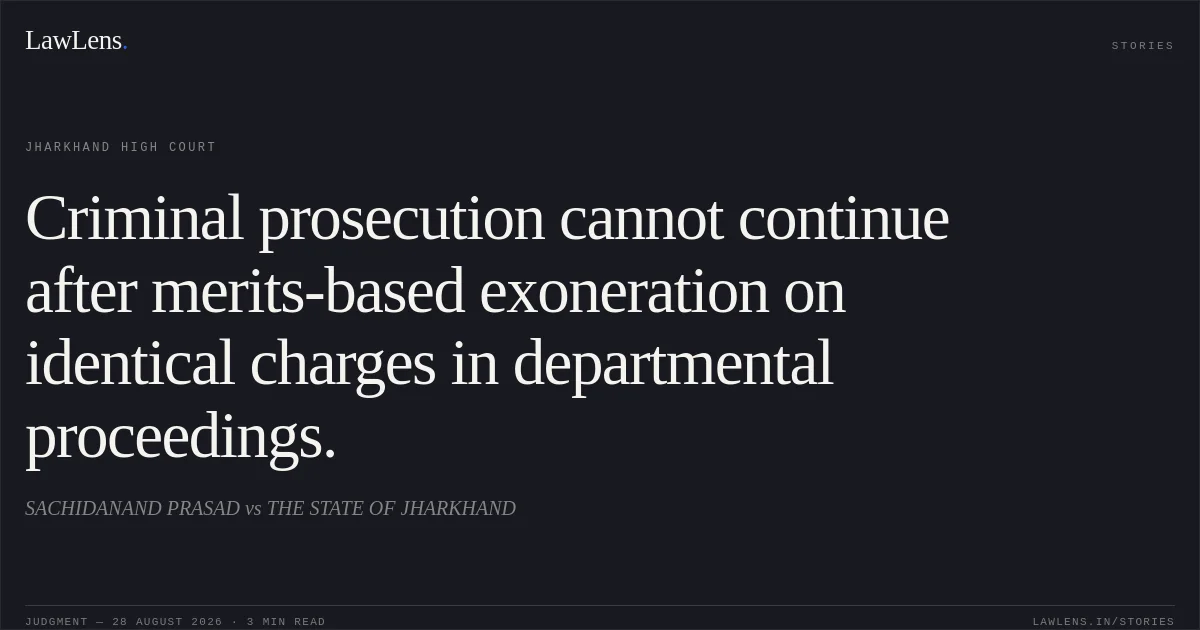
It held that, because the criminal and surcharge proceedings involved identical allegations and the petitioner had been exonerated on merits in the surcharge proceeding, continuation of the criminal prosecution was impermissible and abusive.
Source reference: pp.8–9Accordingly, the orders dated 29.09.2022 taking cognizance and 28.01.2023 issuing summons in Seraikella P.S. Case No. 34 of 2018, corresponding to G.R. Case No. 288 of 2018, were quashed insofar as they related to the petitioner.
Source reference: p.10The criminal miscellaneous petition was allowed, and pending interlocutory applications were disposed of.
Source reference: p.10Acts & Sections Cited
8 provisions across 3 statutes referred to in this judgment. Each provision opens on LawLens.
Indian Penal Code, 18606
Code of Criminal Procedure, 19731
Bharatiya Nagarik Suraksha Sanhita, 20231
Original Court PDF
SACHIDANAND PRASADvsTHE STATE OF JHARKHAND
Click to open original judgment
Original judgment, available to read, download and summarize on LawLens.in
![Courts will not interfere with transfers absent mala fides or violation of statutory rules.. M Ramya vs EMPLOYEES STATE INSURANCE CORPORATION (ESIC). CAT - ['Chennai']. LawLens](/stories/thumbnails/courts-will-not-interfere-with-transfers-absent-mala-fides-or-violation-of-statutory-rules-a6845e9ca6f548fca284c51c8351957f.webp)
![Courts cannot direct one-time recruitment age relaxation absent authority in the governing rules or advertisement.. UT OF PUDUCHERRY vs M ANDAL. CAT - ['Chennai']. LawLens](/stories/thumbnails/courts-cannot-direct-one-time-recruitment-age-relaxation-absent-authority-in-the-governing-895d78fde47143e2a8ed0207c4b6a44f.webp)
![A review cannot correct an allegedly erroneous decision absent an error apparent on the record.. Ajit Kumar Jha vs RAILWAY BOARD. CAT - ['Delhi']. LawLens](/stories/thumbnails/a-review-cannot-correct-an-allegedly-erroneous-decision-absent-an-error-apparent-on-the-re-8ac952fd4eba470c92f7da20af72a220.webp)