Facts
The applicants sought to quash FIR C.R. No. I-8 of 2017 registered at Jalalpore Police Station for offences under Sections 406, 420, 465, 467, 468, 471, and 120B of the IPC
Source reference: p.2The de facto complainant alleged that the accused conspired to grab his land using Power of Attorneys (PoA) executed in 2007 at the Indian Embassies in Qatar and Canada
Source reference: p.3While the complainant issued a public notice in 2011 claiming the PoA was only for administration and not for sale, a registered Sale Deed had already been executed in favor of Accused No. 3
Source reference: p.3-4The complainant subsequently filed a Special Civil Suit (No. 42 of 2019) challenging the transaction
Source reference: p.4Although an FSL report indicated the complainant’s signature on one PoA did not match, the court noted that the complainant had not initially disputed the signatures in his 2011 notice
Source reference: p.6-7, 19Issues
1. Whether the allegations in the FIR, taken at face value, satisfy the essential statutory ingredients of the alleged offences under the IPC
Source reference: p.11 / para. 7.12. Whether the dispute is predominantly civil in nature, rendered under a criminal cloak to exert pressure on the applicants
Source reference: p.6, 17 / para. 4.8, 7.63. Whether the continuation of criminal proceedings constitutes an abuse of the process of law warranting exercise of inherent powers under Section 482 of the CrPC
Source reference: p.11, 21 / para. 7, 10Law Applied
The Court relied on the foundational principles for quashing FIRs established in State of Haryana v. Bhajan Lal, which identifies categories where judicial intervention is necessary to prevent abuse of process
Source reference: p.9-11It applied the "four-step analytical framework" from Pradeep Kumar Kesarwani v. State of Uttar Pradesh to determine if the defense material is indubitable and rules out the charges
Source reference: p.17-18Section 406 (Criminal Breach of Trust) and Section 420 (Cheating) are antithetical and cannot coexist on the same set of facts as per Delhi Race Club (1940) Ltd. v. State of Uttar Pradesh
Source reference: p.12The High Court should quash criminal cases that are predominantly civil wrongs as per Madhavrao Jiwaji Rao Scindia v. Sambhajirao Chandrojirao Angre
Source reference: p.20-21Reasoning
The Court observed that the core of the dispute involves the interpretation of the recitals in the PoA—specifically whether they granted the power to sell—which is a matter for a Civil Court, not a criminal investigation
Source reference: p.4, 12, 19The court scrutinized the statutory ingredients for forgery and cheating, finding them absent because the complainant acknowledged the existence of the PoA for years and only disputed the scope of authority after property prices rose
Source reference: p.5, 12-16The discrepancy in the FSL report was deemed insufficient to sustain a criminal charge of forgery since the complainant’s own 2011 public notice did not involve a denial of execution
Source reference: p.19The execution of Consent Deeds and the receipt of partial consideration by the complainant’s relatives indicated a commercial transaction rather than a criminal conspiracy
Source reference: p.5, 16The Court concluded that the nine-year delay in lodging the FIR and the pending civil litigation signaled a malicious attempt to give a civil dispute a "criminal cloak"
Source reference: p.17, 20Holding
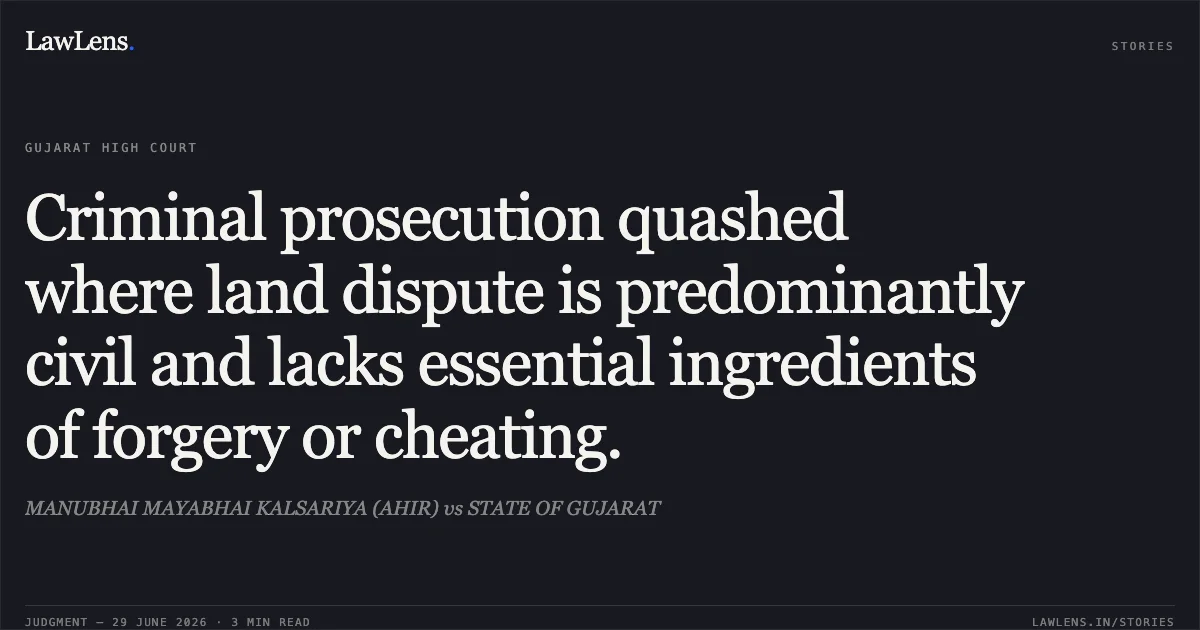
The Court answered the issues in the affirmative, holding that the FIR was a manifest abuse of the process of law and lacked the essential ingredients of the charged offences
Under Section 482 of the CrPC, the High Court quashed and set aside FIR C.R. No. I-8 of 2017 and all consequential proceedings qua the applicants
Source reference: p.21The Court clarified that this judgment would not affect pending civil or revenue proceedings
Source reference: p.22Acts & Sections Cited
15 provisions across 2 statutes referred to in this judgment. Each provision opens on LawLens.
Code of Criminal Procedure, 19733
Original Court PDF
MANUBHAI MAYABHAI KALSARIYA (AHIR)vsSTATE OF GUJARAT
Click to open original judgment
Original judgment, available to read, download and summarize on LawLens.in


