Facts
Respondents 2 and 3 complained that the petitioners were obstructing the work of the SC/ST Employees’ Association and had discredited its members in a written complaint. A representation to the Chief Minister described the association as “self-declared” and questioned its existence.
Source reference: p. 4–6On the complaint dated 4 September 2020, Halasurgate Police registered Crime No. 142/2020 for alleged offences under Sections 3(1)(q) and 3(1)(zc) of the SC/ST (Prevention of Atrocities) Act, 1989, and Sections 7(1)(b) and 4(6) of the Protection of Civil Rights Act, 1955. The petitioners sought to quash the complaint and FIR, contending that the allegations did not disclose the ingredients of the offences.
Source reference: p. 4–6The High Court examined the complaint and the representation to the Chief Minister.
Source reference: p. 8–9Issues
1. Whether the complaint and the related representation disclosed the ingredients of the alleged offences under the SC/ST (Prevention of Atrocities) Act, 1989.
Source reference: p. 8–112. Whether the complaint and FIR should be quashed in the exercise of the High Court’s jurisdiction under Section 482 Cr.P.C.
Source reference: p. 3–4, 9–12Law Applied
The Court considered Sections 3(1)(q) and 3(1)(zc) of the SC/ST (Prevention of Atrocities) Act, 1989, and Sections 7(1)(b) and 4(6) of the Protection of Civil Rights Act, 1955, which were the provisions invoked in the FIR.
Source reference: p. 3–4In discussing the Atrocities Act, the Court stated that the alleged conduct must involve an intentional insult or intimidation, with the intent to humiliate a person belonging to a Scheduled Caste or Scheduled Tribe, and must occur within public view. It referred to the principles discussed in Special Leave Petition (Criminal) No. 12144 of 2025 (12 January 2026) and Special Leave Petition (Criminal) Nos. 8778–8779 of 2024 (31 January 2025), concerning the requirement of an intention to humiliate and the meaning of “within public view”.
Source reference: p. 6–7, 9–10Reasoning
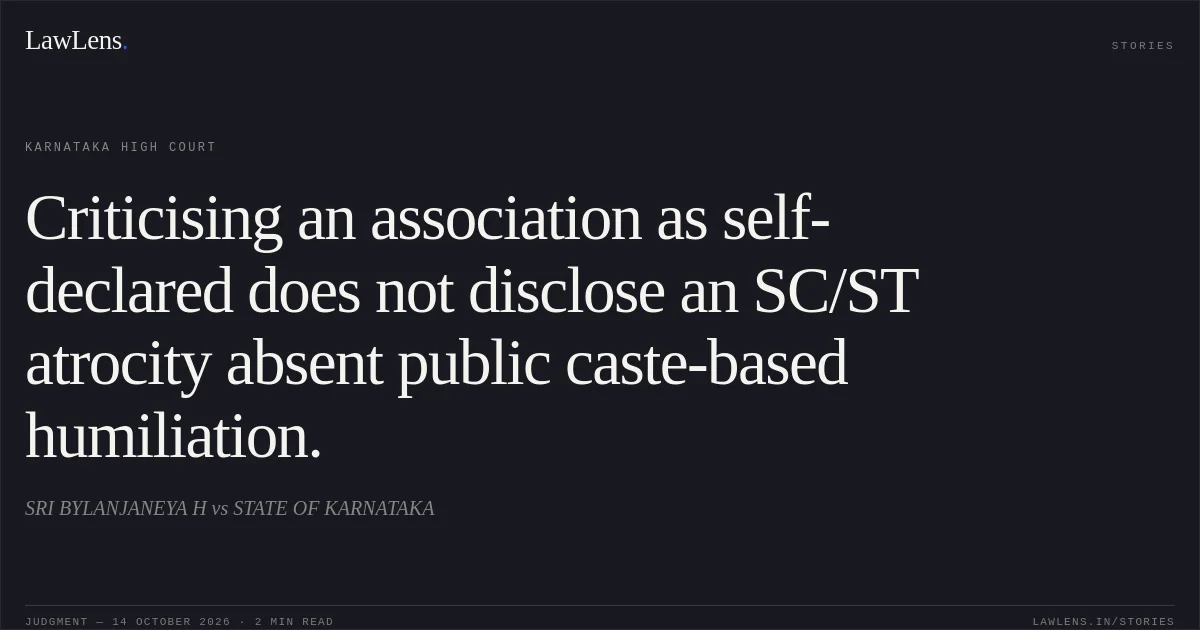
The Court found that the complaint and the representation described a dispute between rival groups and referred to the association as self-declared or not in existence. They did not allege caste-based abuse or identify conduct showing an intention to humiliate a person belonging to a Scheduled Caste or Scheduled Tribe within public view.
Source reference: p. 8–11On that record, the Court held that the essential ingredients of the alleged offences were not disclosed; it therefore rejected the State’s submission that the matter required investigation.
Source reference: p. 8–11Holding
The Court allowed the petition and quashed the complaint dated 4 September 2020 and the FIR in Crime No. 142/2020, registered for the alleged offences under Sections 3(1)(q) and 3(1)(zc) of the SC/ST (Prevention of Atrocities) Act, 1989, and Sections 7(1)(b) and 4(6) of the Protection of Civil Rights Act, 1955.
Acts & Sections Cited
4 provisions across 3 statutes referred to in this judgment. Each provision opens on LawLens.
Code of Criminal Procedure, 19731
Scheduled Castes and the Scheduled Tribes (Prevention of Atrocities) Act, 19891
Original Court PDF
SRI BYLANJANEYA HvsSTATE OF KARNATAKA
Click to open original judgment
Original judgment, available to read, download and summarize on LawLens.in


