Facts
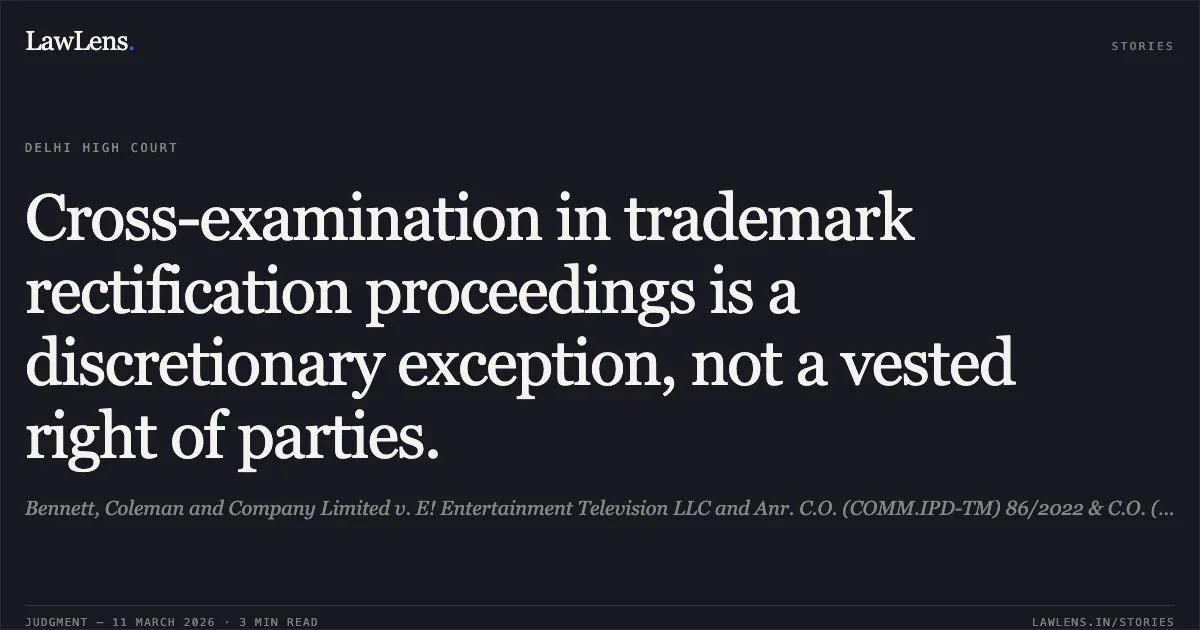
The Petitioner, Bennett, Coleman and Company Limited, filed two rectification petitions under Section 57 of the Trade Marks Act, 1999, seeking to cancel the Respondent’s registration of the mark "/E!" in Classes 38 and 41.
Source reference: p. 2The challenges were based on grounds of non-use for five years and three months, and a lack of distinctive character.
Source reference: paras. 2-3Following the framing of issues, the Respondent filed evidence by way of an affidavit from witness Ms. Monique Cheng (RW-1).
Source reference: para. 5.3The Petitioner subsequently moved applications (I.A. 2999/2025 and I.A. 2998/2025) seeking leave to cross-examine RW-1, alleging that the documents relied upon originated from the USA, the user claims were false, and that cross-examination is an "indelible right" in cases of disputed facts.
Source reference: paras. 1, 6.3Issues
1. Whether a party has a vested or inherent right to cross-examine a witness in trademark rectification proceedings conducted before the High Court.
Source reference: para. 5.62. Whether the Petitioner demonstrated sufficient "necessary" grounds under the IPD Rules to warrant the cross-examination of the Respondent’s witness.
Source reference: para. 14Law Applied
The Court primarily applied Rule 7(viii) of the Delhi High Court Intellectual Property Rights Division Rules, 2022 (IPD Rules), which mandates that cross-examination is an exception and requires the Court to record specific reasons why it is "necessary".
Source reference: para. 14It further relied on the principles established in *The Financial Times v. The Times Publishing House Ltd. (2016)*, which held that in trademark matters, evidence is largely documentary and the power to allow cross-examination should be exercised sparingly as the Court's role is to form an opinion on parameters like "distinctiveness" rather than resolve oral disputes.
Source reference: paras. 16-17The Court also referenced Section 57 of the Trade Marks Act, 1999, regarding the summary nature of rectification.
Source reference: para. 17The Court also clarified that Section 142 of the Bharatiya Sakshya Adhiniyam, 2023 (BSA) regarding contradictions is inapplicable without a demonstrated inconsistency.
Source reference: para. 23Reasoning
The Court reasoned that under the IPD Rules, rectification petitions are intended to be decided primarily on pleadings and affidavits.
Source reference: para. 14It observed that Ms. Monique Cheng’s affidavit was based entirely on official company records rather than personal knowledge; thus, she was merely exhibiting publicly available documents.
Source reference: para. 15The Court found that the Petitioner failed to identify any specific infirmity, falsity, or lack of authenticity in the exhibited documents that would necessitate oral testimony.
Source reference: paras. 20-21Furthermore, for the petition regarding T.M. No. 2340887 (filed on a 'proposed to be used' basis), the Court noted that 'use' was not even an issue, making cross-examination on user claims irrelevant.
Source reference: paras. 31-35The Court emphasized that legal determinations such as "distinctiveness" or "deceptive similarity" are judicial functions based on the Court's perception of the mark and documents, and cannot be established through the oral opinion of a witness.
Source reference: para. 27Holding
The Court held that there is no inherent right to cross-examine witnesses in rectification proceedings and that the Petitioner failed to establish any "necessary" grounds for the same.
The Court dismissed both applications (I.A. 2998/2025 and I.A. 2999/2025), clarifying that the Petitioner's burden to prove non-use or lack of distinctiveness could be addressed through final arguments based on the existing documentary record.
Source reference: paras. 26, 37The matters were listed for further directions on March 16, 2026.
Source reference: para. 38Acts & Sections Cited
9 provisions across 3 statutes referred to in this judgment. Each provision opens on LawLens.
Trade Marks Act, 19995
Bharatiya Sakshya Adhiniyam, 20233
Code of Civil Procedure, 19081
Original Court PDF
Bennett, Coleman and Company Limited v. E! Entertainment Television LLC and Anr. C.O. (COMM.IPD-TM) 86/2022 & C.O. (COMM.IPD-TM) 243/2022
Click to open original judgment
Original judgment, available to read, download and summarize on LawLens.in