Facts
The Petitioner was defending two complaints filed under Section 138 of the Negotiable Instruments Act, 1881, involving cheques of Rs. 4 lakhs each.
Source reference: para. 2–3During the trial, the Petitioner's right to cross-examine the complainant and lead defense evidence was closed due to a persistent "dilatory," "sluggish," and "lackluster" conduct, including a refusal to pay previously imposed costs.
Source reference: para. 6, 8The Petitioner moved an application under Section 311 Cr.P.C. to recall the complainant for cross-examination, claiming negligence by previous counsel.
Source reference: para. 5The Trial Court dismissed the application on February 17, 2026, citing the Petitioner's deliberate attempts to delay proceedings.
Source reference: para. 6, 10Issues
1. Whether the court should exercise its discretionary power under Section 311 Cr.P.C. to allow cross-examination of the complainant despite the accused's prior negligent conduct.
Source reference: para. 11, 122. Whether the denial of the opportunity to cross-examine would result in an unfair trial and grave prejudice to the accused.
Source reference: para. 12Law Applied
The court primarily applied Section 311 of the Code of Criminal Procedure (Cr.P.C.), which empowers the court to summon or recall witnesses if their evidence appears essential to the just decision of the case.
Source reference: para. 5This power must be exercised with "great caution and circumspection" and only for "strong and valid reasons".
Source reference: para. 6The court also relied on the constitutional principle of a "fair trial," identifying cross-examination as an "integral and indispensable component" necessary to test the credibility and veracity of a witness.
Source reference: para. 12Reasoning
The Court observed that while the Petitioner was undeniably responsible for his own "miseries" due to his lackluster approach and attempts to malign previous counsel, the total absence of cross-examination and defense evidence rendered the outcome of the case a fait accompli.
Source reference: para. 7, 11, 12The Court balanced the Petitioner's history of dilatory tactics against the fundamental necessity of a fair trial.
Source reference: para. 12It noted that the complainant, in a spirit of fairness, agreed to one final opportunity provided heavy costs were imposed and a strict timeline followed.
Source reference: para. 13The Court determined that justice would be better served by allowing a single, final opportunity to cross-examine, provided the Petitioner waived his right to lead defense evidence and committed to immediate final arguments, thereby preventing further delays.
Source reference: para. 15, 17Holding
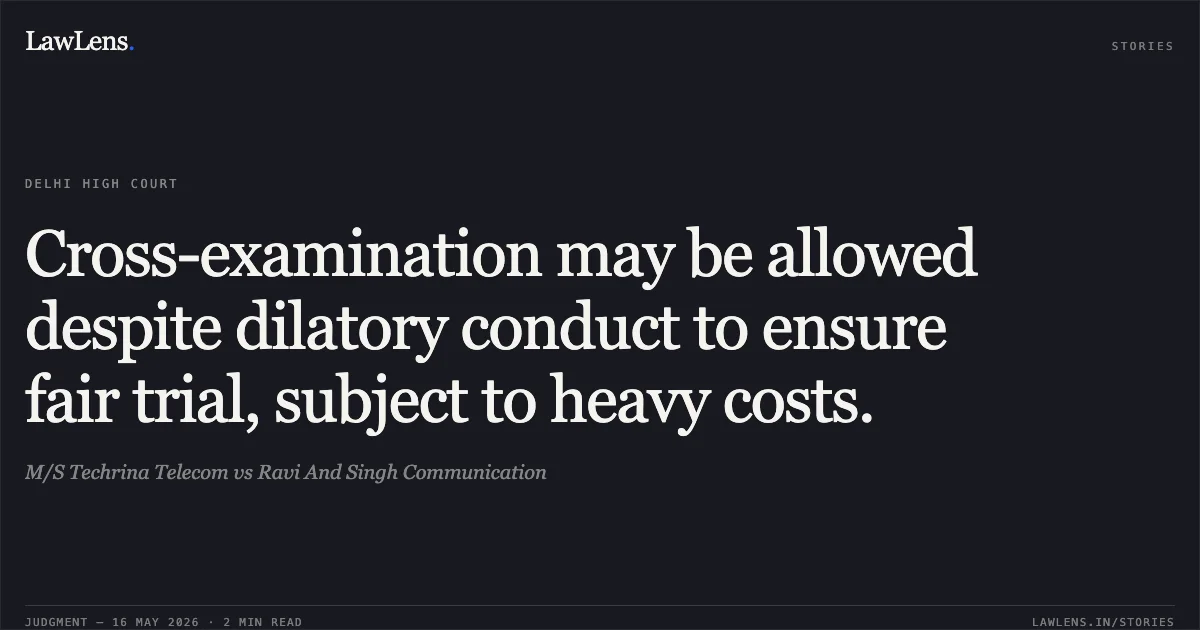
The High Court allowed the petitions to the limited extent of granting one last and final opportunity to cross-examine the complainant on the next scheduled hearing date (May 28, 2026).
The holding was conditioned upon the payment of Rs. 25,000 as costs in each case, the conclusion of the cross-examination on the same day, the bar on leading any defense evidence, and an order that no further adjournments shall be entertained.
Source reference: para. 16, 17, 18The petitions were disposed of accordingly.
Source reference: para. 19Acts & Sections Cited
2 provisions across 2 statutes referred to in this judgment. Each provision opens on LawLens.
Negotiable Instruments Act, 18811
Code of Criminal Procedure, 19731
Original Court PDF
M/S Techrina TelecomvsRavi And Singh Communication
Click to open original judgment
Original judgment, available to read, download and summarize on LawLens.in