01Facts
The claimant sought compensation under the Employees’ Compensation Act, 1923, alleging that he was employed as an autorickshaw driver by the second respondent and was injured in an accident while driving the vehicle.
¶ 2–6The Employees’ Compensation Commissioner found an employer–employee relationship, assessed 35% loss of earning capacity, and awarded ₹1,59,230 with interest at 12% from the date of the accident, directing the insurer to pay.
¶ 2–6The insurer appealed, challenging the finding on the employment relationship. The claimant filed a cross objection seeking further relief.
¶ 7–1102Issues
i.Whether the Commissioner’s finding that the claimant was employed by the second respondent was perverse, thereby relieving the insurer of liability under the policy.
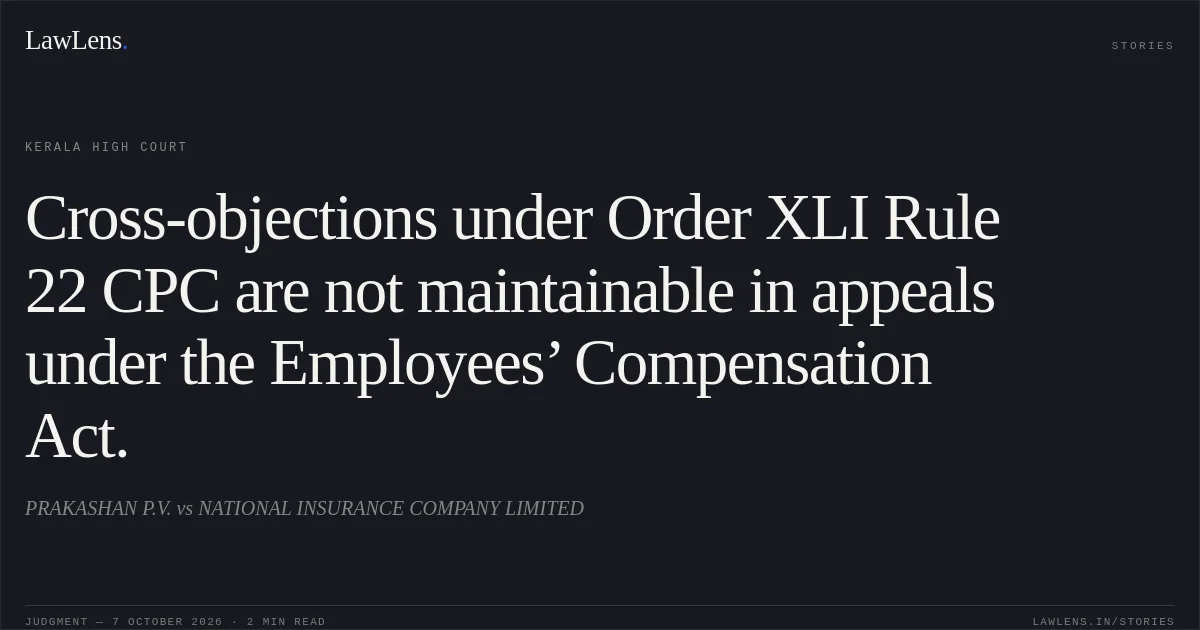
¶ 7–10ii.Whether a cross objection under Order XLI Rule 22 CPC is maintainable in an appeal under Section 30 of the Employees’ Compensation Act, or can be treated as an independent appeal.
¶ 11–14, 2003Law Applied
Section 30 of the Employees’ Compensation Act, 1923 permits an appeal only where a substantial question of law is involved.
¶ 20Section 23 of the Act confers specified civil-court powers on the Commissioner but does not generally incorporate the CPC into proceedings under the Act.
¶ 12Rule 41 of the Workmen’s Compensation Rules, 1924 applies only the CPC provisions it expressly lists to proceedings before Commissioners; it does not apply Order XLI Rule 22 to appeals under Section 30.
¶ 13–14The Court followed decisions of the Jammu and Kashmir, Chhattisgarh, Himachal Pradesh and Andhra Pradesh High Courts holding that cross objections are not maintainable in such statutory appeals.
¶ 15–19Factual findings of the Commissioner may be interfered with where they disclose patent perversity.
¶ 13Provisions in the judgment · 2 · Linked ones open on LawLens
Code of Civil Procedure, 1908 Section 4
Code of Criminal Procedure, 1973 Section 195
04Reasoning
The Commissioner had considered the pleadings and evidence, including the claimant’s testimony, the police report and the insurance policy issued in favour of the second respondent.
¶ 10The High Court found no patent perversity in the conclusion that the claimant was employed by the person who controlled and possessed the vehicle; it also held that the insurer, having issued the policy in favour of the second respondent, could not avoid indemnity on the ground raised.
¶ 10Order XLI Rule 22 CPC was not among the provisions made applicable by Rule 41, and the Act and Rules contained no separate provision authorising cross objections.
¶ 14Nor could the cross objection be treated as an independent appeal, since no substantial question of law had been formulated.
¶ 2005Holding
The Court held that the insurer’s challenge disclosed no substantial question of law warranting interference and dismissed the appeal.
¶ 10It held the claimant’s cross objection not maintainable under Order XLI Rule 22 CPC and incapable of being treated as an independent appeal; the cross objection was rejected.
¶ 14, 20Original Court PDF
PRAKASHAN P.V.vsNATIONAL INSURANCE COMPANY LIMITED
Click to open original judgment
Original judgment, available to read, download and summarize on LawLens.in