Facts
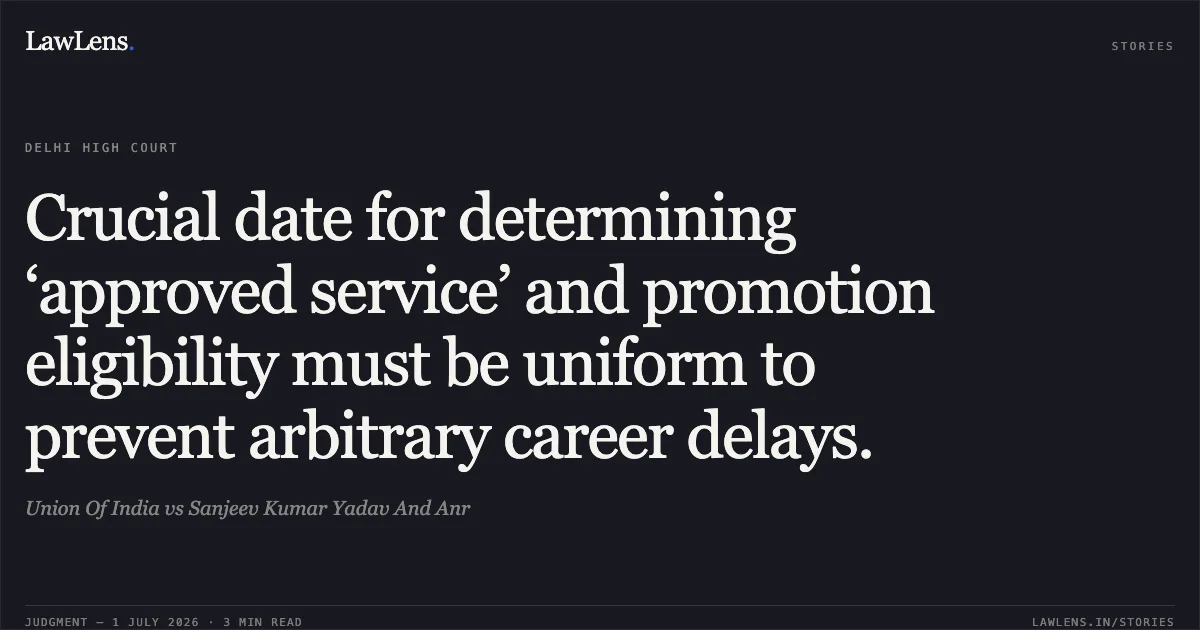
The Petitioners challenged orders dated 16.01.2025 passed by the Central Administrative Tribunal (CAT), which quashed the 2022 Amendments to the DANIPS and DANICS Rules.
Source reference: p. 2Initially, 'approved service' for these cadres was reckoned from July 1st, while the crucial date for promotion eligibility was January 1st, causing a mismatch and Year-long delays in promotions.
Source reference: para 3.1, 3.4In a previous round of litigation (2018), CAT found this dual-date system discriminatory and directed the Ministry of Home Affairs (MHA) and DoPT to harmonize the dates.
Source reference: para 3.4MHA proposed January 1st as the uniform date, but DoPT—without providing reasons—fixed July 1st as the common date for both reckoning and eligibility via the 2022 Amendments.
Source reference: para 3.5, 3.6The Respondents challenged these amendments before CAT, which quashed the notifications and directed the government to amend the rules to reflect January 1st as the crucial date.
Source reference: para 3.7, 3.8Issues
1. Whether the fixation of July 1st as the uniform date for reckoning 'approved service' and determining promotion eligibility was arbitrary and discriminatory.
Source reference: p. 14 / para 222. Whether the Central Administrative Tribunal exceeded its jurisdiction by directing the government to amend service rules in a specific manner.
Source reference: p. 12, 26 / para 18, 28Law Applied
The Court applied the principles of judicial review over policy decisions and rules framed under the proviso to Article 309 of the Constitution of India, holding that such rules can only be struck down on grounds of manifest arbitrariness, perversity, or violation of fundamental rights.
Source reference: para 20It relied on B.S. Yadav v. State of Haryana and R.L. Bansal v. Union of India to establish that while the Court should not substitute its wisdom for that of the executive, it must intervene if a policy is riddled with arbitrariness.
Source reference: para 20, 21The Court also considered the principle of non-discrimination under Articles 14 and 16 of the Constitution, emphasizing that similarly situated services (like AFHQCS) cannot be treated differently without a rational nexus.
Source reference: para 25, 26Reasoning
The Court noted that the DoPT failed to provide any reasoned decision for rejecting the MHA’s proposal to use January 1st, which was DoPT's own general policy for other services.
Source reference: para 24.1, 24.3By fixing July 1st, the government failed to cure the prejudice identified in the 2018 litigation.
Source reference: para 25.4Specifically, DANIPS/DANICS officers would suffer a six-month deficit in service length compared to the AFHQCS (another Group ‘B’ service) and contemporaneous IPS/IAS officers, whose service is reckoned from January 1st of their allotment year.
Source reference: para 25.1, 25.4This deficit would have a cascading effect on their seniority and eligibility for induction into All India Services (IPS/IAS).
Source reference: para 25.4The Court found that the government’s failure to produce the decision-making record, despite court orders, supported the conclusion that the amendment was arbitrary.
Source reference: para 24.3However, the Court observed that the Tribunal overstepped by effectively "rewriting" the rules through a mandatory direction to amend them in a specific way.
Source reference: para 28Holding
The High Court upheld the quashing of the 2022 Amendments, confirming they were arbitrary and discriminatory.
However, it set aside the Tribunal's specific direction to the government to amend the rules to a particular date, holding that the judiciary cannot dictate the exact mode of legislation.
Source reference: para 28, 31Instead, the Court directed the MHA and DoPT to conduct a fresh, reasoned exercise within two months to frame a non-prejudicial mechanism.
Source reference: para 30To prevent an administrative vacuum, the Court ordered that 1st January following the year of examination shall be treated as the crucial date for 'approved service' until the new rules are lawfully notified.
Source reference: para 30Acts & Sections Cited
1 provisions across 1 statute referred to in this judgment. Each provision opens on LawLens.
General Clauses Act, 18971
Original Court PDF
Union Of IndiavsSanjeev Kumar Yadav And Anr
Click to open original judgment
Original judgment, available to read, download and summarize on LawLens.in