01Facts
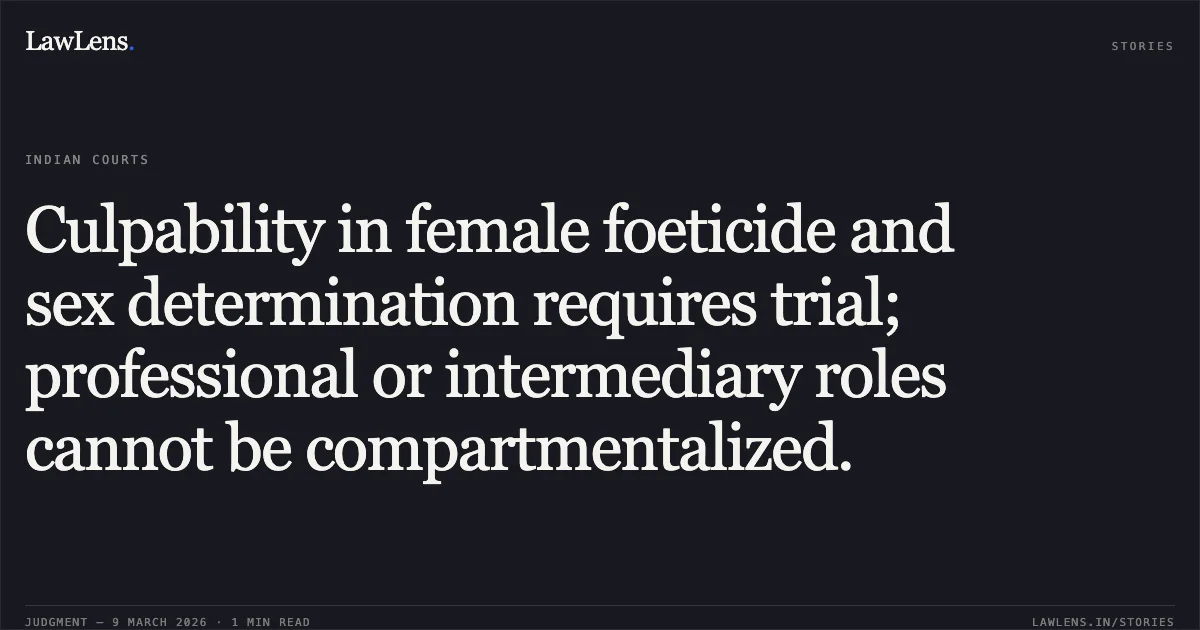
The case involves two sets of petitioners arising from a common substratum of facts concerning illegal sex determination and female foeticide.
On 22-08-2025, Smt. Harshitha (mother of two girls) sought to determine the sex of her third fetus.
p. 5Accused Nos. 2, 3, 4, and 5 allegedly acted as agents/facilitators, coordinating with Dr. Shashi S.L. (Petitioner in Crl.P. 14326/2025), a radiologist at Ramanagara District Hospital, to conduct an illegal scan.
p. 6, 18The name "Sharadamma" was allegedly written on the victim's hand as a code to the doctor.
p. 18Upon being told the fetus was female, the couple was directed to a clinic where abortion medication (Cytolog) was administered.
p. 6, 11The victim developed profuse bleeding that night, and the fetus died.
p. 12Consequently, FIR No. 286/2025 was registered under Section 4 of the MTP Act and Sections 91 r/w 3(5) of the BNS.
p. 2Simultaneously, a private complaint (PCR No. 401/2024) was filed by the District Health Officer under the PCPNDT Act.
p. 3The petitioners sought quashing of these proceedings.
p. 802Issues
i.1. Whether the proceedings against the facilitators (Accused Nos. 4 & 5) and the radiologist (Accused No. 1) warrant quashing under Section 528 of the BNSS due to lack of evidence or procedural non-compliance.
pp. 8 / para. 6-7ii.2. Whether the order of taking cognizance by the Magistrate suffered from non-application of mind or violated the mandatory provisions of the PCPNDT Act.
pp. 7-8 / para. 5-703Law Applied
The Court primarily applied Section 91 of the Bharatiya Nyaya Sanhita (BNS), which penalizes acts done with intent to prevent a child from being born alive.
p. 13Section 4 of the Medical Termination of Pregnancy (MTP) Act, 1971, which restricts the places where pregnancy may be terminated.
p. 14Sections 4, 5, 6, and 23 of the Pre-conception and Pre-natal Diagnostic Techniques (PCPNDT) Act, 1994, which prohibit sex selection and the communication of the sex of a fetus.
pp. 20-21The Court relied on the precedent of *Rekha Sengar v. State of Madhya Pradesh (2021)*, which established that pre-natal sex determination is a grave offence against society and that courts should not show leniency at the threshold of such prosecutions to avoid rendering the Act a "paper tiger".
pp. 23-26Provisions in the judgment · 12 · Linked ones open on LawLens
Bharatiya Nyaya Sanhita, 2023 Section 3Section 91
Bharatiya Nagarik Suraksha Sanhita, 2023 Section 223Section 210Section 227Section 528
Medical Termination of Pregnancy Act, 1971 Section 4
Pre-conception and Pre-natal Diagnostic Techniques (Prohibition of Sex Selection) Act, 1994 Section 5Section 4Section 6Section 22Section 23
04Reasoning
The Court observed that the complaint by the District Health Officer was precise and detailed a "chilling and interconnected chain of facts".
p. 14It rejected the petitioners' claim of innocence, noting that Accused Nos. 4 and 5 acted as conduits/agents in a "coterie" operating in Ramanagara, while the radiologist (Accused No. 1) allegedly abused his professional position to facilitate the crime by bypassing digital records with manual Form Fs.
p. 15, 19Regarding cognizance, the Court held that the Magistrate need not conduct a "meticulous evaluation of evidence" at the initial stage, but only satisfy themselves that a prima facie case exists.
pp. 22-23The Court emphasized that since the allegations disclose a concerted design toward female foeticide—a "moral blight and constitutional affront"—it is impermissible to quash the proceedings in their infancy.
p. 16, 23The veracity of the evidence must be tested in the "crucible of trial".
p. 2705Holding
The High Court dismissed both Criminal Petitions.
p. 28It held that there were sufficient prima facie materials to proceed against all the accused under the BNS, MTP Act, and PCPNDT Act.
p. 22The Court clarified that the truth of the allegations and individual culpability are matters for trial and refused to interdict the legitimate prosecution.
p. 27It further directed that the observations made in the order should not influence the subsequent investigation or trial.
p. 28Original Court PDF
Sardamma & Anr. v. State of Karnataka & Anr. [Crl.P. No. 884/2026 c/w Crl.P. No. 14326/2025]
Click to open original judgment
Original judgment, available to read, download and summarize on LawLens.in