Facts
The appellant challenged his conviction by the Additional Sessions Judge (Fast Track), Budgam, for offences under Sections 376, 450 and 506 of the Ranbir Penal Code (RPC), arising from an alleged sexual assault on 15 July 2007
Source reference: para. 1, 3–8The prosecution principally relied on the prosecutrix’s testimony; her parents testified to her disclosure after the alleged incident.
Source reference: para. 4–6, 19–23The initial complaint, FIR and statements recorded during investigation referred to an attempt to commit rape; after the medical opinion reported prior sexual intercourse, the investigation proceeded on the basis of completed rape
Source reference: para. 4–6, 19–23The Trial Court convicted the appellant and imposed concurrent sentences, including seven years’ rigorous imprisonment under Section 376 RPC.
Source reference: para. 12, 1On appeal, the High Court reappraised the evidence and allowed the appeal
Source reference: para. 15–16, 40–42Issues
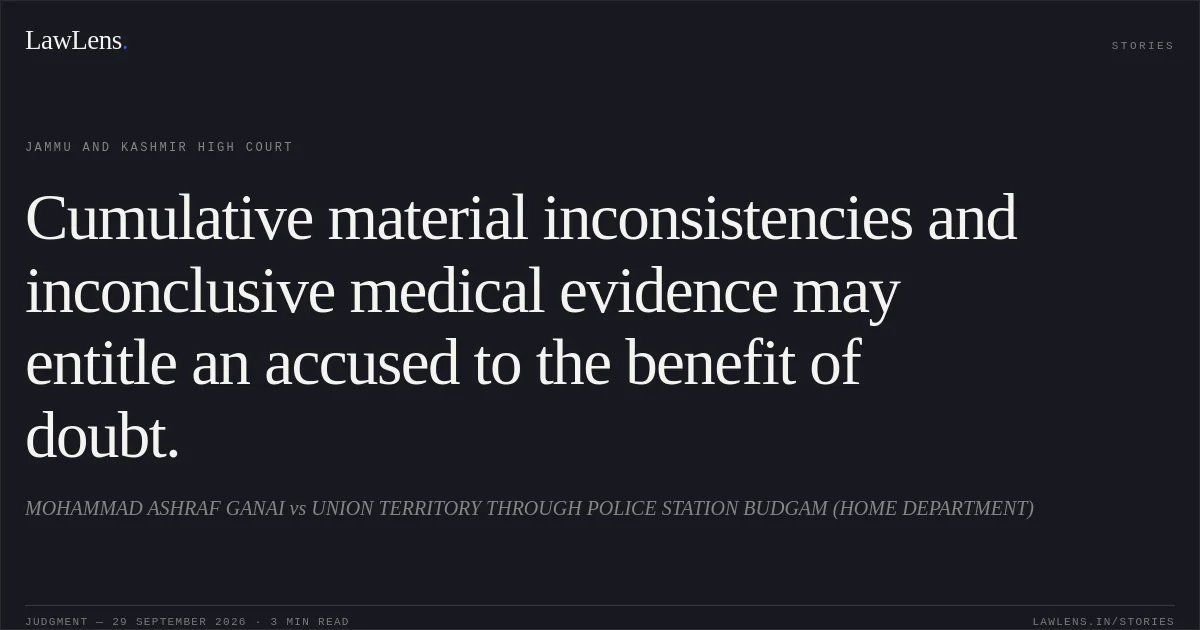
Whether the prosecution proved beyond reasonable doubt that the appellant committed rape, notwithstanding the material difference between the initial account of an attempt and the subsequent allegation of completed intercourse, and the limitations of the medical evidence.
Source reference: para. 19–25, 34–40Whether the evidence, assessed cumulatively, established the offences under Sections 450 and 506 RPC beyond reasonable doubt.
Source reference: para. 32–33Whether the Trial Court’s convictions and sentences should be set aside on appeal.
Source reference: para. 16, 40–41Law Applied
Under Section 374 of the Code of Criminal Procedure, Samvat 1989 (Cr.P.C.), the appellate court may independently reassess the evidence in an appeal against conviction.
Source reference: para. 16A prosecutrix’s reliable testimony may sustain a conviction without corroboration as a rule of law, but guilt must still be proved beyond reasonable doubt; the Court referred to State of Punjab v. Gurmit Singh, (1996) 2 SCC 384, and Vijay @ Chinee v. State of M.P., (2010) 8 SCC 191.
Source reference: para. 17An FIR is not substantive evidence, and a statement under Section 161 Cr.P.C. is not substantive proof, though a material omission or contradiction may be assessed in the context of the evidence as a whole.
Source reference: para. 20Minor discrepancies do not automatically discredit otherwise trustworthy evidence, and falsus in uno, falsus in omnibus does not generally apply in Indian criminal law.
Source reference: para. 21, 27The Court also applied the principle that an accused’s failure to establish an alibi cannot fill a gap in the prosecution case, citing Dudhi Nath Pandey v. State of U.P., (1981) 2 SCC 166, and Binay Kumar Singh v. State of Bihar, (1997) 1 SCC 283.
Source reference: para. 31The prosecution must prove the charged offences under Sections 376, 450 and 506 RPC beyond reasonable doubt.
Source reference: para. 12, 17, 32–40Reasoning
The Court treated the change from an initial allegation of attempted rape to completed rape as significant because it concerned the nature of the principal alleged act, while recognising that the prosecutrix’s explanation and the circumstances of reporting required careful assessment.
Source reference: para. 19–21, 34The medical evidence established, at most, that intercourse had occurred at an unspecified time; it did not identify the appellant, establish when the intercourse took place, or determine whether it was consensual.
Source reference: para. 22–25, 35The Court considered the uncertainty about the timing of the examination and the other inconsistencies cumulatively, rather than treating any single discrepancy, the absence of injuries, or lack of forensic evidence as independently decisive.
Source reference: para. 24–28, 36, 39The parents’ evidence supported the circumstances of disclosure but did not establish the sexual act itself, and the unproven alibi did not remedy the deficiencies in the prosecution case.
Source reference: para. 18, 29–31, 37–38The cumulative effect left reasonable doubt as to the prosecution version, including the related allegations under Sections 450 and 506 RPC.
Source reference: para. 32–40Holding
The High Court held that the prosecution had not proved the charges beyond reasonable doubt and allowed the appeal.
It set aside the conviction and sentence under Sections 376, 450 and 506 RPC, acquitted the appellant by extending the benefit of doubt, and directed his release forthwith unless required in another case.
Source reference: para. 41Acts & Sections Cited
9 provisions across 2 statutes referred to in this judgment. Linked provisions open on LawLens.
Ranbir Penal Code, Samvat 19895
Code of Criminal Procedure, Samvat 19894
Original Court PDF
MOHAMMAD ASHRAF GANAIvsUNION TERRITORY THROUGH POLICE STATION BUDGAM (HOME DEPARTMENT)
Click to open original judgment
Original judgment, available to read, download and summarize on LawLens.in