Facts
The parties married on 20 October 2021 and lived together first at Visakhapatnam and later at Hyderabad, where both worked in the IT sector.
Source reference: para. 1–3, 6The wife alleged physical and mental cruelty, including assaults, demands for money and humiliation at the matrimonial home. She left for Rayagada with her parents in June 2023 and obtained a divorce decree from the Family Court, Rayagada, on the ground of cruelty under Section 13(1)(ia) of the Hindu Marriage Act, 1955.
Source reference: para. 1–3, 6The husband appealed, disputing the evidence and relying, among other things, on his petition for restitution of conjugal rights. The Family Court had separately rejected the wife’s claim for return of streedhan articles.
Source reference: para. 1–3, 6Issues
1. Whether the wife proved that the husband’s conduct constituted cruelty under Section 13(1)(ia) of the Hindu Marriage Act, 1955
Source reference: para. 72. Whether the Family Court’s decree dissolving the marriage on that ground warranted interference in appeal
Source reference: para. 28–30Law Applied
Section 13(1)(ia) of the Hindu Marriage Act permits divorce where one spouse has treated the other with cruelty; cruelty may be physical or mental and must be assessed in light of the parties’ circumstances and the effect of the conduct on the complainant spouse.
Source reference: no citationUnder Samar Ghosh v. Jaya Ghosh, mental cruelty is assessed cumulatively across the matrimonial relationship, and ordinary wear and tear or isolated trivial disputes are insufficient.
Source reference: para. 8A. Jayachandra v. Aneel Kaur confirms that matrimonial cruelty is determined on the probabilities and its effect on the complainant spouse, rather than by the criminal standard of proof.
Source reference: para. 9V. Bhagat v. D. Bhagat states that mental cruelty must cause such pain and suffering that the parties cannot reasonably be expected to live together.
Source reference: para. 11Irretrievable breakdown is not, by itself, a statutory ground for divorce, though it may be considered as a relevant circumstance when assessing cruelty [*K. Srinivas Rao v. D.A. Deepa*].
Source reference: para. 26–27Reasoning
The Court considered the wife’s evidence of assaults, being locked in a room, money demands, a public altercation and humiliation at the Hyderabad residence, together with the circumstances of the final confrontation before she left.
Source reference: para. 10, 12–13It found corroborative circumstances in the defence evidence, including admissions that a dispute occurred at the residence, relatives were called, and the wife left the following day; the husband’s evidence about contacting the watchman also lent support to her account of distrust and humiliation.
Source reference: para. 13–18The Court treated the parties’ messages as relevant context, but not as conclusive admissions, and assessed the evidence cumulatively rather than as isolated incidents.
Source reference: para. 19–22The parties’ later shared desire to end the relationship and the failed settlement efforts reinforced the assessment of the relationship’s condition, but did not replace proof of cruelty. Similarly, the husband’s Section 9 petition did not erase the effect of the conduct preceding separation.
Source reference: para. 23, 27–28Holding
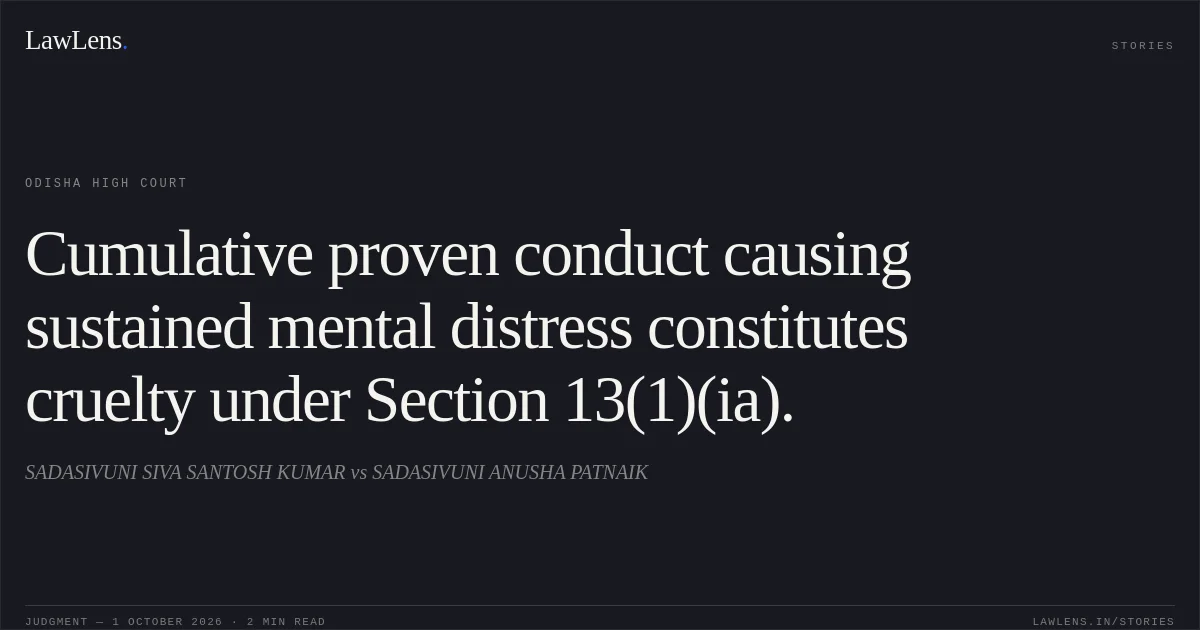
The Court held that the cumulative evidence established cruelty under Section 13(1)(ia), and that the Family Court’s decision to dissolve the marriage was justified.
It dismissed the husband’s appeal and left the divorce decree undisturbed.
Source reference: para. 29–30Acts & Sections Cited
6 provisions across 2 statutes referred to in this judgment. Each provision opens on LawLens.
Hindu Marriage Act, 19555
Family Courts Act, 19841
Original Court PDF
SADASIVUNI SIVA SANTOSH KUMARvsSADASIVUNI ANUSHA PATNAIK
Click to open original judgment
Original judgment, available to read, download and summarize on LawLens.in