Facts
Rooparam, the petitioner’s husband and an undertrial prisoner, had been lodged in Central Jail, Jodhpur since 20 August 2023. On 2 July 2025, he allegedly became unwell in the barrack, was taken to the jail dispensary and thereafter referred to Mahatma Gandhi Hospital, where he was declared brought dead.
Source reference: paras. 1–2.3; pp. 3–5The petitioner alleged custodial violence and sought registration of an FIR, an independent investigation and compensation under Article 226 of the Constitution.
Source reference: paras. 1–2.3; pp. 3–5The post-mortem report recorded multiple ante-mortem injuries, including incised wounds caused by a sharp-edged weapon and other injuries caused by blunt force, sustained within six hours before death.
Source reference: paras. 2.1, 5.2–5.3; pp. 4, 19–20A judicial inquiry under Section 196(2) of the Bharatiya Nagarik Suraksha Sanhita, 2023 found that the death was unnatural and attributable to the combined effect of injuries to the head and neck, rather than natural cardiac causes.
Source reference: paras. 5–5.12; pp. 18–25The Court’s examination of CCTV footage further disclosed that co-prisoners attempted to revive Rooparam for approximately half an hour before medical personnel arrived; there were inadequate CCTV facilities, insufficient lavatories and drinking-water arrangements, and no senior jail official was seen supervising the emergency.
Source reference: paras. 4.4, 7–16 of the order dated 30.04.2026; pp. 11–16Despite the suspicious circumstances and the petitioner’s complaints, no FIR had initially been registered.
Source reference: paras. 2.2, 9.6–9.8; pp. 4–5, 35–37Issues
Whether the circumstances of Rooparam’s death in judicial custody, including the ante-mortem injuries and delayed medical assistance, disclosed a violation of his fundamental right to life under Article 21 and made the State constitutionally liable
Source reference: paras. 7.4, 9.1–9.5, 17–18; pp. 27–30, 32–46Whether the State police were required to register an FIR and conduct a fair, effective and independent criminal investigation into the unexplained injuries and death
Source reference: paras. 9.6–9.8, 25–25.6; pp. 35–37, 54–58Whether the High Court could award compensation under Article 226 notwithstanding that individual criminal responsibility had not yet been determined
Source reference: paras. 18–20, 24–24.2; pp. 45–47, 52–54Whether systemic deficiencies in medical care, CCTV surveillance, sanitation, drinking water and custodial supervision required continuing judicial directions
Source reference: paras. 12–16.3, 24; pp. 37–43, 52–53Law Applied
Article 21 protects every person in custody, including prisoners and undertrials; imprisonment curtails liberty but does not suspend the right to life, dignity or humane treatment.
Source reference: paras. 8–8.6; pp. 28–31Under Article 226, a constitutional court may award public-law compensation for a proven or prima facie established violation of fundamental rights, independently of civil damages, criminal prosecution or departmental proceedings, as recognised in Nilabati Behera v. State of Orissa, (1993) 2 SCC 746.
Source reference: paras. 11, 18–19; pp. 37, 45–47D.K. Basu v. State of West Bengal, (1997) 1 SCC 416 establishes safeguards against custodial abuse and reinforces the State’s obligation to protect persons in custody.
Source reference: para. 13; p. 38In Re: Inhuman Conditions in 1382 Prisons, (2016) 3 SCC 700 recognises prisoners’ entitlement to dignity, adequate medical care, sanitation, staffing and humane prison conditions.
Source reference: paras. 14–15, 21.3; pp. 38–39, 48–49Lalita Kumari v. Government of Uttar Pradesh, (2014) 2 SCC 1 requires registration of an FIR where information discloses a cognizable offence.
Source reference: para. 3; p. 5The State bears institutional and vicarious responsibility for failures of custodial care, including inadequate supervision, delayed medical intervention and deficient prison infrastructure.
Source reference: paras. 16–17.3; pp. 39–45Reasoning
The Court distinguished between criminal culpability and constitutional accountability. It did not finally determine whether Rooparam was murdered or identify the person responsible; those questions were left to criminal investigation.
Source reference: paras. 9.2–9.5, 17.3, 25.1–25.4; pp. 33–35, 44–45, 54–56Nevertheless, the undisputed custody, unexplained ante-mortem injuries, medical evidence inconsistent with a purely natural death, and the absence of timely medical assistance established circumstances warranting constitutional scrutiny.
Source reference: paras. 5.2–5.12, 7–7.4, 9.1–9.5; pp. 19–27, 32–35The CCTV footage showed that co-inmates, rather than trained medical personnel, attempted resuscitation for nearly half an hour, while the jail lacked adequate surveillance and effective custodial supervision.
Source reference: paras. 4.4, 7–16; pp. 11–16Applying Article 21 and the constitutional-tort principles in Nilabati Behera and D.K. Basu, the Court held that the State could not avoid public-law responsibility merely because the precise cause and individual criminal liability remained unresolved.
Source reference: paras. 17–19, 24–24.2; pp. 43–47, 52–54The failure to register an FIR despite circumstances indicating a cognizable offence further justified a direction for prompt investigation.
Source reference: paras. 9.6–9.8, 25.2–25.6; pp. 35–37, 54–58Holding
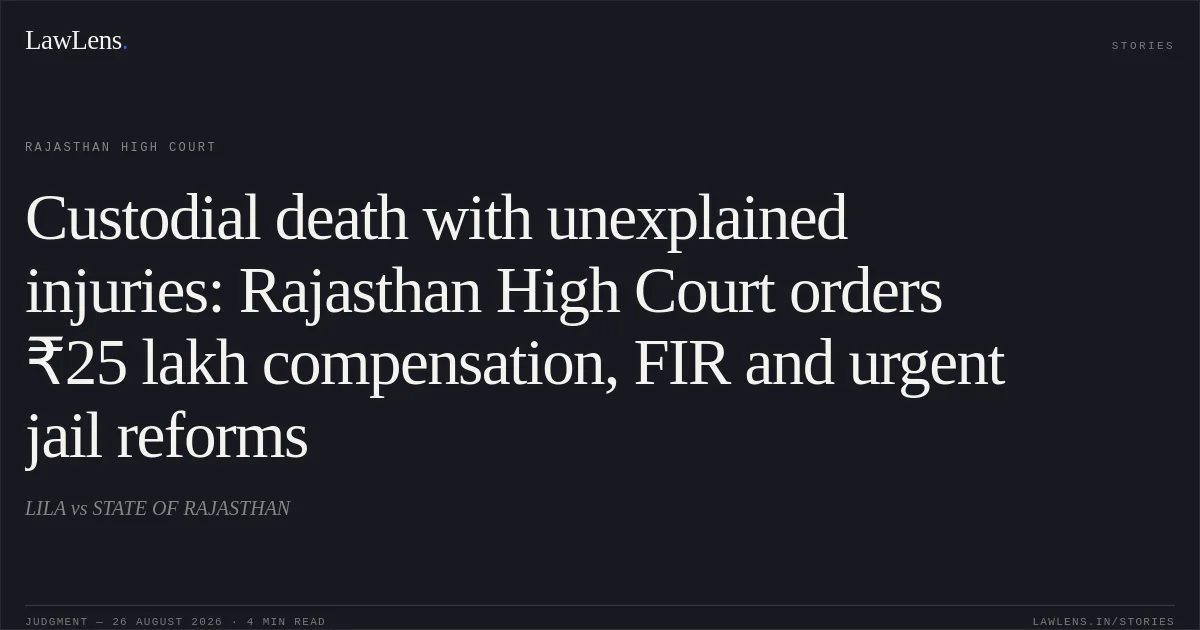
The Court held that Rooparam died an unnatural death while in judicial custody and that the circumstances could not prima facie be accepted as natural or suicidal; the question of homicide and individual criminal responsibility was left open for investigation.
Exercising jurisdiction under Article 226, it directed the State to pay ₹25,00,000 as constitutional compensation to the petitioner and the deceased’s family within 60 days.
Source reference: para. 27(i); p. 59The Director General of Police was directed to ensure registration of an FIR within 48 hours and entrust the investigation to an officer not below the rank of RPS.
Source reference: para. 27(ii); p. 60The Court further directed 24×7 medical assistance, improved CCTV surveillance, additional lavatories and potable-water facilities, adequate emergency equipment including ECG facilities, and consideration of dedicated medical staff in jails.
Source reference: para. 27(iii)(a)–(f); pp. 60–63The matter was retained for continuing supervision, with compliance reports and the presence of senior jail and health officials required after 60 days; it was listed for compliance on 30 October 2026.
Source reference: para. 27(iii)(g), (v), 29; pp. 63–64Acts & Sections Cited
1 provisions across 1 statute referred to in this judgment. Each provision opens on LawLens.
Bharatiya Nagarik Suraksha Sanhita, 20231
Original Court PDF
LILAvsSTATE OF RAJASTHAN
Click to open original judgment
Original judgment, available to read, download and summarize on LawLens.in
![Courts will not interfere with transfers absent mala fides or violation of statutory rules.. M Ramya vs EMPLOYEES STATE INSURANCE CORPORATION (ESIC). CAT - ['Chennai']. LawLens](/stories/thumbnails/courts-will-not-interfere-with-transfers-absent-mala-fides-or-violation-of-statutory-rules-a6845e9ca6f548fca284c51c8351957f.webp)
![Courts cannot direct one-time recruitment age relaxation absent authority in the governing rules or advertisement.. UT OF PUDUCHERRY vs M ANDAL. CAT - ['Chennai']. LawLens](/stories/thumbnails/courts-cannot-direct-one-time-recruitment-age-relaxation-absent-authority-in-the-governing-895d78fde47143e2a8ed0207c4b6a44f.webp)
![A review cannot correct an allegedly erroneous decision absent an error apparent on the record.. Ajit Kumar Jha vs RAILWAY BOARD. CAT - ['Delhi']. LawLens](/stories/thumbnails/a-review-cannot-correct-an-allegedly-erroneous-decision-absent-an-error-apparent-on-the-re-8ac952fd4eba470c92f7da20af72a220.webp)