Facts
The petitioner sought anticipatory bail regarding FIR No. 90/2025 under Sections 420/406 IPC.
Source reference: p. 1The complainant alleged that the petitioner, representing himself as a luxury watch expert, induced him to hand over three high-value watches (a limited edition Breguet and two Rolexes) on 30.06.2023 at Hotel Taj, Delhi, for a consideration of Rs. 4.5 Crores.
Source reference: p. 2The petitioner issued a cheque for Rs. 4.25 Crores, which was subsequently dishonored due to "Insufficient Funds".
Source reference: p. 3While the petitioner claimed the cheque pertained to a different transaction and that his signature on the handover receipt was forged (citing a private handwriting expert report), the prosecution alleged non-cooperation and noted that the petitioner’s own valuation report stated a "physical inspection" of the watches had occurred, implying they were in his possession.
Source reference: p. 3, 5, 7Issues
1. Whether the petitioner is entitled to the extraordinary relief of anticipatory bail under Section 482 of BNSS (erstwhile Section 438 CrPC) in a matter involving serious economic fraud and the need for recovery of high-value movable property.
Source reference: para. 22-312. Whether the petitioner’s old age/medical condition (80 years old, diabetes, and hypertension) outweighs the necessity for custodial interrogation for the purpose of recovering the case property.
Source reference: para. 37-38Law Applied
The court applied Section 482 of the Bhartiya Nagrik Suraksha Sanhita, 2023.
Source reference: p. 1It relied on *Y.S. Jagan Mohan Reddy v. CBI*, establishing that economic offences constitute a "class apart" and must be viewed seriously due to their impact on society.
Source reference: para. 30The court relied on *P. Chidambaram v. Directorate of Enforcement*, which dictates that anticipatory bail should be exercised sparingly in economic offences.
Source reference: para. 31Regarding interrogation, the court cited *State v. Anil Sharma* and *XXX v. Arun Kumar CK*, holding that custodial interrogation is qualitatively more effective for disinterring concealed information than questioning a suspect protected by a bail order.
Source reference: para. 34-35Finally, it applied the principle from *Sameer Mahandru v. ED* that common lifestyle diseases and age do not automatically entitle an accused to bail if the prison can provide adequate medical care.
Source reference: para. 38Reasoning
The court found the petitioner’s defenses contradictory and unpersuasive.
Source reference: no citationWhile the petitioner denied possession of the watches, his submitted valuation report explicitly stated it was based on an "external physical inspection," creating grave suspicion regarding his *bona fides*.
Source reference: para. 26, 29The court rejected the private handwriting expert’s report as the signatures compared were not contemporaneous (2023 vs. 2025) and held that such veracity must be determined by state FSL during investigation.
Source reference: para. 27-28The court noted that the investigation was at a nascent stage and the recovery of property worth crores was paramount.
Source reference: para. 32-33It reasoned that the petitioner’s failure to provide a conclusive explanation for the dishonored cheque or the whereabouts of the watches necessitated custodial interrogation, which is "qualitatively more elicitation-oriented" than routine questioning.
Source reference: para. 24, 34Holding
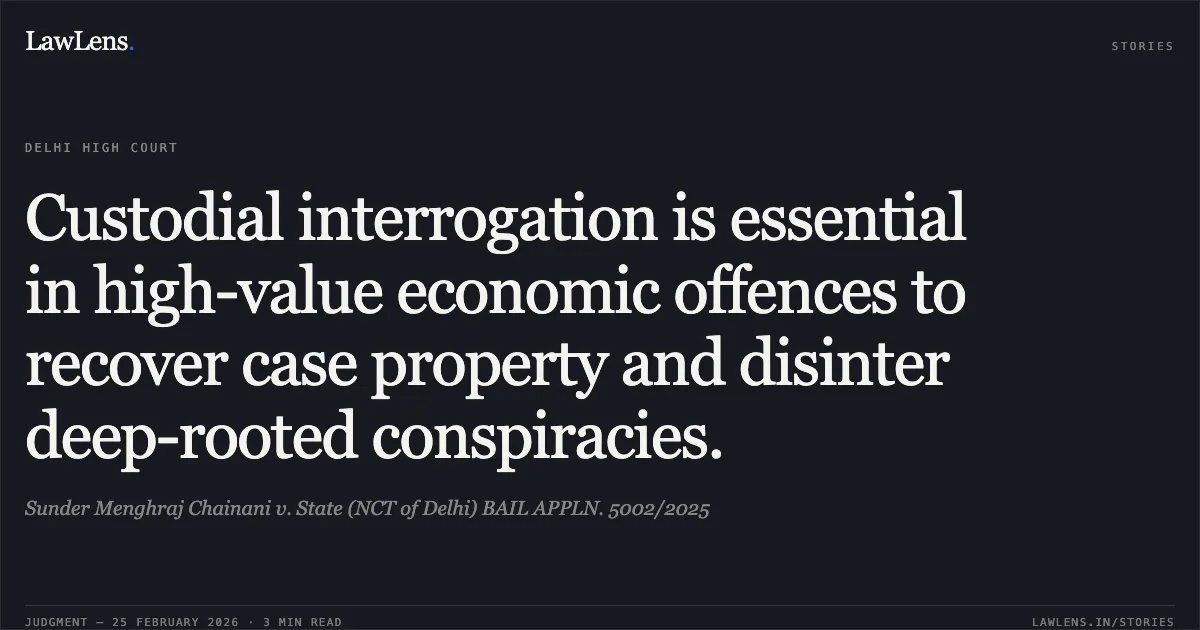
The court answered the issues in the negative and dismissed the anticipatory bail application.
It held that the gravity of the economic offence, the high value of the unrecovered case property, and the petitioner's contradictory stands made him unfit for the grant of bail.
Source reference: para. 39The court further held that the petitioner's medical ailments (diabetes/hypertension) were manageable and did not warrant bail given the seriousness of the crime.
Source reference: para. 38The interim protection previously granted was withdrawn.
Source reference: para. 41Acts & Sections Cited
4 provisions across 3 statutes referred to in this judgment. Each provision opens on LawLens.
Indian Penal Code, 18602
Code of Criminal Procedure, 19731
Bharatiya Nagarik Suraksha Sanhita, 20231
Original Court PDF
Sunder Menghraj Chainani v. State (NCT of Delhi) BAIL APPLN. 5002/2025
Click to open original judgment
Original judgment, available to read, download and summarize on LawLens.in


