01Facts
The petitioner, mother of 2½-year-old Gurnaaz Kaur, sought a writ of habeas corpus for recovery of the child from respondent No. 4, her biological father, and his family members.
¶ 1–3The petitioner alleged matrimonial cruelty, dowry-related harassment, physical abuse, threats, and that respondent No. 4 had taken the child from her parental home on 20.04.2026 and thereafter refused to return her while demanding money.
¶ 1–3The respondents denied the allegations, contending that the father’s custody was lawful, that the child was receiving proper care and education, and that the petitioner’s remedy lay before the Guardian or Family Court under the Guardians and Wards Act, 1890.
¶ 4, 6The petitioner was employed as a Senior Assistant at Punjab University, while the respondents did not adequately disclose respondent No. 4’s employment, education, or income.
¶ 5, 2302Issues
i.Whether a writ of habeas corpus is maintainable in a child-custody dispute between two natural guardians, despite the availability of a remedy under the Hindu Minority and Guardianship Act, 1956 or the Guardians and Wards Act, 1890.
¶ 7–11ii.Whether, having regard to the welfare and tender age of the 2½-year-old child, her custody should be restored to the petitioner-mother.
¶ 12–24iii.Whether the allegations of matrimonial cruelty and counter-allegations raised by the parties required determination in the habeas corpus proceedings.
¶ 1303Law Applied
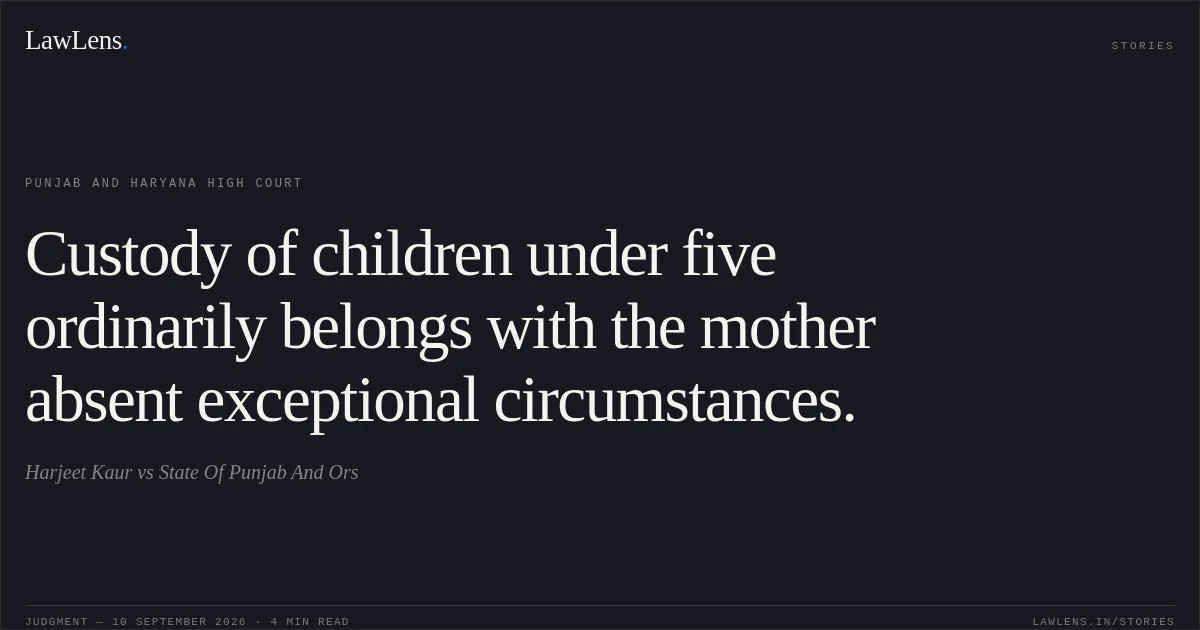
The Court applied Section 6(a) of the Hindu Minority and Guardianship Act, 1956, under which custody of a minor below five years ordinarily lies with the mother, while the father remains the natural guardian in the statutory sense.
¶ 14–15Section 13 of the Act makes the welfare of the minor the paramount consideration in guardianship matters.
¶ 18Section 17 of the Guardians and Wards Act, 1890 requires the Court to assess the minor’s welfare with reference to factors including age, sex, religion, character and capacity of the proposed guardian, and the child’s existing relationship with the guardian.
¶ 20Relying on Tejaswini Gaud v. Shekhar Jagdish Prasad Tewari, 2019 AIR SC 2318, Yashita Sahu v. State of Rajasthan, 2020, and Suryakant M. Raikar v. State of Karnataka, the Court held that habeas corpus may be issued in child-custody matters where the child’s welfare requires judicial intervention; the availability of an alternative custody remedy does not bar the writ.
¶ 7–11The Court further applied the principle that the welfare of a child below five years is ordinarily best served by maternal custody, subject to exceptional circumstances demonstrating the mother’s unfitness.
¶ 14–17Provisions in the judgment · 4 · Linked ones open on LawLens
Guardians and Wards Act, 1890 Section 17
Hindu Minority and Guardianship Act, 1956 Section 2Section 6Section 13
04Reasoning
The Court held that the writ was maintainable because child-custody habeas corpus proceedings are concerned substantially with the child’s welfare and not merely with the technical legality of the detention.
¶ 7–11Although respondent No. 4 was the biological father and a natural guardian, the child was only 2½ years old, attracting the statutory presumption that custody should ordinarily remain with the mother.
¶ 14–15The Court declined to adjudicate the parties’ competing allegations of matrimonial cruelty, psychiatric illness, dowry demands, or substance abuse, observing that such disputed matters were unsuitable for determination in writ proceedings.
¶ 13On the welfare question, the Court found that the petitioner was an educated, financially secure working professional with long-standing employment, whereas respondent No. 4 had not provided adequate particulars regarding his education, employment, or income.
¶ 22–23The Court found no credible material establishing that the mother suffered from a psychiatric condition or that any exceptional circumstance justified depriving the child of maternal custody.
¶ 23–24Given the child’s tender age and the special mother-child bond, restoration of custody to the petitioner was considered consistent with the child’s best interests.
¶ 21–2405Holding
The petition was allowed.
¶ 25(i)–(ii)Respondent No. 4 was directed to hand over custody of Gurnaaz Kaur to the petitioner on 22.09.2026 between 10:00 a.m. and 11:00 a.m. at the petitioner’s parental home; in default, respondents No. 2 and 3 were directed to secure and hand over the child’s custody to the petitioner.
¶ 25(i)–(ii)Respondent No. 4 was granted liberty to seek custody before the competent Guardian or Family Court under the Hindu Minority and Guardianship Act, 1956 or the Guardians and Wards Act, 1890, and that court was directed to decide the matter independently, uninfluenced by the High Court’s observations.
¶ 25(iii)–(iv)Pending such adjudication, respondent No. 4 was granted visitation every Sunday for two hours, or alternatively scheduled video calls, and respondents No. 2 and 3 were directed to provide necessary protection to the petitioner and the child.
¶ 25(v)–(vi)Original Court PDF
Harjeet KaurvsState Of Punjab And Ors
Click to open original judgment
Original judgment, available to read, download and summarize on LawLens.in