01Facts
Four applications for bail were heard together because they raised common factual and legal questions.
¶ 1Commercial quantities of narcotic drugs/psychotropic substances had allegedly been seized from each petitioner.
¶ 2No argument was advanced on the merits of the prosecution cases; bail was sought principally on the grounds of prolonged custody, lack of progress in trial, and the petitioners’ constitutional right to a speedy trial under Article 21.
¶ 3The periods of custody were approximately one year and four months in CRM (NDPS) No. 388 of 2026, one year and eleven months in CRM (NDPS) No. 390 of 2026, one year and nine months in CRM (NDPS) No. 336 of 2026, and two years and one month in C.R.M. (NDPS) No. 337 of 2026.
¶ 4The State opposed bail, contending that the mandatory twin conditions under Section 37 of the Narcotic Drugs and Psychotropic Substances Act, 1985 (“NDPS Act”) had not been satisfied.
¶ 12–1402Issues
i.1. Whether the petitioners, accused in cases involving commercial quantities under the NDPS Act, could be granted bail without recording satisfaction of the twin conditions under Section 37(1)(b)(ii) of the NDPS Act, solely on the ground of prolonged incarceration and delay in trial under Article 21 of the Constitution.
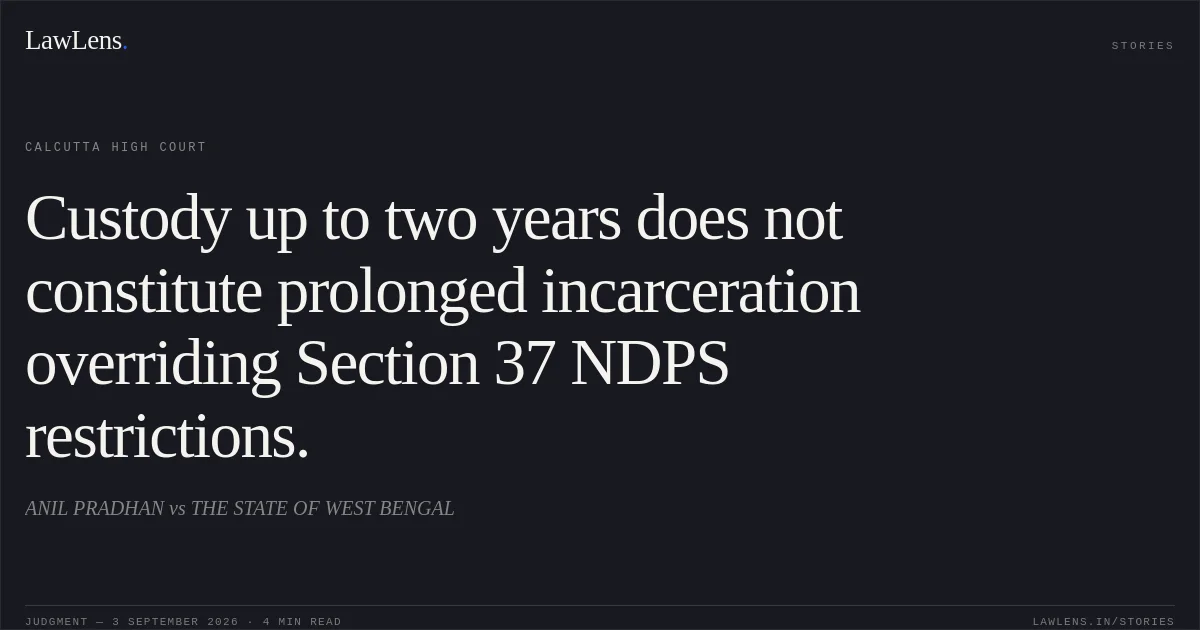
¶ 2, 15ii.2. Whether the periods of custody—ranging from approximately one year and four months to two years and one month—constituted “prolonged incarceration,” such that Article 21 would override the restrictions imposed by Section 37 of the NDPS Act.
¶ 15–18iii.3. Whether the absence of substantial progress in the trials justified the petitioners’ release on bail in the circumstances of the four cases.
¶ 1703Law Applied
Section 37(1)(b)(ii) of the NDPS Act imposes mandatory and cumulative conditions for bail in cases involving commercial quantities: the Court must be satisfied that there are reasonable grounds for believing that the accused is not guilty and that he or she is not likely to commit any offence while on bail.
¶ 12–15The Supreme Court decisions in Narcotics Control Bureau v. Kashif, Narcotics Control Bureau v. Mohit Aggarwal, State of Punjab v. Sukhwinder Singh @ Gora, and State of Punjab v. Balraj Singh @ Billa were relied upon for the proposition that prolonged custody or delay, by itself, does not satisfy or dilute Section 37.
¶ 12–14Conversely, Mohd. Muslim @ Hussain v. State (NCT of Delhi) and Union of India v. K.A. Najeeb establish that constitutional courts retain power under Article 21 to grant bail where incarceration has become excessive, the trial is unlikely to conclude within a reasonable time, and a substantial part of the prescribed sentence has already been undergone.
¶ 9–10Article 21 protects the right to a speedy trial, but that right must initially operate within the statutory framework of the NDPS Act; only in appropriate cases of prolonged incarceration and no reasonable prospect of an early trial may it override Section 37.
¶ 15Provisions in the judgment · 3 · Linked ones open on LawLens
Code of Criminal Procedure, 1973 Section 437Section 439
Narcotic Drugs and Psychotropic Substances Act, 1985 Section 37
04Reasoning
The Court harmonised Section 37 with Article 21 rather than treating either provision as wholly overriding the other.
¶ 15Although the trials had made limited progress, the petitioners had remained in custody for periods between one year and four months and two years and one month, while the applicable punishment on conviction was a minimum of ten years and a maximum of twenty years’ imprisonment.
¶ 16The Court held that none of the petitioners had undergone incarceration amounting to a substantial part of the maximum sentence, and therefore their custody could not yet be characterised as “prolonged incarceration” sufficient to trigger the overriding operation of Article 21.
¶ 16–18The Court also found that an early conclusion of the trials was not impossible because the number of witnesses was not very large.
¶ 17Accordingly, delay alone could not justify bail in the absence of satisfaction of the Section 37 twin conditions.
¶ 17The Trial Court was directed to ensure speedy disposal by avoiding unnecessary adjournments, fixing frequent dates for witness examination, and taking steps to secure the attendance of recalcitrant witnesses under the Bharatiya Nagarik Suraksha Sanhita, 2023 or the Code of Criminal Procedure, 1973.
¶ 1705Holding
The Court answered the issues against the petitioners and dismissed all four bail applications, holding that the stage had not yet been reached for Article 21 to override the restrictions under Section 37 of the NDPS Act.
¶ 18–20The petitioners were granted liberty to renew their bail applications if their respective trials were not concluded within fifteen months from the next date fixed for hearing.
¶ 19The four applications were accordingly disposed of, with liberty to obtain urgent certified copies upon compliance with formalities.
¶ 20–21Original Court PDF
ANIL PRADHANvsTHE STATE OF WEST BENGAL
Click to open original judgment
Original judgment, available to read, download and summarize on LawLens.in