Facts
The Customs authority seized a consignment belonging to the petitioner under a Detention Memo and Seizure List dated March 24, 2026, issued under Section 110 of the Customs Act, 1962
Source reference: p. 1-2The petitioner challenged the seizure, alleging a lack of jurisdiction and absence of "reasons to believe" recorded by the authority
Source reference: para. 2On March 31, 2026, the petitioner applied for the provisional release of the goods under Section 110A of the Act
Source reference: para. 2, 5The Customs authority contended that they had initiated proceedings before a jurisdictional Magistrate under Section 110(1B) for certification of the consignment and argued that the Section 110A application could only be processed after the Magistrate’s conclusion
Source reference: para. 3Issues
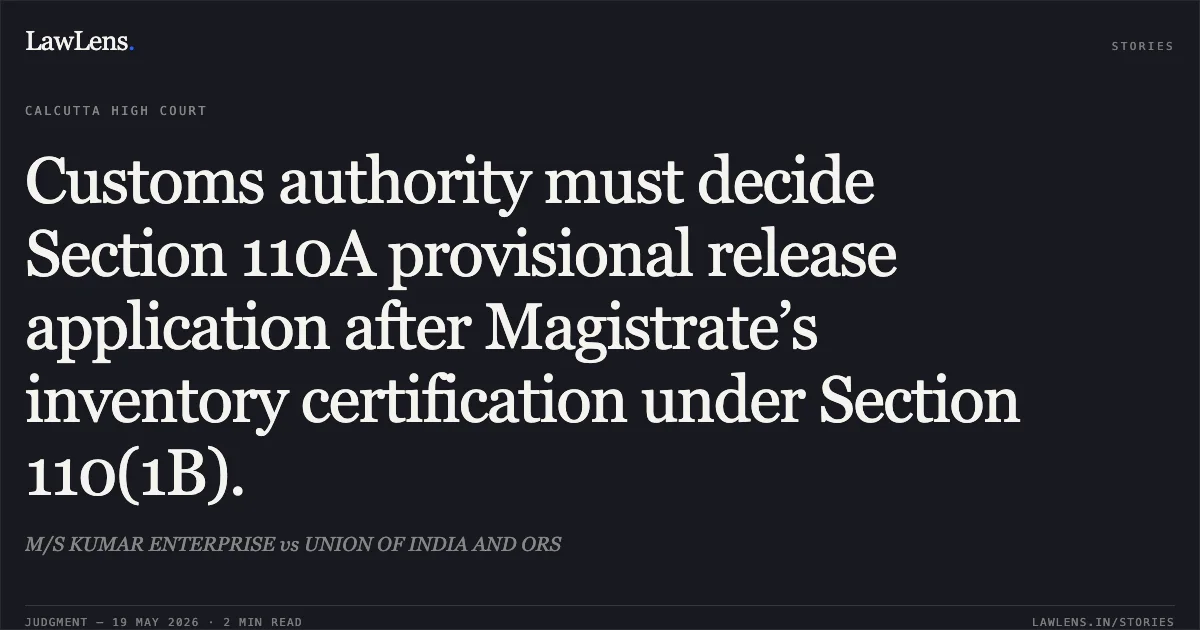
1. Whether the Customs authority is required to dispose of an application for provisional release under Section 110A during the pendency of certification proceedings before a Magistrate under Section 110(1B)?
Source reference: p. 2-3Law Applied
Section 110(1B) of the Customs Act, 1962, which mandates the procedure for a Magistrate to certify the correctness of the inventory of seized goods
Source reference: p. 2Section 110A of the Customs Act, 1962, which empowers the adjudicating authority to allow the provisional release of goods, documents, and things seized pending adjudication upon taking security/bond
Source reference: p. 2, 3Reasoning
The Court noted that while the Customs authority acknowledged the pending application for provisional release, they justified the delay by citing the ongoing mandatory certification process under Section 110(1B) before the Magistrate
Source reference: para. 3The Court determined that a time-bound synchronization of these two procedures was necessary to ensure the petitioner's statutory right to seek provisional release was not rendered illusory by administrative or judicial delays
Source reference: para. 4, 5The Court refrained from deciding on the merits of the seizure or the "reasons to believe," instead focusing on the procedural mandate that once the Magistrate completes the certification (the "logical conclusion" of the seizure's inventory verification), the Customs authority is legally obligated to exercise its discretion under Section 110A regarding the release of the goods
Source reference: para. 5, 7, 8Holding
The jurisdictional Magistrate is requested to conclude the Section 110(1B) proceedings within four weeks
The Customs authority must pass a reasoned order on the Section 110A application within two weeks of the Magistrate’s certification
Source reference: para. 5If release is granted, it must be executed within three working days of the order; if refused, the petitioner may challenge the refusal before the appropriate forum
Source reference: para. 6, 7The Court held that it had not entered into the merits of the seizure, leaving all points, including jurisdiction, open for future litigation
Source reference: para. 8, 10Acts & Sections Cited
1 provisions across 1 statute referred to in this judgment. Each provision opens on LawLens.
Customs Act,19621
Original Court PDF
M/S KUMAR ENTERPRISEvsUNION OF INDIA AND ORS
Click to open original judgment
Original judgment, available to read, download and summarize on LawLens.in


![Subsequent exoneration does not retrospectively invalidate a finalized promotion select list.. UNNIKRISHNAN M vs M/o Environment And Forests. CAT - ['Ernakulam']. LawLens](/stories/thumbnails/subsequent-exoneration-does-not-retrospectively-invalidate-a-finalized-promotion-select-li-ce80a0e84f2f4887857271e8b4341c42.webp)