Facts
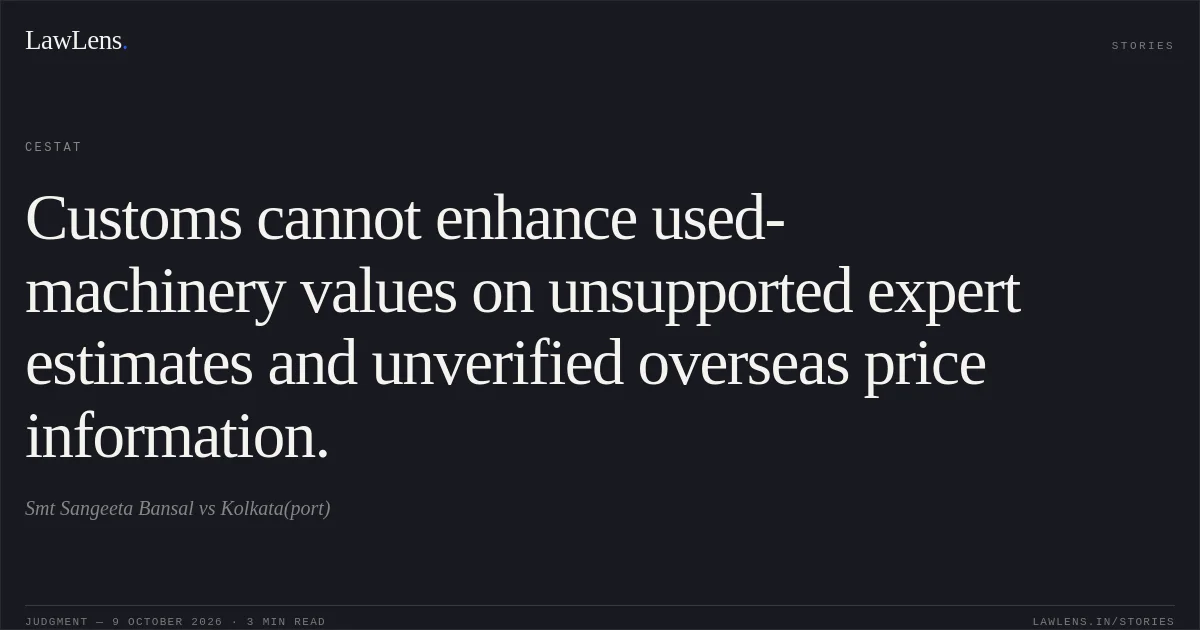
Agarwal Graphic Machinery imported used offset-printing machines through 28 Bills of Entry during 2007. Customs examined the machines and enhanced their declared values before clearance.
Source reference: p. 2–4After a DRI search in January 2008, a show-cause notice dated 22 May 2012 alleged undervaluation of 39 machines: 27 seized machines, 11 previously imported and sold machines, and one provisionally assessed machine. The Commissioner redetermined values, confirmed differential duty, ordered confiscation with redemption fines, and imposed penalties on the company, its directors and Chartered Engineers.
Source reference: p. 2–4, 8–9Issues
Whether the Revenue established a lawful and evidential basis to reject the values previously assessed by Customs and redetermine the values of the used machines?
Source reference: p. 13–16, 20–26Whether the evidence relied upon—including overseas enquiry material and technical experts’ reports—was reliable, and whether refusal of cross-examination vitiated the adjudication?
Source reference: p. 18–26Whether confiscation could be sustained without a notice under Section 124 of the Customs Act, 1962, and whether redemption fines could be imposed on machines unavailable for confiscation?
Source reference: p. 11–13, 30–31Whether the differential-duty demands were barred by limitation, and whether penalties on the company and its directors could survive?
Source reference: p. 31–35Law Applied
Section 28 of the Customs Act governs recovery of duty not levied or short-levied, whereas Section 124 requires notice and an opportunity to respond before confiscation; the two provisions serve distinct purposes.
Source reference: p. 12–13Section 111(m) concerns goods that do not correspond in value or other particulars with the import entry, while Section 125 provides for redemption fine in lieu of confiscation.
Source reference: p. 11–12Rejection and redetermination of transaction value must comply with the applicable Customs Valuation Rules; the Tribunal considered Rule 8 of the 1988 Rules and Rule 9 of the 2007 Rules.
Source reference: p. 14–16The extended limitation period cannot be invoked merely because a later valuation differs where material particulars were disclosed and Customs assessed the goods at import.
Source reference: p. 33–34The Tribunal also relied on Hiseins Exim v. The Additional Commissioner for the distinct functions of Sections 28 and 124, Shiv Kripa Ispat Pvt. Ltd. for the rule that redemption fine cannot be imposed where goods are unavailable and were not cleared under bond or undertaking, and Suraj Impex v. Commissioner of Customs on limitation following prior Customs assessment.
Source reference: p. 12–13, 30–31, 33–34Reasoning
The Tribunal found that the overseas enquiry material was not adequately documented: the relied-upon Brussels letter did not identify the Bills of Entry or machines, explain the enquiry, or substantiate the stated values, and other claimed COIN enquiries were not produced.
Source reference: p. 18–20The printing-technology experts’ reports did not disclose the experts’ qualifications, a valuation methodology, or a basis for the approximate values; the Tribunal therefore rejected them as evidence of enhanced value.
Source reference: p. 20–26The appellant’s request to cross-examine those experts had also been ignored.
Source reference: p. 25–26For the 27 seized machines, no notice under Section 124 seeking confiscation had been issued.
Source reference: p. 12–13For the 11 machines already sold, the Tribunal found no basis for confiscation or redemption fine, including because the goods were unavailable and had not been cleared under bond.
Source reference: p. 27–31The one provisionally assessed machine had not first been taken through finalisation of its assessment, and the valuation evidence was insufficient in any event.
Source reference: p. 31Finally, because the imports had been assessed by Customs and undervaluation was not corroborated, the Tribunal found no basis for suppression or extended limitation; it also found certain demands beyond five years.
Source reference: p. 31–34Holding
The Tribunal held that the redeterminations and all three differential-duty demands—₹31,68,988 for the 27 seized machines, ₹57,88,802 for the 11 previously imported machines, and ₹10,85,041 for the provisionally assessed machine—were unsustainable.
It set aside the confiscations and redemption fines, the penalties on the importer and the two director-appellants, and the impugned order. The appeals were allowed, with consequential relief, if any, in accordance with law.
Source reference: p. 33–36Acts & Sections Cited
9 provisions across 2 statutes referred to in this judgment. Each provision opens on LawLens.
Customs Act,19628
Central Excise Act, 19441
Original Court PDF
Smt Sangeeta BansalvsKolkata(port)
Click to open original judgment
Original judgment, available to read, download and summarize on LawLens.in