Facts
On 4 February 2019, customs officers intercepted the petitioner, an Indian passport holder arriving from Dubai, after he crossed the green channel at IGI Airport.
Source reference: p. 2–3Two gold bars, weighing 2,000 grams in total, were recovered from a concealed location in an airport toilet after the petitioner disclosed that he had hidden them there.
Source reference: p. 2–3In statements under Section 108 of the Customs Act, 1962, he said the gold belonged to an Afghan national and that he was to receive ₹30,000 for delivering it.
Source reference: p. 2–3The adjudicating authority confiscated the gold but allowed redemption on payment of fine and imposed penalties.
Source reference: p. 3The Commissioner (Appeals) partly allowed the petitioner’s appeal, reducing the fine and penalties.
Source reference: p. 3The department filed a revision under Section 129DD. On 14 July 2025, the revisional authority set aside the appellate order and remanded the matter for fresh adjudication.
Source reference: p. 4–6The petitioner challenged that order, contending, among other things, that the revision was time-barred and that the revisional authority lacked power to remand.
Source reference: p. 4–6Issues
1. Whether the revisional authority under Section 129DD of the Customs Act had power to remand the matter for fresh adjudication.
Source reference: p. 9–102. Whether the revisional authority exceeded its jurisdiction or prejudged the question of redemption by considering the evidence concerning ownership and the invoice.
Source reference: p. 10–123. Whether the revision was filed beyond the limitation period prescribed by Section 129DD(2).
Source reference: p. 4, 12–134. Whether Section 129DD(5) required separate notice before the matter could be remanded.
Source reference: p. 5, 12–13Law Applied
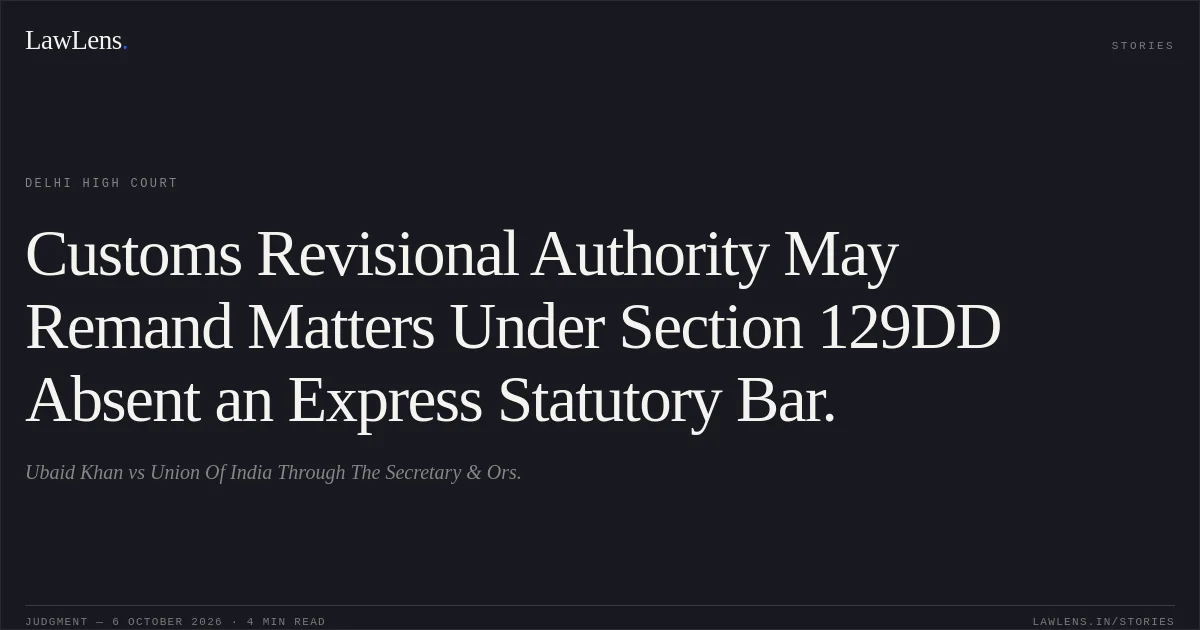
Section 129DD empowers the Central Government, acting as revisional authority, to annul or modify an order passed under Section 128A; absent an express statutory bar, that power includes the incidental power to remand for fresh adjudication, as explained in Union of India v. Umosh Dhaimode.
Source reference: p. 8–10The court distinguished MIL India Ltd. v. Commissioner of Central Excise, where legislation had expressly removed the relevant remand power.
Source reference: p. 10Revisional jurisdiction permits scrutiny of an order’s legality or propriety, including where findings are perverse, unsupported by evidence, or reached by ignoring material evidence, but is not equivalent to an appeal permitting unrestricted reappreciation of facts; the court applied the principle stated in Hindustan Petroleum Corporation Ltd. v. Dilbahar Singh.
Source reference: p. 11–12Under Section 123, where covered goods are seized on a reasonable belief that they are smuggled, the burden of proving that they are not smuggled rests on the person from whose possession they were seized or a person claiming ownership.
Source reference: p. 7, 11Section 129DD(2) requires an application within three months of communication of the order, with a possible further three months for sufficient cause; Section 5 of the Limitation Act cannot extend the statutory period beyond that limit, as recognised in Singh Enterprises v. Commissioner of Central Excise, Jamshedpur.
Source reference: p. 8, 13Section 129DD(5) requires notice in the specified circumstances involving enhancement of penalty or fine, or confiscation of goods of greater value.
Source reference: p. 8, 12–13Reasoning
The court held that the power to annul or modify an appellate order under Section 129DD, read with the absence of an express bar on remand, permitted the revisional authority to remit the matter for fresh adjudication.
Source reference: p. 9–10The remand was not a final determination that the petitioner was ineligible for redemption: the revisional authority had identified matters requiring consideration, including that the invoice was produced during adjudication, did not bear the petitioner’s passport number, and appeared inconsistent with his stated location on the purchase date, while his Section 108 statement attributed the gold to another person.
Source reference: p. 10–12Those matters raised questions relevant to the burden under Section 123 and could be considered by the adjudicating authority afresh.
Source reference: p. 10–12The court found no impermissible reappreciation of evidence or prejudgment.
Source reference: p. 11–12Section 129DD(5) did not require separate notice for this remand, which did not enhance the fine or penalty or confiscate goods of greater value; moreover, the petitioner had been heard by the revisional authority.
Source reference: p. 12–13On limitation, the record did not establish when the appellate order was communicated to the department, and the issue had not been raised before the revisional authority; therefore, the court found no factual foundation to conclude that the revision exceeded the permitted six-month period.
Source reference: p. 13Holding
The court rejected the challenge to the revisional authority’s order, holding that the remand was within its jurisdiction, the notice objection did not apply, and the limitation claim was not established on the record.
The writ petition was dismissed, and all pending applications were disposed of.
Source reference: p. 14Acts & Sections Cited
8 provisions across 3 statutes referred to in this judgment. Each provision opens on LawLens.
Customs Act,19626
Central Excise Act, 19441
Limitation Act, 19631
Original Court PDF
Ubaid KhanvsUnion Of India Through The Secretary & Ors.
Click to open original judgment
Original judgment, available to read, download and summarize on LawLens.in