Facts
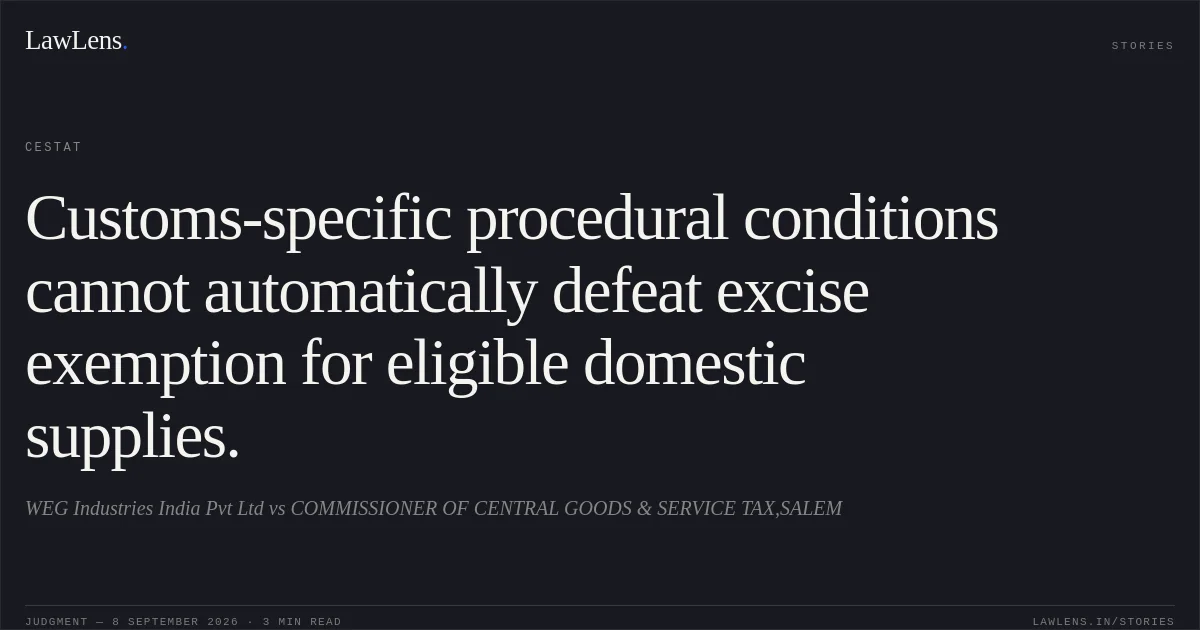
M/s. WEG Industries (India) Pvt. Ltd., a manufacturer of electric motors, generators and spare parts, cleared alternators during June 2013 and August 2014 without payment of excise duty by claiming exemption under Serial No. 336 and Condition No. 41 of Notification No. 12/2012-CE, applicable to goods supplied under International Competitive Bidding contracts.
Source reference: para. 2The appellant had furnished prior intimation to the jurisdictional authorities and produced Project Authority Certificates certifying that the goods were intended for eligible petroleum exploration projects and would have qualified for customs exemption if imported.
Source reference: paras. 3, 9The Department alleged that the appellant had not fulfilled certain documentary and procedural conditions prescribed under the customs notification.
Source reference: para. 2The demands were confirmed by the adjudicating authority and upheld by the Commissioner (Appeals), leading to the present appeal.
Source reference: paras. 1–2Issues
Whether denial of the exemption under Notification No. 12/2012-CE, on the ground of alleged non-fulfilment of conditions under Notification No. 12/2012-Cus, was legally sustainable?
Source reference: para. 5(i)Whether the consequential demands of excise duty, interest and penalties were sustainable in law?
Source reference: para. 5(ii)Law Applied
The Tribunal applied Serial No. 336 and Condition No. 41 of Notification No. 12/2012-CE, under which goods supplied against International Competitive Bidding were exempt where the goods, if imported, would be exempt from customs duty; customs conditions were incorporated only mutatis mutandis, meaning only insofar as they were capable of application to domestic clearances.
Source reference: paras. 7–8The Tribunal held that import-specific procedural requirements could not be mechanically imposed on domestic manufacturers.
Source reference: para. 8It relied on Commissioner of Customs (Imports), Mumbai v. Tullow India Operations Ltd., 2005 (189) E.L.T. 401 (S.C.), for the principle that procedural conditions should not defeat an exemption where substantive eligibility is established.
Source reference: para. 11Ercon Composites v. Commissioner of Central Excise and Service Tax, Jaipur-II, for the proposition that import-oriented certificate requirements could not rigidly be applied to domestic suppliers.
Source reference: para. 12Commissioner of Central Excise, Nashik v. Kent Introl Pvt. Ltd., 2016 (331) E.L.T. 77 (Bom.), along with related Tribunal decisions, for the same distinction between substantive eligibility and procedural compliance.
Source reference: para. 13Since interest under Section 11AA of the Central Excise Act, 1944 presupposes a legally recoverable duty liability, it could not survive once the principal demand failed.
Source reference: para. 22Penalties under Rule 25 of the Central Excise Rules, 2002 were also held inapplicable where the dispute was interpretational and there was no suppression or clandestine removal.
Source reference: para. 23Reasoning
The Tribunal found that the Department had incorrectly treated every condition in the customs notification as automatically applicable to the appellant’s domestic clearances.
Source reference: paras. 7–8The expression “mutatis mutandis” required adaptation of the customs conditions to the context of domestic manufacture; it did not authorise the mechanical enforcement of requirements framed specifically for import transactions.
Source reference: para. 8The appellant had supplied the alternators under valid International Competitive Bidding contracts, furnished prior intimation, and produced genuine Project Authority Certificates establishing the eligibility of the petroleum exploration projects.
Source reference: para. 9The Department did not dispute the authenticity of the certificates, the eligibility of the projects, the actual end use of the goods, or any diversion or misuse.
Source reference: paras. 9, 16In these circumstances, the alleged deficiencies were procedural rather than substantive.
Source reference: no citationApplying the principles in Tullow India Operations, Ercon Composites and Kent Introl, the Tribunal held that such procedural objections could not defeat the substantive exemption or frustrate the legislative purpose of maintaining tax parity between imported and domestically manufactured goods.
Source reference: paras. 10–15As the exemption was validly available, the associated duty demands failed; the interest and penalties, being consequential or unsupported by any deliberate violation, also could not be sustained.
Source reference: paras. 18, 21–25Holding
The Tribunal held that the appellant was entitled to the exemption under Notification No. 12/2012-CE and that the Department had unlawfully denied it by mechanically applying import-specific procedural conditions under Notification No. 12/2012-Cus.
The aggregate excise duty demand of Rs.64,45,871/-, along with consequential interest under Section 11AA and penalties under Rule 25, was set aside.
Source reference: paras. 19, 25–26The impugned Order-in-Appeal was set aside, and the appeal was allowed with consequential relief in accordance with law.
Source reference: para. 27Acts & Sections Cited
1 provisions across 1 statute referred to in this judgment. Each provision opens on LawLens.
Central Excise Act, 19441
Original Court PDF
WEG Industries India Pvt LtdvsCOMMISSIONER OF CENTRAL GOODS & SERVICE TAX,SALEM
Click to open original judgment
Original judgment, available to read, download and summarize on LawLens.in