Facts
On the night of 27/28 August 2006, several armed persons allegedly entered the informant’s house, restrained and gagged him, threatened him with a knife, and committed dacoity by taking jewellery, clothes, cash, documents, electronic articles and other valuables.
Source reference: p.2–3; para.4A case was registered under Sections 395 and 397 of the Indian Penal Code, with Section 412 subsequently added.
Source reference: p.3; para.5After investigation, the appellants were charge-sheeted and tried in S.T. No.378 of 2007.
Source reference: p.3–4; paras.7–8The prosecution examined five witnesses and produced documentary and material evidence, including recovered articles identified in a test identification proceeding.
Source reference: p.3–4; paras.7–8The Additional Sessions Judge convicted the appellants under Section 395 IPC and sentenced each to eight years’ rigorous imprisonment on 30 May/1 June 2009.
Source reference: p.2; para.3In appeal, the appellants did not challenge the conviction on merits and sought reduction of sentence on the ground that they had already undergone more than three years’ custody and had suffered prolonged trial-related hardship.
Source reference: p.4–5; para.11Issues
Whether the appellants’ conviction under Section 395 IPC was sustainable on the basis of the prosecution evidence, recoveries and identification of the stolen articles.
Source reference: p.5–6; para.13Whether, considering the age of the occurrence, the appellants’ period of custody and the prolonged pendency of the proceedings, the sentence of eight years’ rigorous imprisonment should be reduced to the period already undergone.
Source reference: p.5–6; paras.11–15Law Applied
The Court applied Section 395 IPC, which criminalises dacoity and prescribes punishment for participation in dacoity.
Source reference: p.5–6; para.13It relied on the evidentiary principle that recovery of stolen property pursuant to investigation, coupled with identification of the recovered articles and other prosecution evidence, may corroborate the accused’s involvement in the offence.
Source reference: p.5–6; para.13In determining sentence, the Court considered the duration of custody already undergone, the substantial lapse of time since the offence, the prolonged agony of trial, and the interests of justice as relevant factors warranting modification of the sentence.
Source reference: p.5–6; paras.11, 14–15Reasoning
The Court found that the prosecution case established that the informant’s house had been subjected to dacoity and that several stolen articles were recovered after the appellants’ apprehension.
Source reference: p.5–6; para.13The articles were identified by the informant in the test identification proceeding and had subsequently been released to him, providing corroboration for the appellants’ involvement.
Source reference: p.5–6; para.13Accordingly, the Court found no error in the conviction under Section 395 IPC and upheld it.
Source reference: p.5–6; para.13However, while assessing sentence, it noted that the occurrence was from 2006, more than two decades had elapsed, and the appellants had already remained in custody for over three years.
Source reference: p.5–6; para.14It therefore considered further incarceration unnecessary and disproportionate in the circumstances.
Source reference: p.5–6; para.14Holding
The appeals were dismissed on merits insofar as the conviction under Section 395 IPC was concerned.
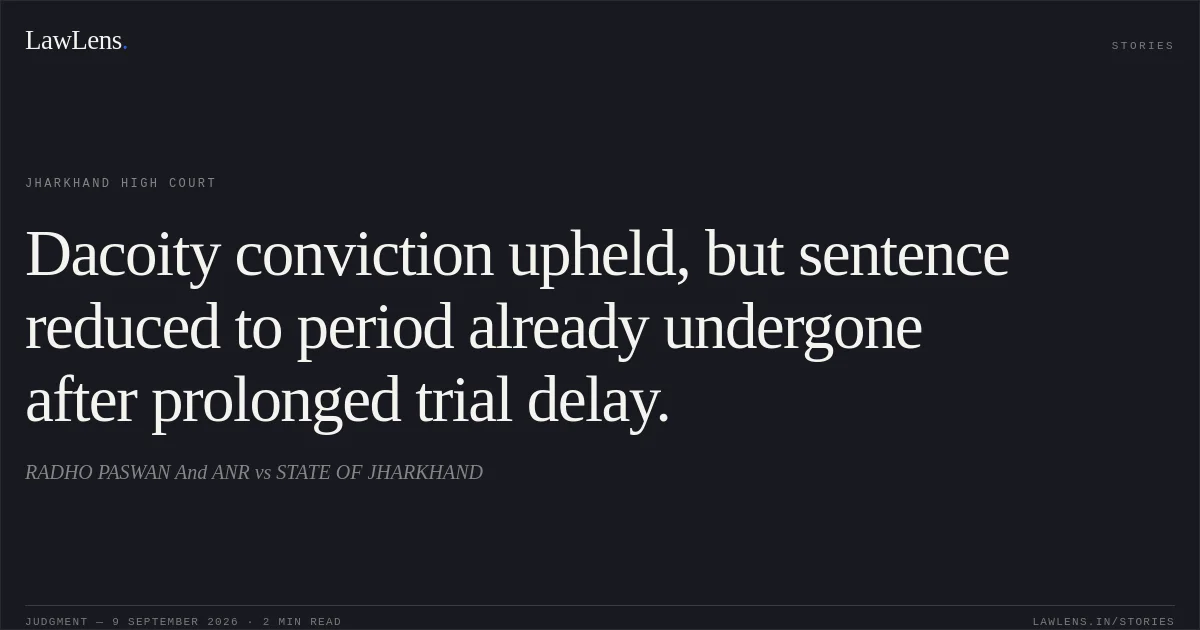
The conviction was upheld, but the sentence of eight years’ rigorous imprisonment was modified to the period already undergone.
Source reference: p.6; paras.13–16As the appellants were on bail, they were discharged from their bail bonds and the sureties were also discharged.
Source reference: p.6; para.17Pending interlocutory applications, if any, were disposed of, and the trial court records were directed to be returned.
Source reference: p.6–7; paras.18–19Acts & Sections Cited
3 provisions across 1 statute referred to in this judgment. Each provision opens on LawLens.
Indian Penal Code, 18603
Original Court PDF
RADHO PASWAN And ANRvsSTATE OF JHARKHAND
Click to open original judgment
Original judgment, available to read, download and summarize on LawLens.in