01Facts
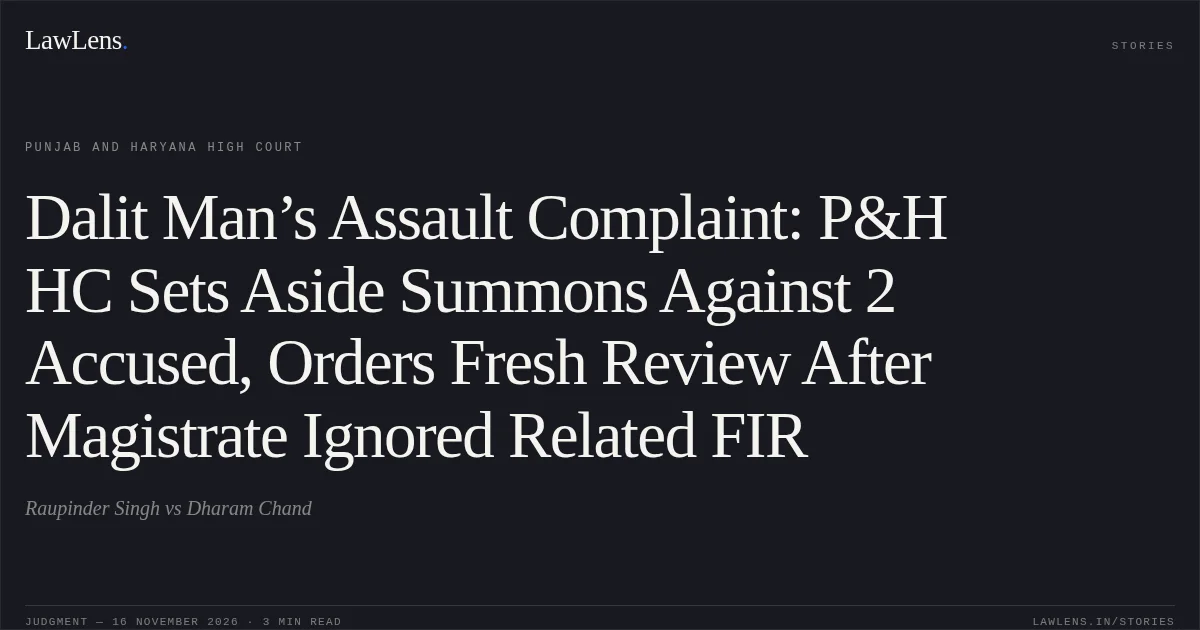
The complainant alleged that the petitioners and others assaulted and robbed him on 14 June 2008. An FIR was registered on 17 June 2008; the complainant later filed a private complaint concerning the same occurrence, alleging, among other things, caste-based abuse and that the police had not recorded his account correctly.
pp. 2–4, 10The Magistrate summoned the accused on 31 January 2014 without referring to the FIR or police report.
pp. 3–4, 10In the petition under Section 482 Cr.P.C., the petitioners sought quashing of the complaint and summoning order. During the proceedings, petitioners 1 and 3 died; petitioners 2 and 4 remained before the Court.
p. 4, 6, 1002Issues
i.Whether the complaint and summoning order were liable to be quashed on the ground that the complaint was an improvement over the FIR and did not disclose offences, including offences under the SC/ST Act.
¶ 11 · p. 6ii.Whether the Magistrate’s failure to follow Section 210 Cr.P.C., where the complaint concerned the same occurrence as a pending police case, vitiated the summoning order.
¶ 12–17 · pp. 7–1103Law Applied
Section 482 Cr.P.C. preserves the High Court’s inherent power to prevent abuse of process, but the Court does not ordinarily assess disputed facts or weigh defence material; the principles in State of Haryana v. Ch. Bhajan Lal, 1992 Supp (1) SCC 335, guide the exercise of that power.
¶ 11 · p. 6Section 210 Cr.P.C. requires a Magistrate, when a complaint case and a police investigation concern the same offence, to coordinate the proceedings: the complaint proceedings are to be stayed and the police report obtained, and, where cognizance is taken on that report against an accused in the complaint, the cases are to be inquired into or tried together.
¶ 12 · pp. 7–8In Sankaran Moitra v. Sadhna Das, (2006) 4 SCC 584, the Supreme Court explained that Section 210 is intended to prevent parallel proceedings, harassment of the accused, and inconsistent cognizance of the same offence.
¶ 13 · p. 8The Court also relied on Savera Sidhu v. Harleen Sidhu, 2010 SCC OnLine P 10659, for the mandatory nature of Section 210 and the potential prejudice from non-compliance, and on Kuldip Raj Mahajan v. Hukam Chand, 2007 SCC OnLine P 1251, and Gurdhian Singh v. State of Punjab, CRM-M-28505-2017, decided 18 July 2023, which applied that requirement to complaint proceedings arising from the same occurrence.
¶ 14–15 · pp. 9–10Provisions in the judgment · 16 · Linked ones open on LawLens
Indian Penal Code, 1860 10 provisions
Section 148Section 149Section 323Section 325Section 341Section 382Section 392Section 452Section 500Section 506Arms Act, 1959 Section 27
Scheduled Castes and the Scheduled Tribes (Prevention of Atrocities) Act, 1989 Section 3Section 4
Code of Criminal Procedure, 1973 Section 173Section 210Section 482
04Reasoning
The Court declined to quash the complaint on its merits because the alleged improvements, the Patwari’s report, and the inquiry findings were matters requiring evidentiary assessment, and the complaint was supported by preliminary and medical evidence.
¶ 11 · p. 6However, the complaint itself disclosed the FIR concerning the same occurrence, and it had been instituted while the investigation was underway. The Magistrate therefore had notice of the police case but proceeded to summon the accused without calling for or considering the police record.
¶ 16 · p. 10The fact that the challan had been filed before the summoning order did not remove the matter from Section 210; rather, the provision addresses the procedure to be followed once a police report is filed.
¶ 17 · p. 11The resulting risk of parallel proceedings and prejudice warranted setting aside the summoning order. The Court left the merits of the SC/ST Act allegations, including the questions of attribution, public view, applicable statutory provisions, and committal, for the Magistrate to consider after examining the police record.
¶ 17, 19 · pp. 11–1205Holding
The petition was partly allowed. The petition qua petitioners 1 and 3 was dismissed as infructuous due to their deaths.
¶ 10, 20 · pp. 6, 12–13The prayer to quash the complaint was declined, but the summoning order was set aside qua petitioners 2 and 4.
¶ 20 · pp. 12–13The matter was remitted to the Magistrate to call for the complete FIR record and proceed afresh in accordance with Section 210 Cr.P.C., after hearing both sides; the parties were directed to appear on 15 December 2026, and the Magistrate was asked to endeavour to decide the matter within six months.
¶ 20 · pp. 12–13The interim order was vacated, and all observations on the merits were expressly left open.
¶ 20–21 · p. 13Original Court PDF
Raupinder SinghvsDharam Chand
Click to open original judgment
Original judgment, available to read, download and summarize on LawLens.in