Facts
The plaintiffs, claiming through Chikkahonnegowda’s branch, sought partition and separate possession of properties said to be ancestral joint-family properties.
Source reference: para. 4–5The defendants contended that Chikkahonnegowda and his brother Puttaswamy had partitioned the properties under a registered deed dated 2 August 1997, and that Chikkahonnegowda later bequeathed the properties allotted to him to defendant No. 2, Ramegowda.
Source reference: para. 6–8The Trial Court dismissed the suit, including on the ground that the plaintiffs were born before the Hindu Succession Act, 1956; the First Appellate Court affirmed that decree.
Source reference: para. 9The plaintiffs’ second appeal challenged those concurrent decisions.
Source reference: para. 1, 10–11Issues
1. Whether the plaintiffs could claim a birthright or seek partition in properties allotted to their father under the 1997 partition deed.
Source reference: para. 13–152. Whether the plaintiffs could claim a share by intestate succession where their father’s Will in favour of defendant No. 2 had been found duly proved.
Source reference: para. 16–193. Whether the concurrent findings disclosed a substantial question of law warranting interference in second appeal.
Source reference: para. 20–21Law Applied
The Court stated that a daughter’s birth before 1956 does not, by itself, defeat her statutory succession rights; where a father dies after the Hindu Succession Act, 1956 came into force and property devolves under Section 8, the daughter cannot be denied a share solely on that basis.
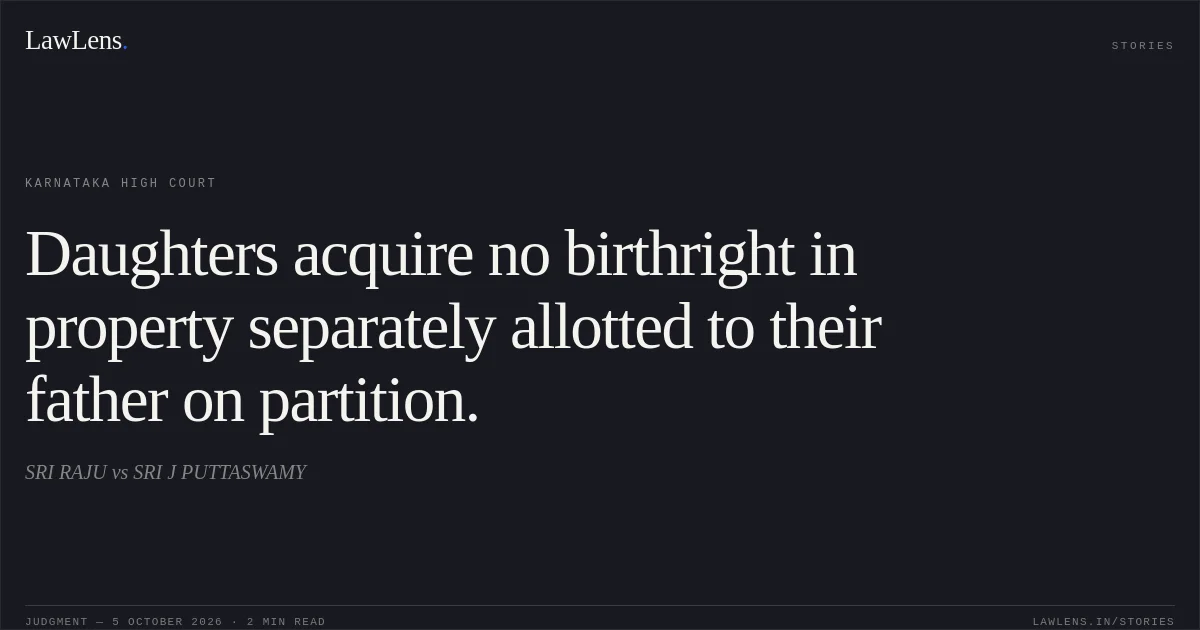
Source reference: para. 12However, the Court held that property jointly acquired by two brothers and later allotted to each under partition becomes that allottee’s separate and absolute property, rather than ancestral or coparcenary property in the hands of the other brother’s descendants; the children therefore acquire no birthright in property allotted to their parent.
Source reference: para. 13–15Property disposed of by a duly proved Will devolves under the testamentary disposition, not the rules of intestate succession under Section 8.
Source reference: para. 16–19The judgment cites no specific precedent.
Source reference: no citationReasoning
The Court treated the registered 1997 partition deed as establishing that the suit properties were jointly acquired by Chikkahonnegowda and Puttaswamy and that the properties allotted to Chikkahonnegowda became his separate property.
Source reference: para. 13–15The plaintiffs therefore had no coparcenary or birthright in those properties, and the subsequent amendment to Section 6 could not create such a right in property that was, on the admitted facts, their father’s separate property.
Source reference: para. 14Further, the Trial Court’s finding that the Will in favour of Ramegowda was duly proved had been affirmed on appeal and was supported by the plaintiffs’ admissions in cross-examination.
Source reference: para. 17–19The Trial Court’s reasoning based solely on the plaintiffs’ pre-1956 births was incorrect, but that error did not undermine the result because the partition and Will independently defeated the claim.
Source reference: para. 12, 20Holding
The Court held that the plaintiffs had established no subsisting right to partition or separate possession and that no substantial question of law arose for decision.
The Regular Second Appeal was dismissed, the judgments and decrees of the Courts below were affirmed, and pending interlocutory applications were disposed of as not surviving.
Source reference: para. 22Acts & Sections Cited
3 provisions across 2 statutes referred to in this judgment. Each provision opens on LawLens.
Code of Civil Procedure, 19081
Original Court PDF
SRI RAJUvsSRI J PUTTASWAMY
Click to open original judgment
Original judgment, available to read, download and summarize on LawLens.in