Facts
The parties were the four children of Muslappa.
Source reference: no citationThe plaintiffs sued for partition, asserting that the suit properties were ancestral joint-family properties.
Source reference: no citationThe trial court decreed the suit in part, granting the two sons 5/12 share each and the two daughters 1/12 share each, relying on Prakash v. Phulavati.
Source reference: p. 6–12The defendant appealed; the plaintiffs filed cross-objections and an application under Order XLI Rule 27 CPC to produce death certificates showing that Muslappa died on 18 May 2009 and his wife, Gouramma, on 15 May 2013.
Source reference: p. 12–13, 17The first appellate court admitted the additional evidence, dismissed the defendant’s appeal, and modified the decree to grant each child a 1/4 share.
Source reference: p. 13–14In these second appeals, the defendant argued that the matter should have been remanded after the additional evidence was admitted and challenged the allowance of the cross-objections.
Source reference: p. 14–15Issues
Whether the first appellate court was required to remand the matter for further evidence after allowing the plaintiffs’ Order XLI Rule 27 CPC application.
Source reference: p. 14–15, 18–19Whether the first appellate court was justified in granting each of Muslappa’s four children an equal 1/4 share in the suit properties.
Source reference: p. 18–22Law Applied
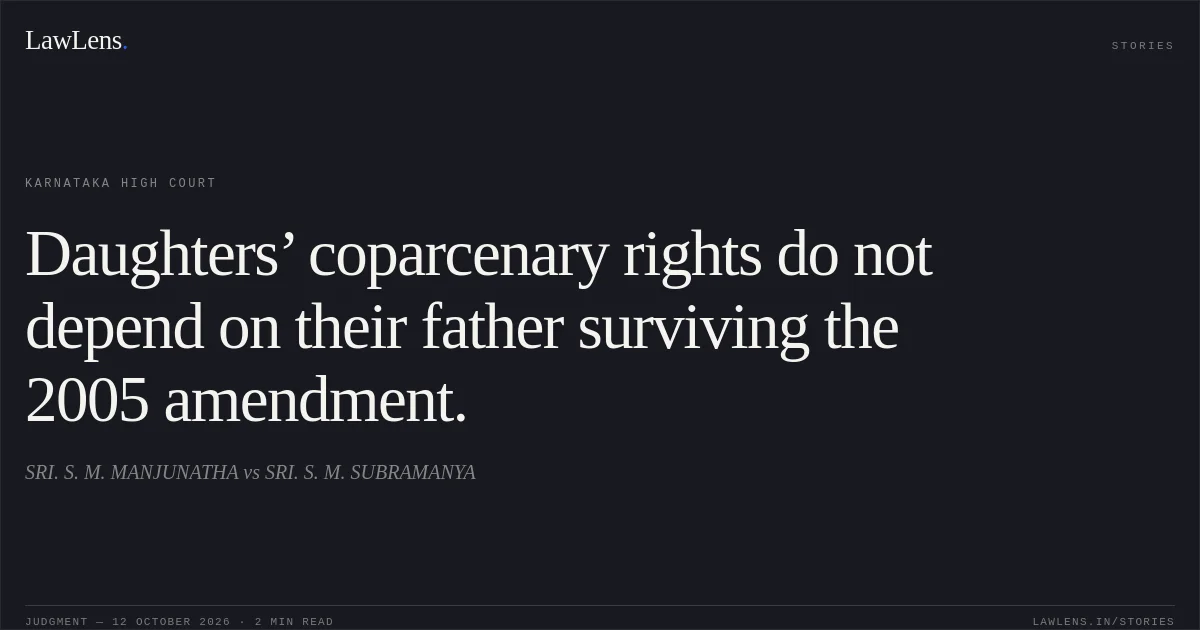
Under substituted Section 6 of the Hindu Succession Act, 1956, a daughter has the same coparcenary rights and liabilities as a son; the right can be claimed whether she was born before or after the amendment, and the father need not have been alive on 9 September 2005.
Source reference: p. 19–21The statutory protection preserves dispositions, alienations, partitions, and testamentary dispositions covered by Section 6, including qualifying partitions effected before 20 December 2004.
Source reference: p. 19–21Vineeta Sharma v. Rakesh Sharma, AIR 2020 SC 3717.
Source reference: p. 19–21Order XLI Rules 22 and 27 CPC governed the plaintiffs’ cross-objections and application to produce additional evidence.
Source reference: p. 12–13Reasoning
The death certificates were admitted without objection, and the defendant did not dispute that Muslappa died in 2009.
Source reference: p. 17–19The High Court held that remand would serve no useful purpose: Vineeta Sharma established that a daughter’s coparcenary right does not depend on her father being alive on the amendment date, and the record disclosed no disputed fact requiring further evidence to determine the shares.
Source reference: p. 19–22The appellate court was therefore justified in modifying the decree to grant all four children equal shares.
Source reference: p. 19–22Holding
The High Court answered the remand and equal-share issues against the appellant.
It found no substantial question of law warranting interference and dismissed both Regular Second Appeals, leaving in force the decree awarding each of Muslappa’s four children a 1/4 share in the suit properties.
Source reference: p. 22–23Acts & Sections Cited
2 provisions across 2 statutes referred to in this judgment. Each provision opens on LawLens.
Code of Civil Procedure, 19081
Hindu Succession Act, 19561
Original Court PDF
SRI. S. M. MANJUNATHAvsSRI. S. M. SUBRAMANYA
Click to open original judgment
Original judgment, available to read, download and summarize on LawLens.in
![ACP/MACP claims require individual service-record verification and reasoned consideration under applicable precedents.. Abdul Majid Bhat vs Military Engineer Services (MES). CAT - ['Srinagar']. LawLens](/stories/thumbnails/acp-macp-claims-require-individual-service-record-verification-and-reasoned-consideration-f1d47f6ae09c467086372baac318237f.webp)
![Regularization and Parity Claims Must Be Considered by a Reasoned Speaking Order.. Javaid Ahmad Mir vs RURAL DEVELOPMENT DEPARTMENT. CAT - ['Srinagar']. LawLens](/stories/thumbnails/regularization-and-parity-claims-must-be-considered-by-a-reasoned-speaking-order-eec466afaad54f56b53a0e8a394099a6.webp)
![Eligible employees are entitled to SRO-based higher pay fixation, with arrears limited to three years before filing.. Yash Pal Singh vs D/o Public Health Engineering Ut Of Jammu And Kashmir. CAT - ['Jammu']. LawLens](/stories/thumbnails/eligible-employees-are-entitled-to-sro-based-higher-pay-fixation-with-arrears-limited-to-t-3b2a7d3634b24db296b8f061ec26c8d4.webp)