Facts
The plaintiffs (appellants) sought a partition of properties and the cancellation of a 1970 sale deed executed by Bauni Devi and Bilasho Devi (daughters of Radha Mahto) in favor of Defendant No. 1
Source reference: para. 18Radha Mahto (son of Dukhi) died intestate prior to 1956 (either 1936 or 1945), leaving behind a widow, Sohagi Devi, and two daughters
Source reference: para. 24Following Radha’s death, Sohagi Devi remarried Kashi Mahto (Radha’s cousin).
Source reference: para. 24The plaintiffs argued that upon Sohagi’s remarriage, the property of Radha Mahto (Khata No. 57 and half of 56) should have devolved upon the agnates (Kashi Mahto’s line) because, under Shastric law prior to 1956, daughters were allegedly excluded from inheritance
Source reference: para. 9-10The Trial Court and First Appellate Court concurrently found that a partition had occurred between Radha and Kailu during their lifetimes, making Radha's holdings his separate property
Source reference: para. 22-23Issues
1. Whether the Appellate Court erred in dismissing the partition suit by overlooking the principle that before 1937 or 1956, daughters and widows were not entitled to inherit the properties of their father or husband, particularly in light of the father’s death in 1936
Source reference: para. 4Law Applied
Section 2 of the Hindu Widows' Remarriage Act, 1856, which stipulates that a widow’s right in her deceased husband’s property ceases upon remarriage as if she had then died, with the next heirs of the husband succeeding to the estate
Source reference: para. 26Hindu Law of Inheritance (Amendment) Act, 1929, which recognized daughters as heirs to separate property
Source reference: para. 35Arunachala Gounder (Dead) v. Ponnusamy, (2022) 11 SCC 520, which established that under Mitakshara law, the self-acquired or separate property of a male Hindu dying intestate devolves by inheritance (not survivorship), and a daughter is entitled to inherit in preference to collaterals even prior to 1956
Source reference: para. 35-36Reasoning
The court reasoned that since Radha Mahto and Kailu Mahto had partitioned their ancestral holdings, the lands in Khata No. 57 and half of 56 were Radha’s separate property
Source reference: para. 27Upon Radha's death (intestate and without a son), his widow Sohagi Devi initially inherited a limited estate. However, under Section 2 of the 1856 Act, her remarriage to Kashi Mahto operated as her "civil death" regarding Radha's estate
Source reference: para. 27, 33Consequently, the succession "re-opened" for the next heirs. Applying the 1929 Act and the precedent in Arunachala Gounder, the court determined that the daughters (Bauni and Bilasho) were the immediate next heirs in the line of succession for separate property, surpassing agnates like Kashi Mahto
Source reference: para. 34-37The court rejected the plaintiffs' contention that the property reverted to the male agnates (survivorship), noting that survivorship only applies to joint coparcenary property, not property held separately following a partition
Source reference: para. 36, 39Holding
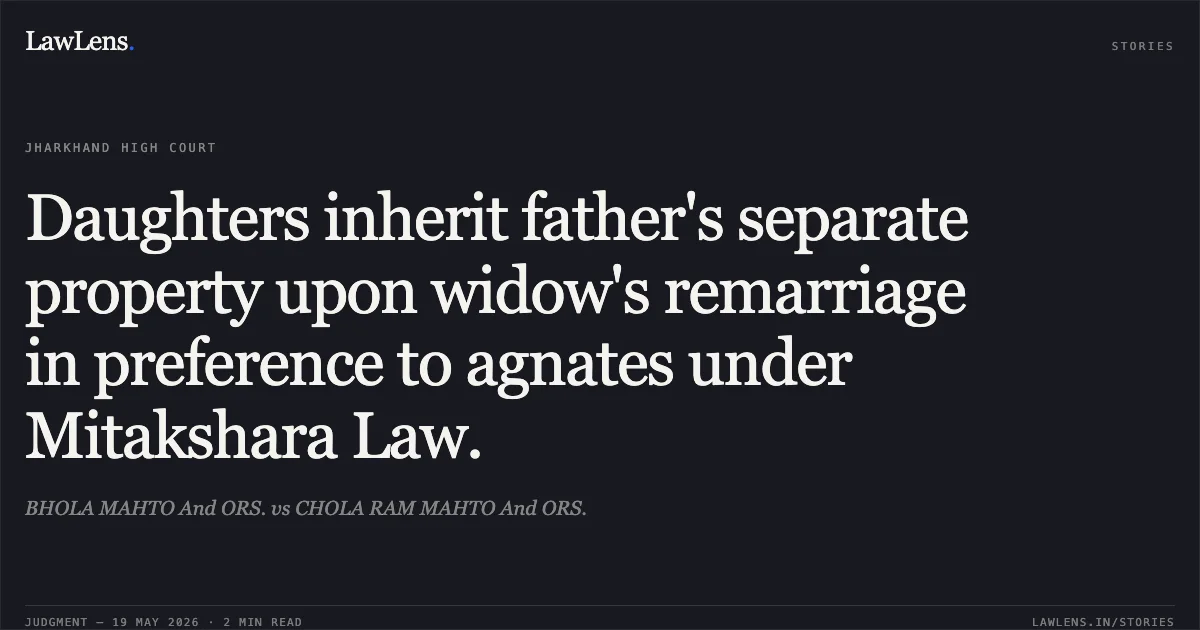
The High Court answered the substantial question of law against the appellants, holding that the daughters were the lawful heirs of Radha Mahto's separate property upon their mother’s remarriage
The court affirmed the lower courts' findings that the 1970 sale deed executed by the daughters was valid and that the plaintiffs had no claim to Radha’s separate estate. The Second Appeal was dismissed, affirming the partial partition decree limited to Kashi Mahto's own properties
Source reference: para. 39, 41Acts & Sections Cited
2 provisions across 2 statutes referred to in this judgment. Each provision opens on LawLens.
Hindu Succession Act, 19561
Code of Criminal Procedure, 19731
Original Court PDF
BHOLA MAHTO And ORS.vsCHOLA RAM MAHTO And ORS.
Click to open original judgment
Original judgment, available to read, download and summarize on LawLens.in


