Facts
The Appellant, a bona fide passenger, was traveling from Manmad to Jalgaon via the Guwahati Express
Source reference: para. 2As the train approached Jalgaon station, the Appellant fell from the running train, sustaining head and leg injuries
Source reference: para. 2The Guwahati Express did not have a scheduled halt at Jalgaon
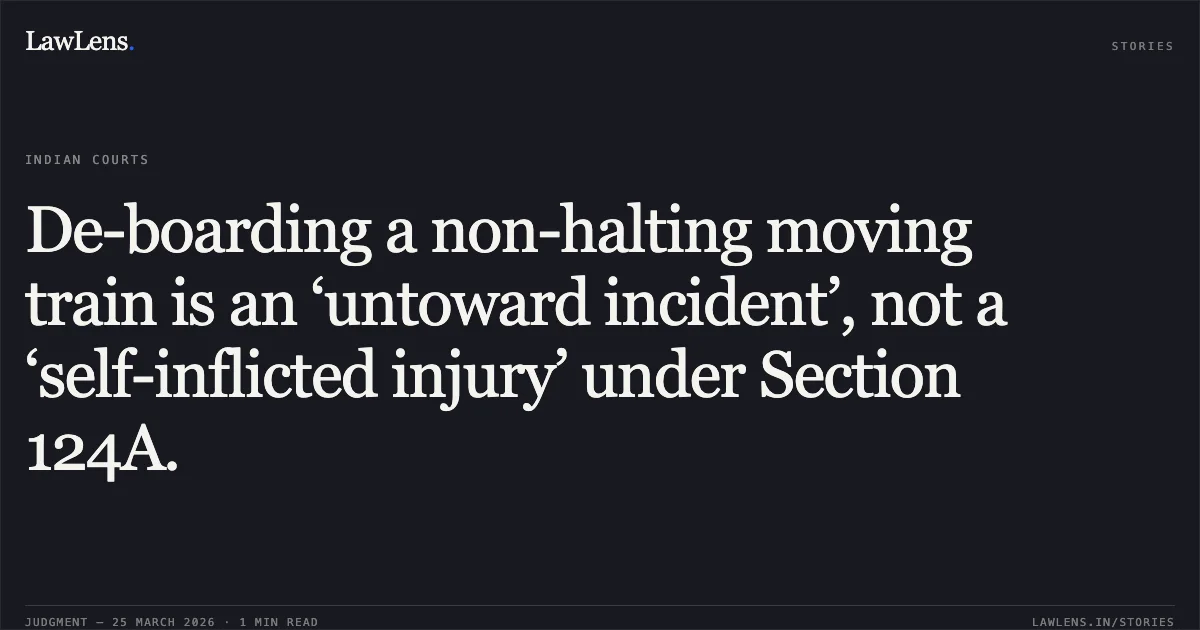
Source reference: para. 2The Railway Claims Tribunal (‘Tribunal’) rejected the claim for compensation, ruling that the incident was not an "untoward incident" but a "self-inflicted injury," as the Appellant was sitting near the door and attempted to de-board a non-stopping train
Source reference: para. 1, 3The Appellant challenged this order before the High Court.
Source reference: no citationIssues
1. Whether a passenger sitting near the door of a train can be denied compensation on the ground of negligence or "self-inflicted injury" under Section 124A of the Railways Act, 1989
Source reference: para. 52. Whether the act of de-boarding a moving train that does not halt at the passenger's destination constitutes a "self-inflicted injury" excluding the passenger from compensation
Source reference: para. 5Law Applied
The Court applied Section 124A of the Railways Act, 1989, which provides for compensation for "untoward incidents" unless the injury falls under specific exceptions such as suicide or "self-inflicted injury"
Source reference: para. 5The Court relied on the Supreme Court’s decision in Jameela v. Union of India (2010), which established that falling from a train while standing or sitting near the door is not a "self-inflicted injury" but an accidental fall
Source reference: para. 6It further followed the Bombay High Court precedents in Ratta v. Union of India (2022) and Union of India v. Reena (2022), which held that boarding a wrong train or attempting to de-board a moving train due to panic or mistake does not necessarily constitute a criminal act or intent to self-inflict injury
Source reference: para. 9Reasoning
The Court reasoned that under Indian traveling conditions, accidental falls from a doorway do not qualify as "self-inflicted injuries" per the Jameela precedent, thereby nullifying the Tribunal's first ground for rejection
Source reference: para. 6Regarding the attempt to de-board a non-stopping train, the Court observed that passengers often board wrong trains due to a bona fide mistake or lack of announcements
Source reference: para. 7-8The Court noted that realizing a train will not halt causes a "loss of mental balance" and "panic," leading to impulsive de-boarding without an actual intent to cause self-harm
Source reference: para. 7Distinguishing a contrary Delhi High Court view in Pappan v. Union of India, the Court chose to follow its own binding precedents, emphasizing that in social welfare legislation, the interpretation must favor the claimant to fulfill the Act’s objective
Source reference: para. 10Holding
The High Court allowed the appeal and set aside the Tribunal’s order
It held that the incident qualified as an "untoward incident" and was not a "self-inflicted injury"
Source reference: para. 7, 10The Respondent was directed to pay compensation of ₹80,000 to the Appellant with interest @6% p.a. from the date of the incident until payment
Source reference: para. 13The Court also advised the Railway authorities to implement public announcement systems in all trains to prevent such incidents
Source reference: para. 11Acts & Sections Cited
1 provisions across 1 statute referred to in this judgment. Linked provisions open on LawLens.
Railways Act, 19891
Original Court PDF
SHRI. ROHIDAS BANDU KUMAVATvsUNION OF INDIA THROUGH THE GENERAL MANAGER
Click to open original judgment
Original judgment, available to read, download and summarize on LawLens.in


