Facts
Sanjay Singh was convicted under Sections 302, 316 and 201 IPC and sentenced to death, with the sentences for the other offences to run as ordered by the trial court.
Source reference: para. 1; para. 51(ii)–(iii)In an earlier appeal and death reference, the High Court set aside the conviction and remanded the case after finding that the trial court had failed to follow the procedure for an accused with unsoundness of mind under Section 329 CrPC and Section 105 of the Mental Healthcare Act, 2017.
Source reference: paras. 10–12On remand, the trial court proceeded with the case, including by treating earlier examination-in-chief evidence as evidence in the retrial; during the proceedings, medical reports recorded that Sanjay had schizophrenia and, at different times, was unfit or fit to stand trial.
Source reference: paras. 13–15, 35–37The High Court considered the appeal against the renewed conviction and the reference for confirmation of the death sentence.
Source reference: paras. 2–3Issues
Whether the proceedings after remand complied with Section 329 CrPC, and whether evidence from the earlier trial could be relied upon despite the prior finding that the trial was vitiated.
Source reference: paras. 24, 37–41Whether the evidence and medical record established that Sanjay was entitled to the defence under Section 84 IPC.
Source reference: paras. 42–49Whether, following acquittal, Sanjay should be released or detained in safe custody under Section 335 CrPC.
Source reference: para. 50Law Applied
Section 329 CrPC requires the court, when an accused appears to be of unsound mind and incapable of making a defence, to determine that issue and postpone proceedings where necessary; the court’s duty to assess fitness is mandatory.
Source reference: paras. 28–30Section 273 CrPC requires evidence to be taken in the accused’s presence, so the accused can know and respond to the evidence against them.
Source reference: para. 32Under Section 84 IPC, an act is not an offence if, at the time of doing it, the person was, by reason of unsoundness of mind, incapable of knowing its nature or that it was wrong or contrary to law.
Source reference: paras. 43–44Prakash Nayi also recognises the court’s broader duty to facilitate a fair trial for an accused with unsoundness of mind and the relevance of medical evidence to the Section 84 defence.
Source reference: para. 30Section 335 CrPC permits safe-custody arrangements where an accused is acquitted on the ground of unsoundness of mind and the court considers custody necessary.
Source reference: para. 50The Court also referred to Accused ‘X’ v. State of Maharashtra, (2019) 7 SCC 1, on assessment of severe mental illness in the context of capital punishment.
Source reference: para. 20Reasoning
The Court found that the trial court had proceeded despite medical material indicating Sanjay’s mental illness, including a report that he was suffering from schizophrenia in partial remission and required continued treatment and follow-ups.
Source reference: paras. 31, 36–37It held that Section 329 CrPC had not been complied with after remand.
Source reference: paras. 40–41The earlier trial had already been held vitiated, yet the trial court treated the earlier examination-in-chief evidence as evidence in the subsequent proceedings; the Court considered that evidence unusable and, given Sanjay’s condition, inconsistent with the protection in Section 273 CrPC.
Source reference: paras. 40–41It therefore concluded that the prosecution had failed to prove its case, without undertaking a further assessment of the remaining evidence.
Source reference: paras. 40–41, 49Separately, medical evidence beginning with an examination the day after the incident, together with later records of schizophrenia, persuaded the Court that Sanjay was incapable, by reason of unsoundness of mind, of knowing the nature or wrongfulness of his acts at the relevant time.
Source reference: paras. 45–48A later AIIMS report confirmed that he continued to suffer from schizophrenia, leading the Court to direct safe custody and treatment rather than release.
Source reference: paras. 46, 50Holding
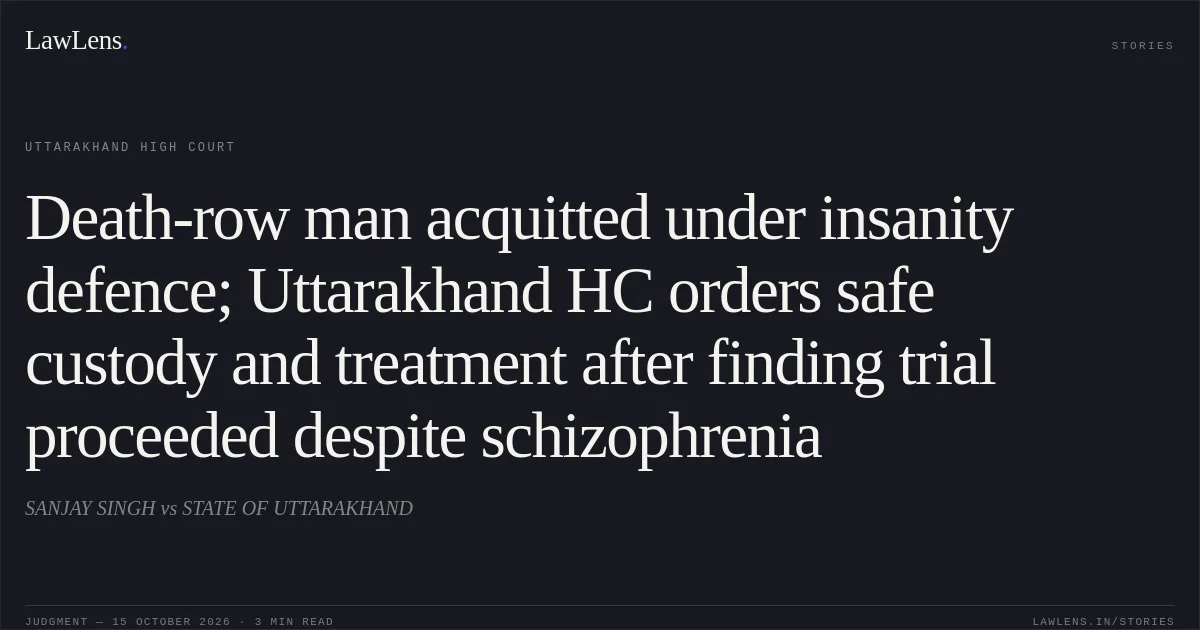
The High Court allowed the appeal, set aside the conviction and sentence, and acquitted Sanjay of the charges under Sections 302, 316 and 201 IPC; it answered the death reference accordingly.
Finding that he continued to suffer from schizophrenia and should not be released, the Court directed his detention in safe custody at the State Mental Health Institute, Selaqui, Dehradun, with treatment until recovery and subsequent accommodation in accordance with the applicable Uttarakhand rules.
Source reference: paras. 50–51(iv)Acts & Sections Cited
21 provisions across 3 statutes referred to in this judgment. Each provision opens on LawLens.
Indian Penal Code, 18604
Code of Criminal Procedure, 1973
Mental Healthcare Act, 20172
Original Court PDF
SANJAY SINGHvsSTATE OF UTTARAKHAND
Click to open original judgment
Original judgment, available to read, download and summarize on LawLens.in