Facts
Bindiyaben, who had married respondent No. 3 approximately four months before the incident, allegedly faced cruelty and harassment from her husband and in-laws, including demands for return of ornaments, physical and mental abuse, and being driven out of the matrimonial home.
Source reference: p.2; para.12She lodged a complaint under Section 498A IPC against the accused before her death.
Source reference: p.2; para.12On 7 May 2012, she allegedly committed suicide by setting herself ablaze with kerosene while at her parental home.
Source reference: p.2; para.12The prosecution case was that the accused’s cruelty and harassment had driven her to suicide, attracting Sections 498A, 306 and 114 IPC.
Source reference: p.2; para.12Following investigation, a charge-sheet was filed and the matter was committed to the Sessions Court as Sessions/Atrocity Case No. 51 of 2012.
Source reference: p.2; paras.2.2–2.3The trial Court acquitted all accused. The State challenged the acquittal under Section 378(1) and (3) CrPC.
Source reference: p.1; para.1Issues
Whether the trial Court was justified in acquitting the accused of offences under Sections 498A, 306 and 114 IPC?
Source reference: p.6; para.11(1)Whether the trial Court properly appreciated the oral and documentary evidence led by the prosecution?
Source reference: p.6; para.11(2)Whether the acquittal suffered from illegality, irregularity or perversity warranting appellate interference?
Source reference: p.6; para.11(3)Whether the prosecution established the requisite cruelty and abetment or instigation connecting the accused with Bindiyaben’s suicide beyond reasonable doubt?
Source reference: pp.9–10; para.15Law Applied
The Court applied Section 498A IPC, including its Explanation defining cruelty as wilful conduct likely to drive a woman to suicide or harassment connected with an unlawful demand.
Source reference: p.9; para.14Section 306 IPC requires proof that the accused abetted the commission of suicide, while Section 107 IPC requires proof of instigation, conspiracy or intentional aid.
Source reference: pp.9–10; para.15The Court also considered the presumptions under Sections 113A and 113B of the Evidence Act, holding that foundational facts connecting the accused’s conduct with the suicide must first be established.
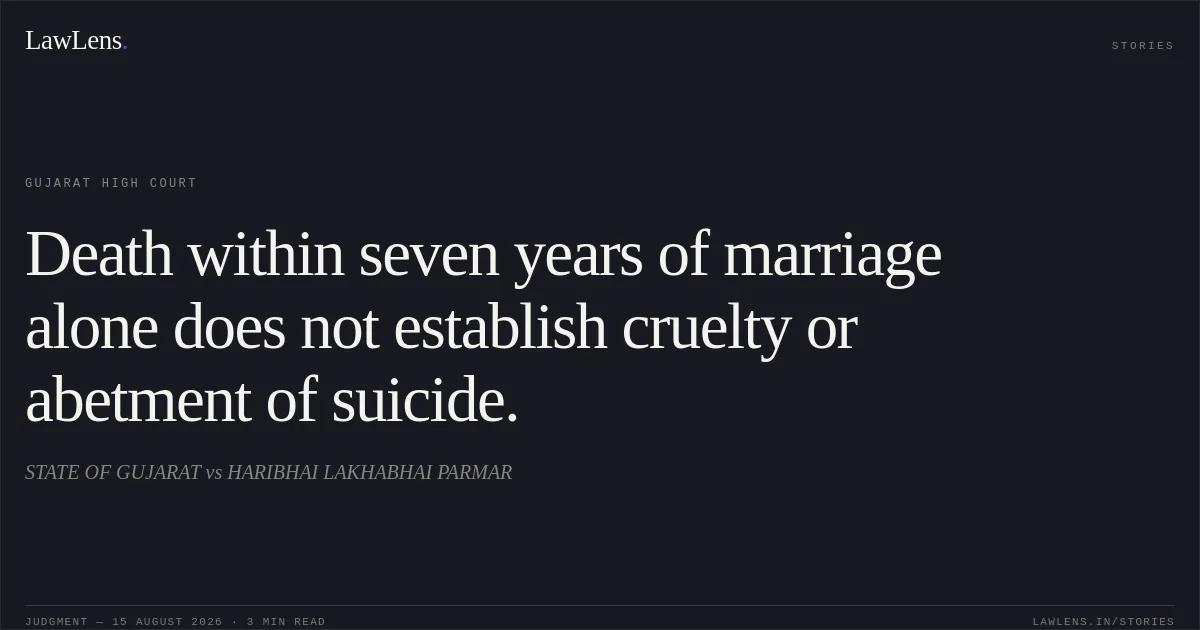
Source reference: p.10; para.15Relying on Ramesh Kumar v. State of Chhattisgarh, Ram Pyarey v. State of Uttar Pradesh and the cited Gujarat decisions, the Court held that suicide within seven years of marriage does not by itself establish offences under Sections 498A or 306 IPC.
Source reference: p.10; para.16On appeals against acquittal, the Court relied on Chandrappa v. State of Karnataka, Rajesh Prasad v. State of Bihar, Babu Sahebagouda Rudragoudar v. State of Karnataka and Ramesh v. State of Karnataka: although the appellate court may reappreciate the evidence, the accused enjoy a reinforced or “double presumption” of innocence, and acquittal should not be disturbed where two reasonable views are possible or absent perversity or manifest illegality.
Source reference: pp.11–14; paras.17–20Reasoning
The Court found that the prosecution failed to establish any specific act of cruelty, instigation or abetment by the accused during the relevant period preceding the suicide.
Source reference: pp.7–10; paras.12, 15The case substantially rested on the evidence of the deceased’s parents, grandmother and a relative, while the panch witnesses did not support the prosecution.
Source reference: p.7; para.12The prosecution also failed to produce independent witnesses from the vicinity of either the matrimonial or parental home.
Source reference: no citationThe Investigating Officers did not adequately verify the prior accidental-death entry, record relevant statements or explain the omission to examine neighbouring witnesses; the Court also noted that the investigation was not supervised in the manner required for a death within seven years of marriage.
Source reference: pp.8–9; para.13In the absence of credible foundational evidence, the statutory presumptions could not be invoked, and the ingredients of Sections 498A, 306 and 114 IPC were not proved beyond reasonable doubt.
Source reference: p.10; para.15Since the trial Court’s view was a reasonable one and was neither perverse nor manifestly illegal, the appellate standard governing acquittals required the High Court to refrain from interference.
Source reference: pp.11–14; paras.17–20Holding
The High Court answered the issues in favour of the accused and held that the prosecution had not proved the charges under Sections 498A, 306 and 114 IPC beyond reasonable doubt.
The State’s appeal against acquittal was dismissed, and the trial Court’s judgment acquitting the respondents was confirmed.
Source reference: p.15; para.23The bail bonds were cancelled and the record and proceedings were directed to be returned to the trial Court.
Source reference: p.15; para.23The Court clarified that its observations would not prejudice the separate prosecution arising from the complaint allegedly lodged by Bindiyaben under Section 498A IPC before the incident.
Source reference: p.15; para.24Acts & Sections Cited
5 provisions across 2 statutes referred to in this judgment. Each provision opens on LawLens.
Code of Criminal Procedure, 19732
Indian Penal Code, 18603
Original Court PDF
STATE OF GUJARATvsHARIBHAI LAKHABHAI PARMAR
Click to open original judgment
Original judgment, available to read, download and summarize on LawLens.in