Facts
The Petitioner was awarded a tender by the Respondents for the supply of paper. It performed part of the contract but admittedly failed to complete the supplies in accordance with the tender conditions.
Source reference: p.3Respondent No. 1 issued a show-cause notice dated 12 March 2026, referring to the alleged contractual lapses and asking why “administrative action” should not be initiated against the Petitioner; the Petitioner replied by email on the same day.
Source reference: p.2Thereafter, Respondent No. 1 passed a Debarment Order dated 13 May 2026, terminating the contract, ordering encashment of the performance security, and debarring the Petitioner for twelve months from participating in any tender issued by India Security Press.
Source reference: p.3Although the Petition initially challenged the termination and encashment as well, the Petitioner confined the proceedings to the challenge against debarment.
Source reference: para. 2, p.2Issues
Whether a general show-cause notice proposing “administrative action” sufficiently apprised the Petitioner that debarment or blacklisting for a specified period was proposed against it?
Source reference: paras. 4–6, pp.3–5Whether the twelve-month debarment order was invalid for breach of the principles of natural justice and the Petitioner’s rights under Articles 14 and 19(1)(g) of the Constitution of India?
Source reference: paras. 4 and 6, pp.3–5Law Applied
Debarment or blacklisting from public procurement has serious civil consequences because it excludes an entity from future dealings with the State and affects its ability to carry on business.
Source reference: para. 6, pp.4–5Relying on Gorkha Security Services v. Government (NCT of Delhi), (2014) 9 SCC 105, and UMC Technologies Private Limited v. Food Corporation of India, (2021) 2 SCC 551, the Court held that a general reference to “administrative action” does not satisfy natural justice where debarment or blacklisting is proposed.
Source reference: para. 6, pp.4–5Reasoning
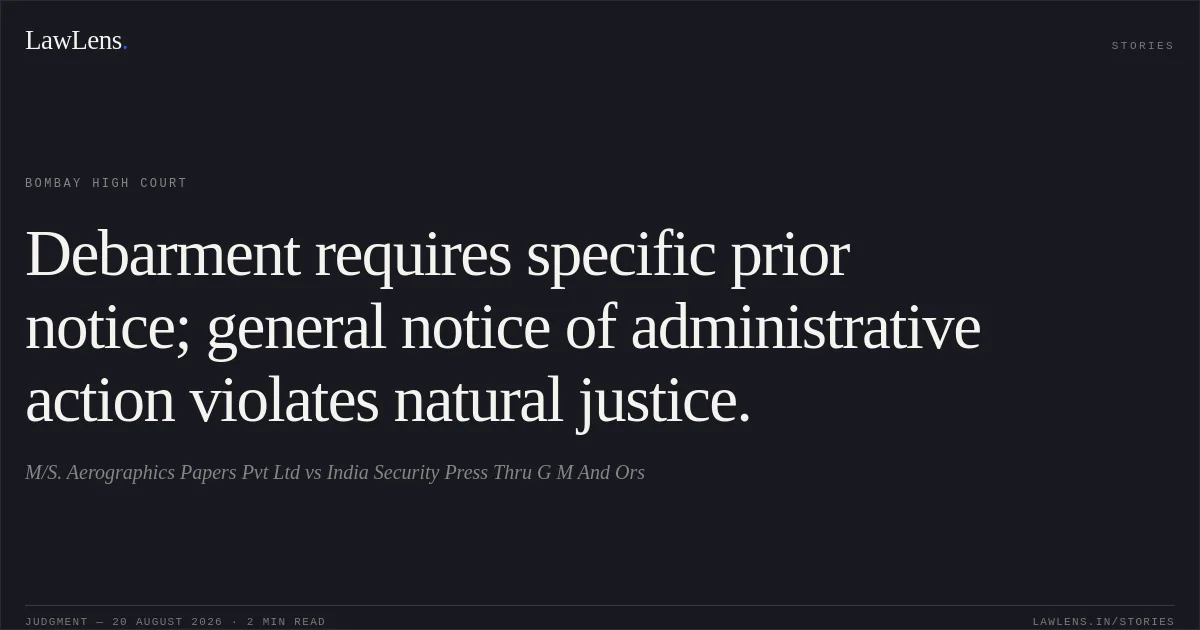
The show-cause notice identified the alleged contractual defaults and asked the Petitioner to explain why administrative action should not be taken, but it did not state that debarment or blacklisting was proposed, nor did it indicate that debarment for twelve months was under consideration.
Source reference: paras. 3 and 6, pp.2, 4–5Since debarment carries consequences substantially more serious than ordinary contractual measures, the Petitioner was entitled to know the specific proposed penalty so that it could effectively address the relevant factors, including the necessity, duration, and proportionality of debarment. The Respondents’ argument that “administrative action” was broad enough to encompass debarment was therefore rejected. The absence of a specific notice rendered the debarment decision contrary to the principles of natural justice.
Source reference: paras. 5–6, pp.4–5Holding
The Court held that the twelve-month debarment was vitiated because the Petitioner had not received a specific notice of the proposed debarment or its duration.
Paragraph 3.3(b) of the Debarment Order was accordingly quashed and set aside.
Source reference: para. 7, p.5The Court expressed no opinion on the validity of the contract termination or encashment of the performance security and left the Petitioner at liberty to pursue appropriate proceedings concerning those actions.
Source reference: para. 8, p.5The Writ Petition was partly allowed, the Rule was made partly absolute, and there was no order as to costs.
Source reference: para. 9, p.6Original Court PDF
M/S. Aerographics Papers Pvt LtdvsIndia Security Press Thru G M And Ors
Click to open original judgment
Original judgment, available to read, download and summarize on LawLens.in