Facts
The petitioner was accused of offences under Section 376 of the Indian Penal Code (IPC) and Section 6 of the POCSO Act following an FIR registered on 14.06.2023
Source reference: para 2, 11After his initial anticipatory bail application was rejected on 20.06.2023, the police conducted multiple unsuccessful raids to locate him
Source reference: para 3, 11Non-Bailable Warrants (NBWs) were issued on 08.08.2023, followed by the initiation of proclamation proceedings under Section 82 of the Cr.P.C. on 18.08.2023
Source reference: para 3While these proceedings were active, the petitioner filed a second anticipatory bail application on 28.08.2023
Source reference: para 4, 12On 12.10.2023, the Sessions Court declared the petitioner a "proclaimed offender"
Source reference: para 1, 4The petitioner challenged this order, arguing that he was pursuing legal remedies (anticipatory bail) and that the alleged offences did not fall under the specific list provided in Section 82(4) of the Cr.P.C.
Source reference: para 7, 10Issues
Whether the pendency of an anticipatory bail application prevents a court from proceeding with or declaring an accused as an absconder under Section 82 of the Cr.P.C.
Source reference: para 10, 14Whether an accused charged with Section 376 IPC and Section 6 POCSO can be declared a "proclaimed offender" under Section 82(4) of the Cr.P.C., given these sections are not specifically enumerated in that sub-section
Source reference: para 10, 17Law Applied
The court primarily applied Section 82 of the Cr.P.C., which governs the proclamation of absconding persons
Source reference: para 18It relied on the Supreme Court precedent in Srikant Upadhyay v. State of Bihar (2024), which established that filing an anticipatory bail application through an advocate does not constitute "appearance" and that, absent interim protection, pendency of such an application is no bar to Section 82 proceedings
Source reference: para 14-15Furthermore, the court applied the distinction between a "proclaimed person" and a "proclaimed offender" as settled in Sanjay Bhandari v. State (NCT of Delhi) (2018) and Avinash Singh v. State (2024), noting that the status of "proclaimed offender" is strictly reserved for those accused of offences specifically listed in Section 82(4) of the Cr.P.C.
Source reference: para 20-21Reasoning
The court rejected the petitioner’s first contention, reasoning that the mere filing of successive anticipatory bail applications cannot be used as a ruse to evade arrest or stay proclamation proceedings.
Source reference: para 13-15Citing Srikant Upadhyay, the court noted that the petitioner failed to physically appear before the trial court by the returnable date of the proclamation (26.09.2023), and the pendency of a bail plea offered no legal immunity from being declared an absconder
Source reference: para 13-15Regarding the second contention, the court conducted a statutory examination of Section 82(4) Cr.P.C., which lists specific heinous offences (e.g., Sections 302, 392, 436 IPC) for which an accused may be declared a "proclaimed offender"
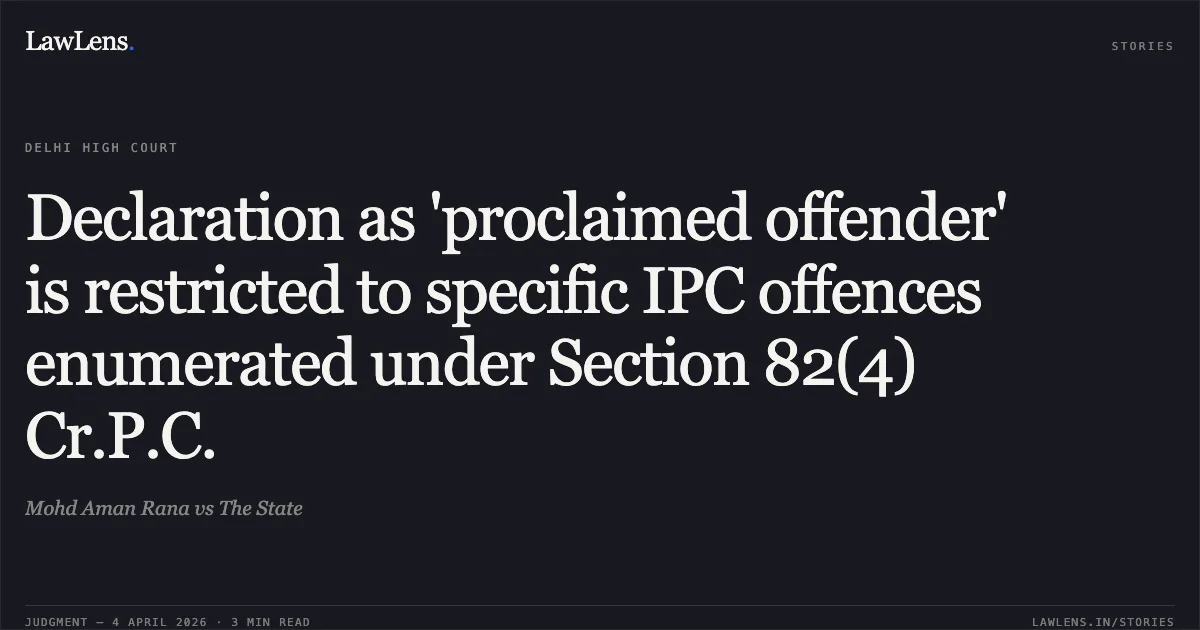
Source reference: para 18-19Since Section 376 IPC and Section 6 POCSO are not included in this exhaustive list, the court determined that the Sessions Court exceeded its jurisdiction by labeling the petitioner a "proclaimed offender" instead of a "proclaimed person"
Source reference: para 22-23Holding
The court partially allowed the petition by modifying the impugned order dated 12.10.2023.
It held that while the petitioner was indeed evading the process of law, he could only be declared a "proclaimed person" and not a "proclaimed offender" because the charged offences are absent from the list in Section 82(4) Cr.P.C.
Source reference: para 23The court clarified that this modification does not interfere with any existing or potential actions against the petitioner under Section 174A IPC for failing to appear in response to the proclamation
Source reference: para 24-25Acts & Sections Cited
26 provisions across 3 statutes referred to in this judgment. Each provision opens on LawLens.
Indian Penal Code, 1860
Code of Criminal Procedure, 19734
Protection of Children from Sexual Offences Act, 20121
Original Court PDF
Mohd Aman RanavsThe State
Click to open original judgment
Original judgment, available to read, download and summarize on LawLens.in


![Subsequent exoneration does not retrospectively invalidate a finalized promotion select list.. UNNIKRISHNAN M vs M/o Environment And Forests. CAT - ['Ernakulam']. LawLens](/stories/thumbnails/subsequent-exoneration-does-not-retrospectively-invalidate-a-finalized-promotion-select-li-ce80a0e84f2f4887857271e8b4341c42.webp)