Facts
The Appellants (plaintiffs) filed a suit for declaration of title and permanent injunction regarding ‘A’ schedule properties, claiming ownership based on a registered Will dated 19.10.2007 executed by Govindhasamy Gounder
Source reference: para 2The Will allegedly granted the 1st Defendant (Pattammal) a life estate with a vested remainder to the Appellants
Source reference: para 11The 1st Defendant challenged the Will, asserting her absolute ownership via a 1964 Settlement Deed from her father, Manicka Gounder
Source reference: para 4During the pendency of the suit, the 1st Defendant sold parts of the property (‘B’ and ‘C’ schedules) to Defendants 2 and 3
Source reference: para 2Both the Trial Court and First Appellate Court dismissed the suit, finding that the testator (Govindhasamy) did not have absolute title to the properties
Source reference: paras 5-6Issues
1. Whether the Courts below were right in dismissing the suit in its entirety, given that the Settlement Deed purportedly granted 1/2 share to the testator, Govindhasamy, thereby entitling the Appellants to at least that share based on his Will?
Source reference: para 72. Whether additional evidence (a 1971 Partition Deed) should be admitted at the second appeal stage under Order 41 Rule 27 of the CPC?
Source reference: para 17Law Applied
The Court applied Section 100 of the Code of Civil Procedure (CPC) regarding the scope of Second Appeals
Source reference: p.1It relied on the principle of spes successionis, holding that a future interest or chance of succession cannot be treated as a present interest in property for the purpose of a title declaration
Source reference: para 12Regarding additional evidence, the Court applied Order 41 Rule 27 of the CPC, which requires a showing of due diligence or necessity for the court to pronounce judgment
Source reference: para 17furthermore, it followed the precedent in Iqbal Ahmed (Dead) by Lrs. & Anr. vs. Abdul Shukoor (2025 INSC 1027), establishing that evidence cannot be considered without a corresponding foundational plea in the pleadings
Source reference: para 18Reasoning
The Court observed that the Settlement Deed (Ex.B2) granted Govindhasamy and Pattammal joint rights, making Govindhasamy a co-owner of only specific items (1, 4, 5, and 7) rather than the absolute owner of the entire ‘A’ schedule
Source reference: paras 13-14Consequently, he could not validly bequeath absolute title to the Appellants
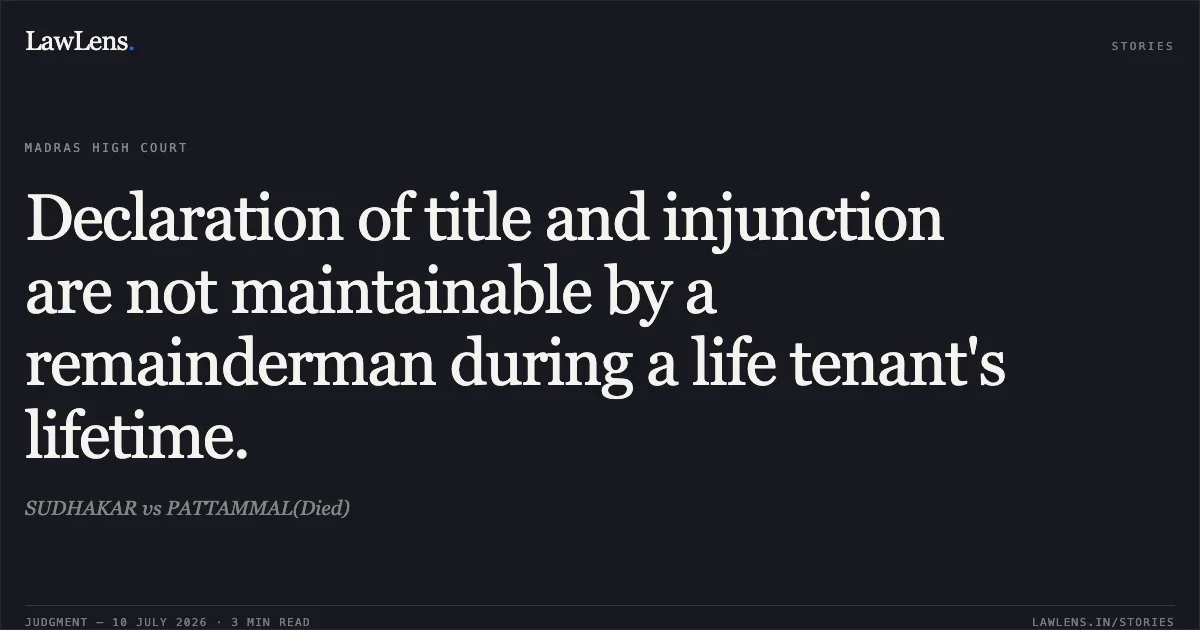
Source reference: para 14The court reasoned that since the life estate holder (1st Defendant) was alive at the time of the suit, the Appellants held only a spes successionis, which does not support a maintainable suit for declaration of title
Source reference: para 12Regarding the application for additional evidence (C.M.P.No.7283 of 2026), the Court noted the Appellants possessed the 1971 Partition Deed since 2013 but failed to exercise due diligence to mark it earlier
Source reference: para 17Furthermore, as there was no plea in the plaint regarding the "blending" of properties or "common hotchpot," the document could not be admitted to support a brand-new legal theory
Source reference: para 19Holding
The High Court dismissed the Second Appeal and the petition for additional evidence
The Court held that the Appellants failed to prove exclusive title to the suit properties and could not maintain a suit for declaration based on a future interest while the life tenant was alive
Source reference: paras 12, 14The Court clarified that the dismissal does not preclude the Appellants from filing a fresh suit for partition against the natural heirs of the deceased Pattammal to claim their 1/2 share in the specific properties covered by the Settlement Deed
Source reference: paras 15, 21No costs were ordered
Source reference: para 21Acts & Sections Cited
2 provisions across 1 statute referred to in this judgment. Each provision opens on LawLens.
Code of Civil Procedure, 19082
Original Court PDF
SUDHAKARvsPATTAMMAL(Died)
Click to open original judgment
Original judgment, available to read, download and summarize on LawLens.in


![Subsequent exoneration does not retrospectively invalidate a finalized promotion select list.. UNNIKRISHNAN M vs M/o Environment And Forests. CAT - ['Ernakulam']. LawLens](/stories/thumbnails/subsequent-exoneration-does-not-retrospectively-invalidate-a-finalized-promotion-select-li-ce80a0e84f2f4887857271e8b4341c42.webp)