Facts
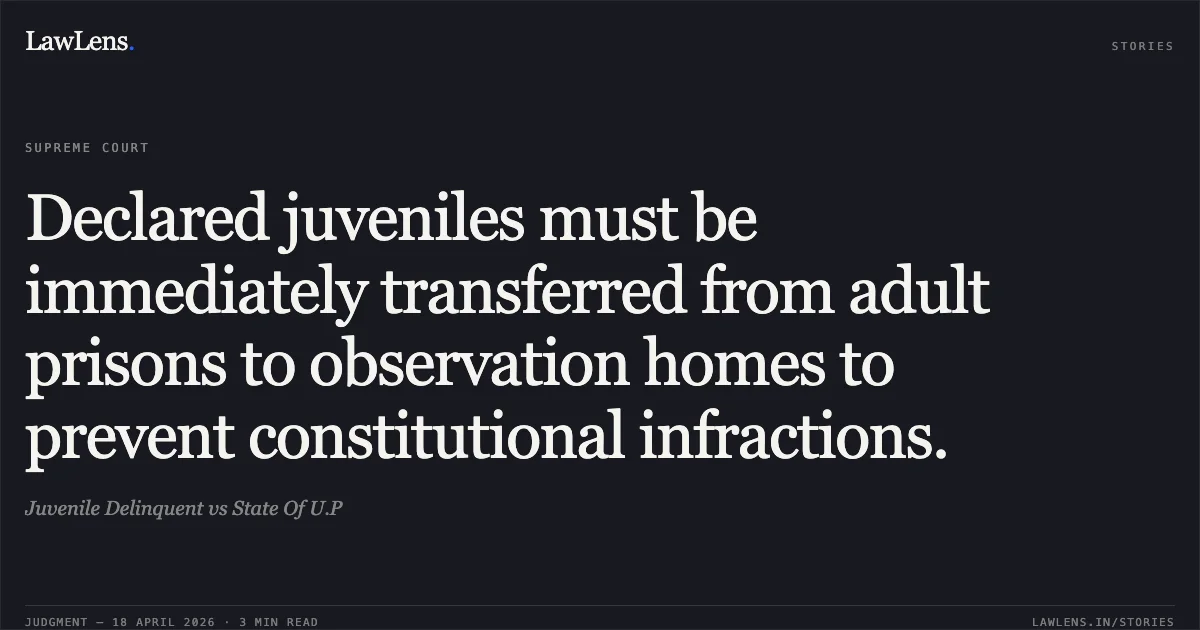
The appellant was declared a juvenile by the Juvenile Justice Board (JJB), Agra, on June 23, 2023, as he was 16 years, 11 months, and 21 days old on the date of the alleged offense (double murder and robbery)
Source reference: para 4Despite this declaration, the appellant remained incarcerated in a regular adult jail for over two and a half years
Source reference: para 7His bail applications were successively rejected by the JJB, the Special Additional Sessions Judge, and the Allahabad High Court
Source reference: paras 3, 5, 6The lower courts justified the denial of bail based on the "heinous" nature of the crime and the apprehension that the appellant might associate with criminals or face moral danger if released
Source reference: paras 3, 5During the Supreme Court proceedings, the State admitted the lapse in transferring the juvenile to an observation home and agreed to pay ₹5 lakhs in compensation for the wrongful detention
Source reference: para 10-11Issues
1. Whether the High Court and lower courts were justified in denying bail to a declared juvenile based primarily on the nature of the offense and perceived moral danger
Source reference: para 7, 122. Whether the continued detention of a declared juvenile in a regular adult jail violates Article 21 of the Constitution and the mandate of the Juvenile Justice (Care and Protection of Children) Act, 2015
Source reference: para 10, 223. What is the mandatory procedure under the JJ Act for determining whether a juvenile between 16 and 18 years should be tried as an adult
Source reference: para 15-16Law Applied
The Court primarily applied the Juvenile Justice (Care and Protection of Children) Act, 2015 (JJ Act).
Source reference: no citationSection 12 mandates that a juvenile shall generally be released on bail unless specific disqualifications exist
Source reference: para 5Sections 15, 18, and 19 establish a mandatory two-tiered assessment (preliminary assessment by the JJB and independent evaluation by the Children’s Court) to determine if a child aged 16–18 should be tried as an adult for a heinous offense
Source reference: paras 15-16The Court also relied on Article 21 of the Constitution regarding the right to life and liberty and the doctrine of "Constitutional Tort" for awarding compensation for wrongful detention
Source reference: paras 10, 22Reasoning
The Court noted that the JJB and lower courts disregarded the District Probation Officer’s (DPO) report, which found the appellant’s behavior normal and suggested reform through a "positive family environment" rather than detention
Source reference: para 17-18The High Court’s conclusion that the appellant was being tried as an adult was found to be legally erroneous because no preliminary assessment under Section 15 or transfer order under Section 18(3) had been passed
Source reference: para 14, 21The Court reasoned that once a person is declared a juvenile, the statutory framework focusing on rehabilitation and reformative measures must prevail, and the "disgusting" nature of the offense cannot be the sole ground for detention unless the Section 15 assessment process is followed
Source reference: para 19-20The Court criticized the systemic "insensitivity" of the stakeholders, holding that the failure to transfer a declared juvenile from a regular jail to an observation home is a grave violation of fundamental rights
Source reference: para 22Holding
The Supreme Court allowed the appeal and set aside the High Court’s order
The Court confirmed the appellant's release on bail and recorded the State’s compliance in paying ₹5 lakhs as compensation for the constitutional tort committed against the juvenile
Source reference: para 10-11The Court directed the Registry to circulate the judgment and the Standard Operating Procedure (SOP) prepared by the Allahabad High Court to all Chief Justices of High Courts, Chief Secretaries of States, and Judicial Academies to ensure the prompt transfer of juveniles from adult jails to observation homes and to sensitize judicial officers
Source reference: paras 24-26Acts & Sections Cited
6 provisions across 1 statute referred to in this judgment. Each provision opens on LawLens.
Juvenile Justice (Care and Protection of Children) Act, 2015.6
Original Court PDF
Juvenile DelinquentvsState Of U.P
Click to open original judgment
Original judgment, available to read, download and summarize on LawLens.in