Facts
Rameshwar, the respondent/decree-holder, instituted a suit for specific performance of an agreement to sell dated 20 January 2015 concerning a 200-square-yard residential property at Palwal. The total sale consideration was ₹60,00,000, of which ₹40,00,000 had allegedly been paid, leaving ₹20,00,000 payable at the time of execution of the sale deed.
Source reference: p.2, para. 2The suit was decreed in favour of Rameshwar on 8 May 2024. The decree was affirmed by the District Judge on 24 April 2026 and by the High Court in RSA No. 1855 of 2026 on 13 May 2026.
Source reference: p.2, para. 2.1During execution, Rameshwar discovered that the property had been mortgaged in 2010 by the petitioner’s son, Pratap Singh, with the Faridabad District Primary Co-operative Agriculture and Rural Development Bank Limited. An outstanding amount of ₹14,90,515 was due to the bank, and the original sale deed was in the bank’s possession.
Source reference: pp.2–3, paras. 2.2–2.3Rameshwar therefore sought permission to pay ₹14,90,515 directly to the bank out of the balance sale consideration and to deposit the remaining ₹3,10,685 after adjustment of execution costs of ₹1,98,800.
Source reference: pp.3–5, para. 7The Executing Court allowed the application, holding that clearance of the mortgage was necessary for execution and registration of the sale deed.
Source reference: pp.5–8, paras. 8–13Leelawati challenged that order under Article 227 of the Constitution.
Source reference: p.1, para. 1Issues
Whether the Executing Court was justified in permitting the decree-holder to pay the outstanding mortgage liability directly to the bank and to adjust that payment against the balance sale consideration.
Source reference: pp.8–10, paras. 8–10Whether the decree-holder’s failure to deposit the balance sale consideration within the three-month period stipulated in the decree rendered the decree for specific performance incapable of execution.
Source reference: pp.6–8, paras. 9–12Whether interference under Article 227 was warranted with the Executing Court’s order permitting payment of the mortgage amount and deposit of the remaining balance consideration.
Source reference: p.1, para. 1; p.10, para. 10Law Applied
The Court applied the principle that a final decree for specific performance must be implemented in its true letter and spirit and that an existing encumbrance preventing execution and registration of the sale deed may be cleared from the balance sale consideration where necessary to give effect to the decree.
Source reference: pp.8–10, paras. 8–9.1Section 28 of the Specific Relief Act, 1963 was relied upon for the proposition that the Court has discretion to extend the time for payment of the balance consideration and that mere delay does not automatically result in rescission or render a decree inexecutable.
Source reference: p.6, para. 9The Court also referred to Dr. Amit Arya v. Kamlesh Kumari, Ram Lal v. Jarnail Singh, and Anand Narayan Shukla v. Jagat Dhari for the principle that delay in depositing the balance consideration is not decisive unless the decree-holder’s conduct demonstrates abandonment or a positive refusal to perform.
Source reference: pp.6–7, para. 11The equitable principle that a party cannot take advantage of its own wrong was applied where the judgment-debtor had failed to disclose the subsisting mortgage.
Source reference: pp.7–8, para. 12; p.9, para. 9.1The scope of Article 227 required the Court to determine whether the Executing Court’s order called for supervisory interference.
Source reference: p.1, para. 1Reasoning
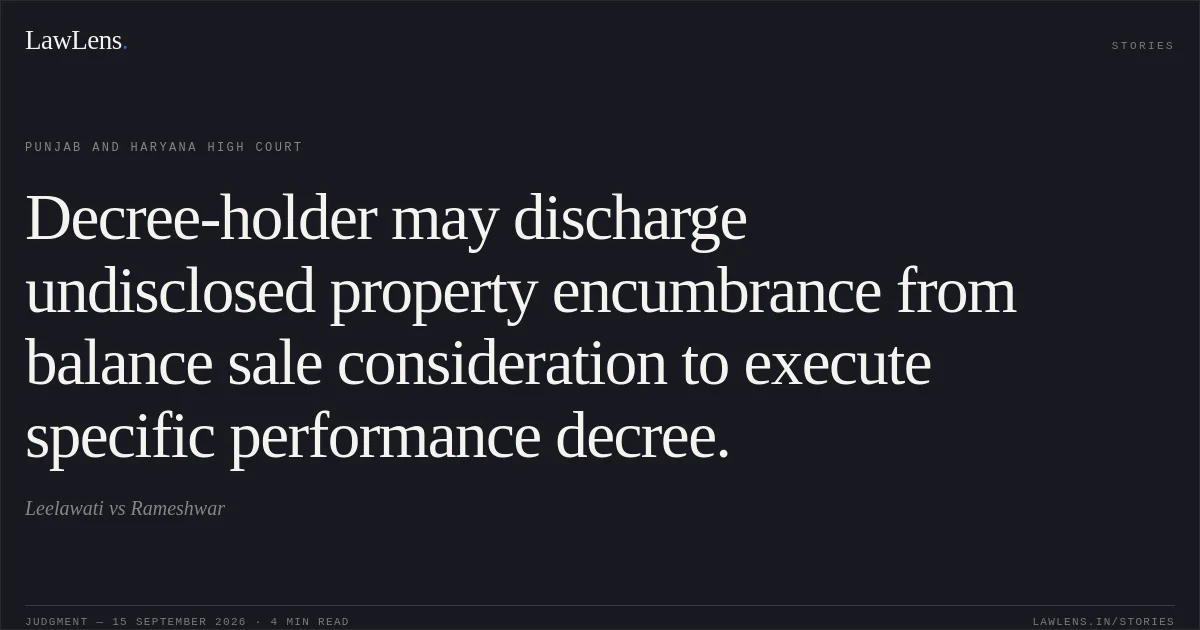
The High Court held that the mortgage created a continuing lien over the property and materially obstructed execution of the decree and registration of the sale deed.
Source reference: pp.8–10, paras. 8–9Since the petitioner had not discharged the loan liability, permitting the decree-holder to pay ₹14,90,515 directly to the bank was a practical means of implementing the decree, with the payment being adjusted against the ₹20,00,000 balance sale consideration.
Source reference: pp.8–10, paras. 8–9The Court further found that the petitioner had not disclosed the encumbrance in the agreement, during trial, or in the appellate proceedings, and therefore could not rely on the resulting impediment to defeat execution.
Source reference: p.9, para. 9.1The decree-holder’s conduct did not establish abandonment: he had already paid a substantial part of the consideration, initiated execution shortly after the decree, and consistently asserted that the petitioner had failed to cooperate.
Source reference: pp.6–7, para. 11Accordingly, the delay in depositing the balance consideration did not justify withholding execution, particularly when the decree had attained finality and the petitioner’s own conduct had contributed to the difficulty.
Source reference: pp.6–10, paras. 9–12Holding
The High Court answered the issues against Leelawati and held that the Executing Court had acted lawfully in permitting Rameshwar to pay the outstanding bank loan of ₹14,90,515 directly to the concerned bank and to deposit the remaining ₹3,10,685 after adjustment of the execution costs and loan payment.
The Court found no ground for interference under Article 227, dismissed the civil revision petition, and directed that all pending applications, if any, stand closed.
Source reference: p.10, paras. 10–12Acts & Sections Cited
1 provisions across 1 statute referred to in this judgment. Each provision opens on LawLens.
Specific Relief Act, 19631
Original Court PDF
LeelawativsRameshwar
Click to open original judgment
Original judgment, available to read, download and summarize on LawLens.in


![Subsequent exoneration does not retrospectively invalidate a finalized promotion select list.. UNNIKRISHNAN M vs M/o Environment And Forests. CAT - ['Ernakulam']. LawLens](/stories/thumbnails/subsequent-exoneration-does-not-retrospectively-invalidate-a-finalized-promotion-select-li-ce80a0e84f2f4887857271e8b4341c42.webp)