Facts
The petitioner (Assignee) entered into a Deed of Copyright Assignment with M/s Rasoi Limited (Assignor) on September 25, 2014, for the transfer of 16 artistic works and 12 registered copyright works for a consideration of Rs. 9 Crores.
Source reference: p. 6, 14At the time of registration, the respondent authorities accepted the valuation but granted a stamp duty exemption under Article 23, Schedule IA of the Indian Stamp Act, 1899, charging only a nominal fee of Rs. 300.
Source reference: p. 7Subsequently, based on an audit objection from the Accountant General—which claimed exemption was only for assignments "by entry"—the respondent no. 1 (DIG of Registration) issued a notice in December 2017 to determine deficit stamp duty.
Source reference: p. 3, 19The respondent no. 1 and later the Appellate Authority (respondent no. 3) directed the petitioner to pay a deficit stamp duty of Rs. 53,99,700, alleging insufficient proof of registration and improper invocation of the exemption.
Source reference: p. 4, 11Issues
1. Whether the respondent authorities were justified in invoking Section 47A of the Indian Stamp Act to demand deficit stamp duty after the deed had been registered and the valuation accepted.
Source reference: p. 3-4, 182. Whether an assignment of copyright in writing under Sections 18 and 19 of the Copyright Act, 1957, is entitled to stamp duty exemption under Article 23 of Schedule IA of the Indian Stamp Act, 1899.
Source reference: p. 4, 19, 23Law Applied
Sections 18 and 19 of the Copyright Act, 1957, stipulate that a copyright assignment is valid if it is in writing and signed by the assignor.
Source reference: p. 12-13Article 23, Schedule IA of the Indian Stamp Act, 1899, provides a specific exemption from stamp duty for the "Assignment of copyright by entry made under the Copyright Act, 1957".
Source reference: p. 19Section 47A of the Indian Stamp Act (West Bengal Amendment) allows for the determination of market value only when the registering officer has reason to believe the property has been undervalued at the time of registration.
Source reference: p. 7-10The doctrine in Residents Welfare Association Noida v. State of Uttar Pradesh (2009) emphasizes that Section 47A requires a finding of an "attempt of undervaluation".
Source reference: p. 18Reasoning
The court found that at the time of registration in 2015, the authorities had accepted the market value of Rs. 9 Crores and granted the exemption.
Source reference: p. 11The subsequent invocation of Section 47A(5) by the respondent no. 1 was deemed arbitrary because there was no dispute regarding the market value; the dispute was purely on the legal eligibility for exemption.
Source reference: p. 18-19The court rejected the Accountant General’s interpretation that the exemption only applied to assignments "by entry," noting that the expression was a carry-over from the 1847 Act and must be read in harmony with the current Mode of Assignment under Section 19 of the 1957 Act, which requires a written, signed instrument.
Source reference: p. 4, 22The petitioner had provided sufficient evidence of registration through Schedule 1 and 2 of the Deed and supplementary affidavits, which the Appellate Authority failed to properly consider or verify through notice.
Source reference: p. 23-24Holding
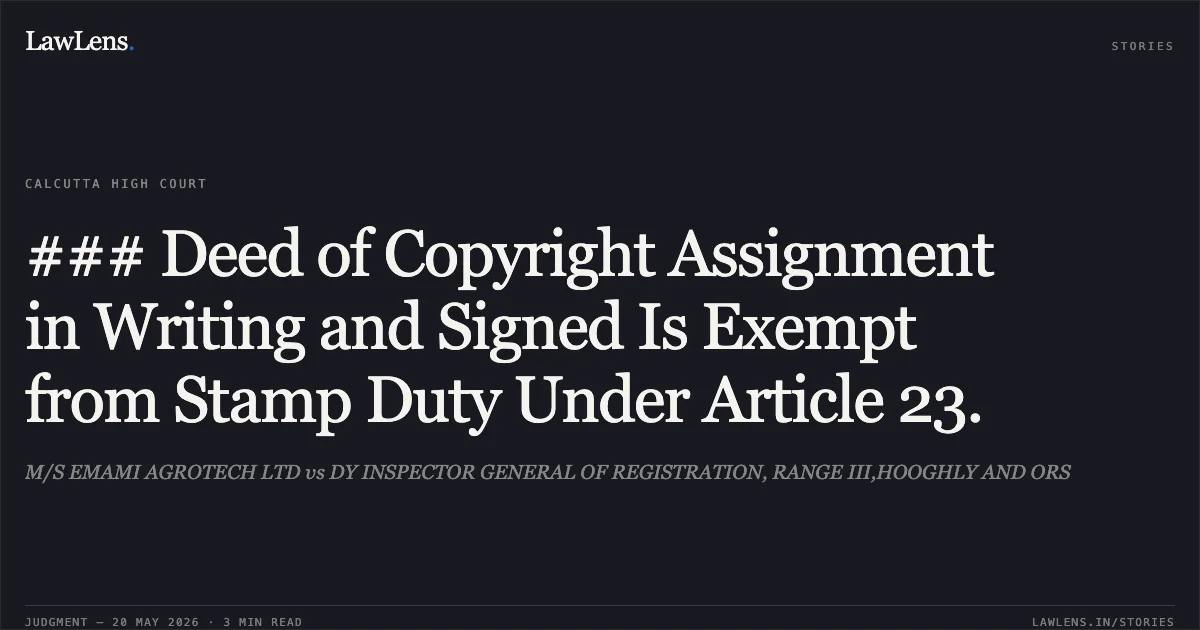
The court held that since the petitioner complied with Sections 18 and 19 of the Copyright Act, 1957, the Deed of Assignment was squarely covered by the exemption under Article 23, Schedule IA of the Indian Stamp Act.
The court concluded that the authorities cannot invoke Section 47A to recover deficit duty where valuation is not in doubt and a valid statutory exemption applies, and accordingly quashed the orders dated September 13, 2018, and March 10, 2022.
Source reference: p. 18, 25Acts & Sections Cited
5 provisions across 2 statutes referred to in this judgment. Each provision opens on LawLens.
Copyright Act, 19572
Indian Stamp Act, 18993
Original Court PDF
M/S EMAMI AGROTECH LTDvsDY INSPECTOR GENERAL OF REGISTRATION, RANGE III,HOOGHLY AND ORS
Click to open original judgment
Original judgment, available to read, download and summarize on LawLens.in