Facts
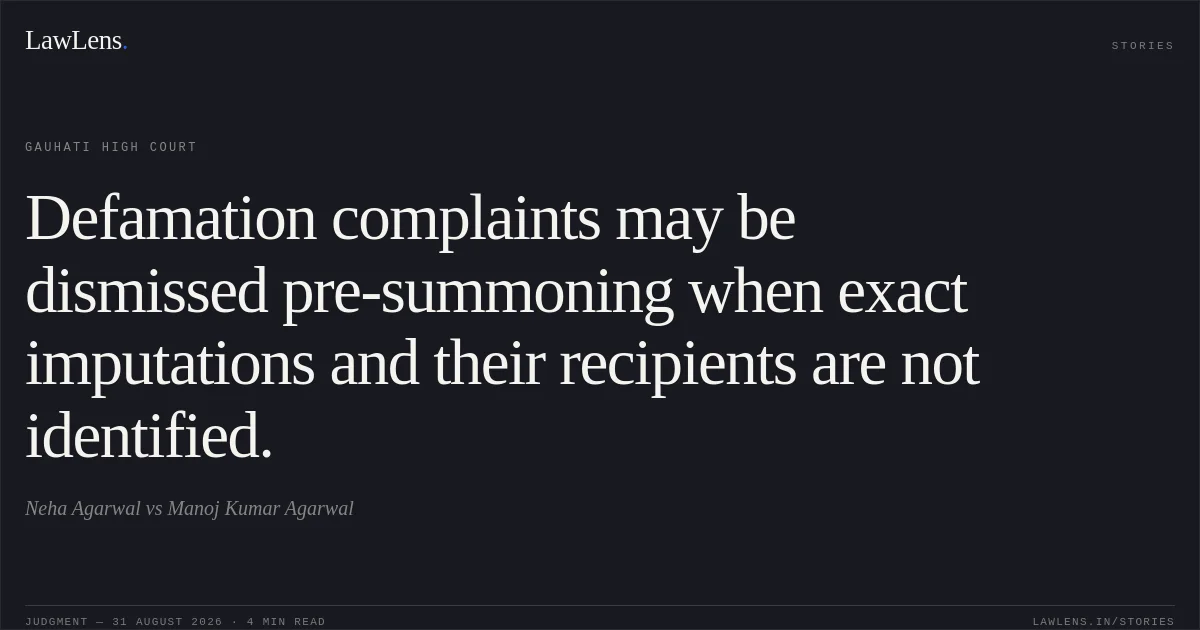
The petitioner filed a complaint under Sections 499, 500 and 501 of the Indian Penal Code against her brother-in-law, alleging that he made defamatory statements questioning the paternity of her minor daughter and imputing illicit relations to her, thereby damaging her reputation and that of her family.
Source reference: p.2, para. 3The complaint also referred to several alleged incidents between 2012 and 2024 involving threats, character assassination, interference in her marriage and other acts of harassment.
Source reference: p.2, para. 3During examination under Section 200 CrPC and further inquiry under Section 202 CrPC, the complainant and her father primarily deposed that the respondent had stated to others that the complainant’s husband was not the father of her daughter. The persons who allegedly heard the statements were not examined.
Source reference: p.2–3, para. 4The Special Judicial Magistrate dismissed the complaint under Section 203 CrPC, finding that the allegations were not adequately supported, that the exact words, dates, places and recipients of the alleged statements were not specified, and that there was no material to attract Section 501 IPC. The Magistrate also considered that statements made in judicial pleadings could fall within Exceptions 8 and 9 to Section 499 IPC.
Source reference: p.3–4, paras. 5–6Issues
1. Whether a Magistrate may dismiss a complaint under Section 203 CrPC after considering not only the complaint but also the statements recorded under Sections 200 and 202 CrPC, even where the complaint alleges a prima facie offence.
Source reference: p.4, para. 7; p.9–10, paras. 16–192. Whether a Magistrate may, at the stage of taking cognizance or issuing process, suo motu consider whether an Exception to Section 499 IPC is clearly attracted.
Source reference: p.5, para. 10; p.10, para. 20Law Applied
The Court applied Sections 499, 500 and 501 IPC, requiring, respectively, defamatory imputation, the resulting offence of defamation and printing or engraving of defamatory matter.
Source reference: p.8–9, para. 15Under Sections 200 and 202 CrPC, the Magistrate must examine the complainant and witnesses and may conduct an inquiry to determine whether sufficient ground exists for proceeding; under Section 203 CrPC, the complaint may be dismissed with reasons if such ground is absent, while Section 204 CrPC governs issuance of process.
Source reference: p.8–9, para. 15Fiona Shrikhande v. State of Maharashtra, (2013) 14 SCC 44, and Kamal Shivaji Pokarnekar v. State of Maharashtra, (2019) 14 SCC 350, establish that the Magistrate must determine whether a prima facie case and sufficient ground for proceeding exist, without conducting a mini-trial.
Source reference: p.8–9, para. 15Dilip Kumar v. Brajraj Shrivastava, (2024) 14 SCC 295, Pepsi Foods Ltd. v. Special Judicial Magistrate, (1998) 5 SCC 749, Mehmood Ul Rehman v. Khazir Mohammad Tunda, (2015) 12 SCC 420, and Nagawwa v. Veeranna Shivalingappa Konjalgi, (1976) 3 SCC 736, require consideration of the complaint, supporting evidence and the complainant’s witnesses at the pre-process stage.
Source reference: p.8–9, para. 15M/s Iveco Magirus Brandschutztechnik GmbH v. Nirmal Kishore Bhartiya, (2024) 2 SCC 86, recognises that a Magistrate is not barred from considering a complete defence under an Exception to Section 499 IPC where it is apparent from the complaint and supporting material.
Source reference: p.12–14, paras. 24–28The Court also relied on the principle that communications made to lawful authorities may attract privilege where the maker and recipient have corresponding interests or duties.
Source reference: p.12–14, paras. 24–28Reasoning
The Court held that the authorities cited by the petitioner did not prevent the Magistrate from examining the complainant’s and witnesses’ depositions. The statutory scheme under Sections 200, 202 and 203 CrPC expressly requires the Magistrate to assess whether the evidence discloses sufficient ground for proceeding; the inquiry is limited and does not amount to adjudication of guilt, but the Magistrate is not a passive recipient of the preliminary evidence.
Source reference: p.9–10, paras. 16–19Applying that standard, the Court found that the complainant’s evidence and her father’s testimony did not adequately establish the alleged defamatory publications. The exact words, dates, places and identities of the persons who allegedly heard the statements were not specified, and none of those persons was examined. In a complaint based on oral defamation, the absence of testimony from the alleged recipients materially weakened the prima facie case.
Source reference: p.14, para. 28As to the statement allegedly made in the respondent’s earlier court complaint concerning the absence of a conjugal relationship, the impugned complaint did not provide sufficient context, the earlier complaint was not annexed, and the complainant’s evidence did not even refer to that statement. Consequently, there was no sufficient ground to proceed, irrespective of whether an Exception to Section 499 IPC applied.
Source reference: p.11–12, paras. 20–22The Court further observed that statements made in pleadings or complaints before lawful authorities should not ordinarily invite a separate defamation prosecution while the original proceedings remain pending, particularly where the maker may establish the truth and bona fides of the allegations.
Source reference: p.12–14, paras. 22–28Holding
The Court answered the first issue in the affirmative: a Magistrate may dismiss a complaint under Section 203 CrPC after considering the complaint, the statements under Sections 200 and 202 CrPC, and the supporting material, even if the complaint superficially alleges an offence.
The second issue was not required to be conclusively answered because the alleged statement in the earlier court complaint itself did not disclose sufficient ground to proceed, independent of any statutory exception.
Source reference: p.12, para. 27Finding no infirmity in the Magistrate’s order, the Gauhati High Court dismissed the revision petition and directed that the trial court record be returned.
Source reference: p.14, paras. 28–30Acts & Sections Cited
8 provisions across 2 statutes referred to in this judgment. Each provision opens on LawLens.
Indian Penal Code, 18603
Code of Criminal Procedure, 19735
Original Court PDF
Neha AgarwalvsManoj Kumar Agarwal
Click to open original judgment
Original judgment, available to read, download and summarize on LawLens.in