01Facts
The suit concerned partition of property bearing No. B-268, Saraswati Vihar, Pitampura, Delhi, originally acquired by Ram Ratan Garg, who died in 2007.
p. 2His widow, Maya Devi, subsequently died in 2020.
p. 2The plaintiffs, being the widow and children of Anil Kumar Garg—one of the sons of Ram Ratan Garg and Maya Devi—claimed a one-fourth share on the basis of intestate succession under Section 8 of the Hindu Succession Act, 1956.
p. 2The defendants relied on two Wills: a registered Will dated 24 April 2001 allegedly executed by Ram Ratan Garg in favour of Maya Devi, and a registered Will dated 20 December 2017 allegedly executed by Maya Devi in favour of Defendant Nos. 1 and 2.
p. 2The plaintiffs sought declaration that the Wills were null, void, forged and not binding, along with partition, possession and injunction.
p. 2The Court framed issues requiring the defendants to prove the valid execution and testamentary capacity of the respective testators under the two Wills, while placing the onus of the partition and declaratory relief issues on the plaintiffs.
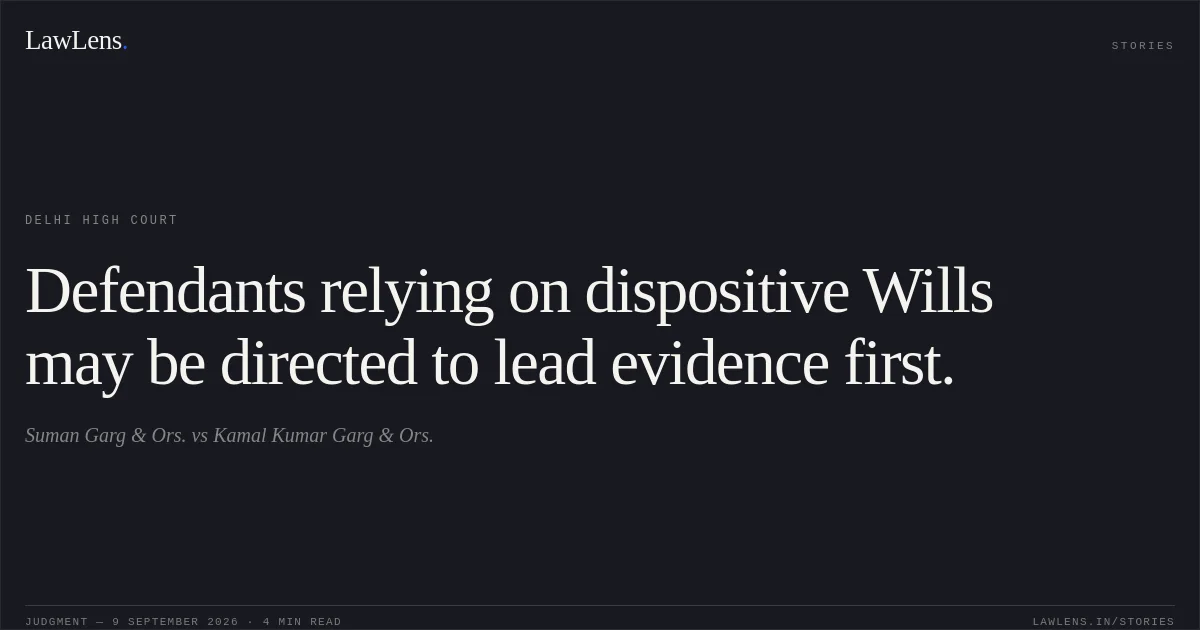
p. 3The present appeal challenged the Joint Registrar’s order directing the plaintiffs to lead evidence first.
pp. 1, 3–402Issues
i.Whether, in a partition suit where the defendants rely exclusively on Wills to defeat the plaintiffs’ claim, the defendants should be directed to lead evidence first under Order XVIII Rule 1 CPC?
pp. 1, 5–8ii.Whether the fact that the Wills were unprobated, probate not being compulsory in Delhi, required the plaintiffs to lead evidence first?
pp. 3–4, 11–12iii.Whether the issues framed by the Court, which placed the burden of proving the validity of both Wills on the defendants, governed the sequence of evidence?
pp. 3, 8–1103Law Applied
The Court applied Order XVIII Rule 1 CPC, which gives the plaintiff the right to begin but permits the defendant to begin where the defendant’s pleaded additional facts or legal case, if proved, would defeat the plaintiff’s relief.
p. 5Relying on Jami Venkata Suryaprabha v. Tarini Prasad Nayak, Poonam Bhanot v. Virender Sharma, and Achala Mohan v. Jayashree Singh, the Court held that the rule is not an inflexible obligation to call upon the plaintiff first; where the defendant’s plea strikes at the root of the controversy and may substantially dispose of the suit, the defendant may be directed to lead evidence first.
pp. 5–8Under Section 63 of the Indian Succession Act, 1925 read with the applicable provision of the Bharatiya Sakshya Adhiniyam, 2023, a Will must be proved through examination of at least one attesting witness, and registration does not dispense with that requirement.
p. 9The propounder bears the initial burden of proving due execution, the testator’s sound and disposing mind, testamentary capacity and voluntariness, and must dispel suspicious circumstances, as stated in H. Venkatachala Iyengar v. B.N. Thimmajamma and Kavita Kanwar v. Pamela Mehta.
pp. 9–11Sections 104 and 105 of the Bharatiya Sakshya Adhiniyam, 2023 place the burden on the party asserting facts necessary to obtain judgment and on the party who would fail if no evidence were led.
p. 11Provisions in the judgment · 6 · Linked ones open on LawLens
Code of Civil Procedure, 1908 Section 151
Hindu Succession Act, 1956 Section 8
Indian Succession Act, 1925 Section 63
Bharatiya Sakshya Adhiniyam, 2023 Section 67Section 104Section 105
04Reasoning
The Court held that the real controversy was not the plaintiffs’ status as heirs or the basic facts concerning the property and family relationship, but the validity and legal effect of the two Wills relied upon by the defendants.
p. 8, 11Issues A and B expressly placed the onus of proving the Wills on the defendants.
p. 8, 11Since the defendants’ success in proving the Wills would substantially or completely defeat the plaintiffs’ claim for partition, their case was analogous to the situations addressed in Poonam Bhanot and Achala Mohan, where the defendant was directed to lead evidence first.
pp. 6–9The Court rejected the reasoning that the plaintiffs had to prove the negative proposition that the Wills were invalid.
pp. 11–12The plaintiffs’ prayer for declaration was consequential to the determination of whether the defendants could prove valid testamentary succession; if the Wills failed, intestate succession would follow without requiring independent proof of invalidity.
pp. 11–12The absence of a probate requirement in Delhi merely meant that the Civil Court could examine the Wills in the suit; it did not alter the burden of proof or relieve the defendants, as propounders, from proving due execution through an attesting witness.
p. 1205Holding
The Court allowed O.A. 94/2026 and set aside the Joint Registrar’s order dated 26 February 2026.
p. 13It directed the defendants to lead evidence first on Issues A and B, concerning the validity and execution of the two Wills, and on any other issues they chose.
p. 13The plaintiffs were thereafter permitted to lead their evidence, including evidence in rebuttal.
p. 13The Court clarified that if the defendants failed to prove the Wills, the plaintiffs’ declaratory and partition claims could proceed on the basis of intestate succession; if the Wills were proved, the controversy would be substantially disposed of.
p. 13The connected application for stay was rendered infructuous, and the matter was listed before the Joint Registrar for fixing the evidence schedule.
p. 13Original Court PDF
Suman Garg & Ors.vsKamal Kumar Garg & Ors.
Click to open original judgment
Original judgment, available to read, download and summarize on LawLens.in