Facts
The petitioner challenged the rejection of its Techno-Commercial Bid for Tender No. EPC-PSI-GKC-CHPG-NER
Source reference: para. 3The respondent rejected the bid on May 19, 2026, via email, stating only that the petitioner "did not fulfill the eligibility criteria"
Source reference: para. 4Following a court directive to provide reasons, the respondent issued an explanation on May 25, 2026, asserting that the bank guarantee’s stamp paper did not comply with the U.P. Stamp Act
Source reference: para. 5The petitioner contended that stamp duty deficiency is a curable defect and cited previous instances where the respondent accepted similar guarantees
Source reference: para. 6, 10the respondent opened financial bids within hours of the initial rejection, declaring an L-1 bidder
Source reference: para. 3, 8Issues
1. Whether the rejection of a technical bid based on deficient stamp duty on a bank guarantee is legally sustainable or constitutes an arbitrary exercise of power
Source reference: para. 9, 102. Whether an authority can supplement or improve upon its reasons for rejecting a bid during the course of legal proceedings
Source reference: para. 93. Whether the opening of financial bids creates an indefeasible right in favor of the L-1 bidder that precludes judicial intervention
Source reference: para. 12, 14Law Applied
Mohinder Singh Gill v. Chief Election Commr., which prohibits authorities from adding new justifications for a decision during legal proceedings
Source reference: para. 9Poddar Steel Corporation v. Ganesh Engineering Works, distinguishing between "essential conditions of eligibility" and "ancillary" requirements, noting that technical irregularities of little significance can be waived
Source reference: para. 7Hindustan Steel Ltd. vs. M/s. Dalip Construction Company, holding that fiscal measures should not be used as weapons of technicality
Source reference: para. 6Meerut Development Authority v. Assn. of Management Studies and Tata Cellular v. Union of India, establishing that an L-1 bidder has no indefeasible right to the contract until it is concluded, and the State’s actions must remain free from arbitrariness and favoritism
Source reference: para. 12, 13, 14Reasoning
The Court observed that the initial rejection was unreasoned and that the subsequent justification regarding stamp duty was an impermissible "improvement" of the original decision
Source reference: para. 9It determined that inadequate stamp duty is a "lacuna" and a "curable defect" rather than a failure of an essential eligibility criterion
Source reference: para. 10The Court noted that the respondent had accepted identical bank guarantees from the petitioner in previous tenders, suggesting the current rejection was mala fide and intended to eliminate the lowest bidder
Source reference: para. 10, 11the haste in opening financial bids—within three hours of the technical rejection—indicated arbitrariness
Source reference: para. 3, 11Applying the cited precedents, the Court held that since no concluded contract existed, the declaration of an L-1 bidder did not bar the Court from correcting a discriminatory evaluation process
Source reference: para. 12, 15Holding
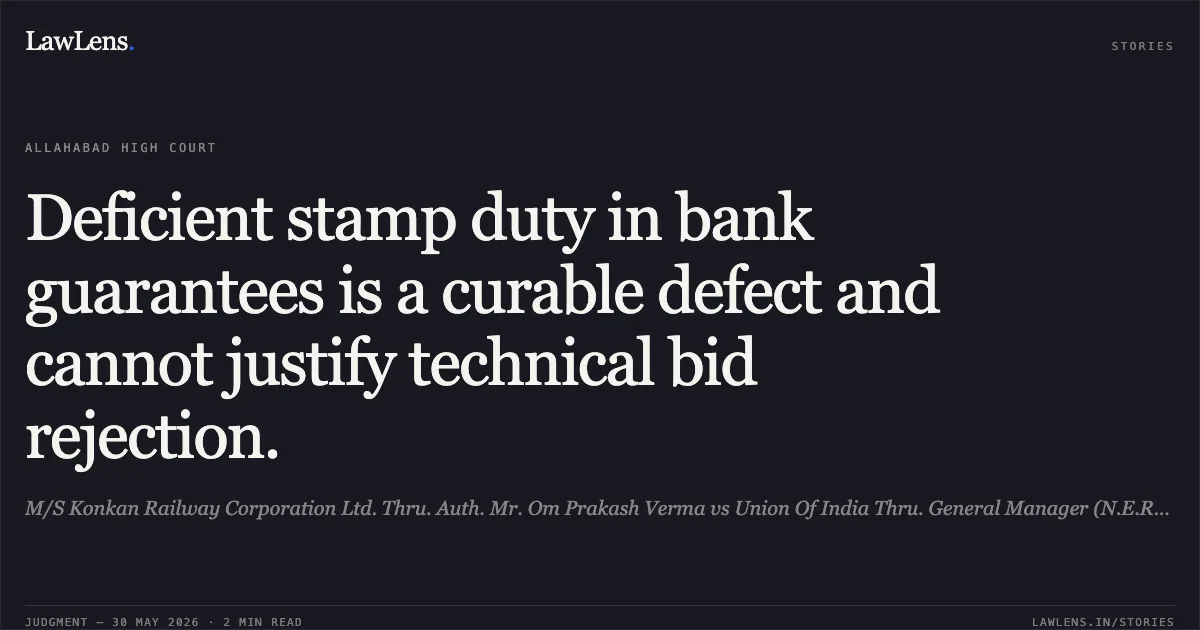
It held that the rejection on the ground of deficient stamp duty was arbitrary and a "flimsy ground"
The Court allowed the writ petition, quashing the financial bid tabulation prepared on May 19, 2026. The Court directed the respondents to reconsider the financial bids of all tenderers, including the petitioner, while ignoring the stamp duty impediment. The petitioner was ordered to make good the deficiency in stamp duty by June 3, 2026, to facilitate the expeditious completion of the tender process
Source reference: para. 15, 16Original Court PDF
M/S Konkan Railway Corporation Ltd. Thru. Auth. Mr. Om Prakash VermavsUnion Of India Thru. General Manager (N.E.R.) Gorakhpur U.P. And 5 Others
Click to open original judgment
Original judgment, available to read, download and summarize on LawLens.in


![Subsequent exoneration does not retrospectively invalidate a finalized promotion select list.. UNNIKRISHNAN M vs M/o Environment And Forests. CAT - ['Ernakulam']. LawLens](/stories/thumbnails/subsequent-exoneration-does-not-retrospectively-invalidate-a-finalized-promotion-select-li-ce80a0e84f2f4887857271e8b4341c42.webp)