01Facts
The petitioner, plaintiff in O.S. No. 11/2016 before the Principal Civil Judge and JMFC, Khanapur, filed a suit for declaration of title.
¶ 6At the stage of arguments, he filed I.A. No. 16 under Order VI Rule 17 read with Section 151 CPC to amend the plaint and seek, as an alternative relief, a decree for delivery of possession of the suit property.
¶ 1 · ¶ 2The Trial Court rejected the application on 29.10.2024, citing delay.
¶ 2The petitioner contended that if the Trial Court found he was not in possession, he would be left remediless in a declaration suit, so the alternative prayer was sought as a matter of abundant caution.
¶ 3The respondents contended that the petitioner, as a witness, admitted in cross-examination that he was not in possession, and that the amendment was an attempt to fill a lacuna that would further delay the proceedings.
¶ 4The petitioner challenged the rejection order under Articles 226 and 227 of the Constitution.
¶ 102Issues
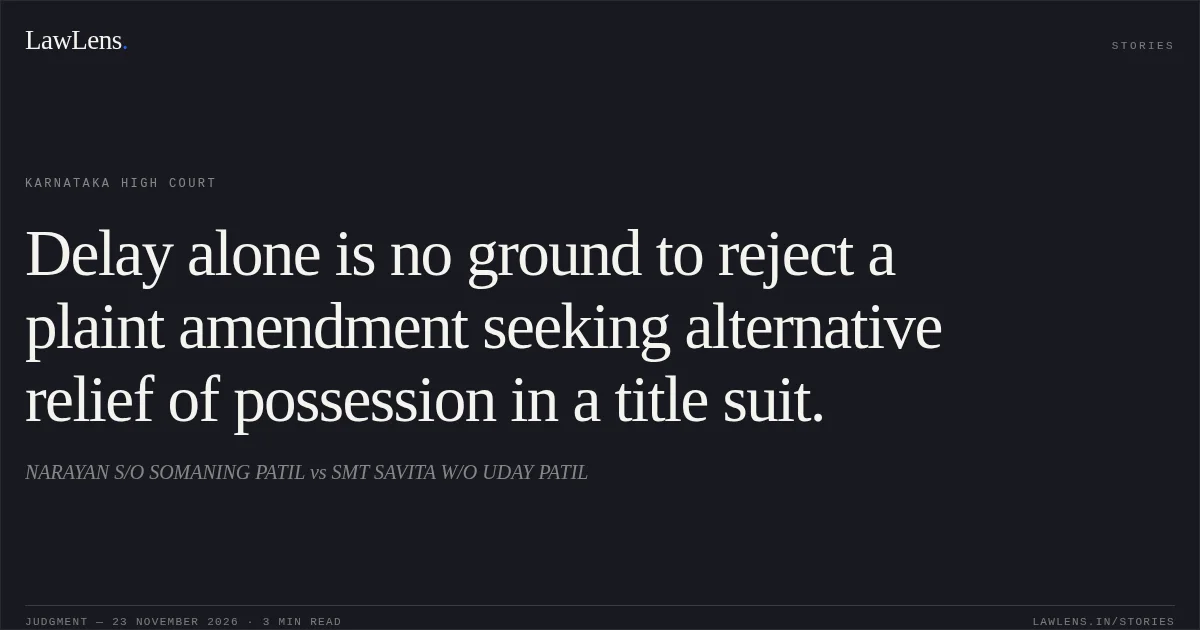
i.1. Whether the Trial Court was justified in rejecting an application for amendment of the plaint solely on the ground of delay.
¶ 2 · ¶ 6ii.2. Whether an alternative prayer for possession, consequential to a declaration of title, may be introduced by amendment at the argument stage.
¶ 6 · ¶ 803Law Applied
Order VI Rule 17 CPC and Section 151 CPC govern amendment of pleadings.
¶ 9(iii)The Supreme Court's decision in Life Insurance Corporation of India v. Sanjeev Builders Private Limited, AIR 2022 SC 4256, particularly the conclusions at para. 70, governs the principles for allowing amendments.
¶ 3 · ¶ 7Amendments necessary for determining the real controversy must be allowed absent injustice or prejudice to the other side.
¶ 7, cl. (ii)A prayer for amendment is generally to be allowed unless it introduces a time-barred claim, changes the nature of the suit, is malafide, or deprives the other side of a valid defence.
¶ 7, cl. (iv)Delay in seeking amendment is, by itself, not a ground to disallow it, and where delay is arguable, the amendment may be allowed with limitation framed as a separate issue.
¶ 7, cl. (ix)Amendment seeking only a different relief, predicated on facts already pleaded, should ordinarily be allowed, whereas amendment that sets up an entirely new case must be disallowed.
¶ 7, cl. (x)The approach favours liberality where costs can compensate the opposite party and where amendment is sought before trial commences.
¶ 7, cl. (v), (xi)Consequential relief of possession flows from the main relief of declaration of title.
¶ 6Provisions in the judgment · 1 · Linked ones open on LawLens
Code of Civil Procedure, 1908 Section 151
04Reasoning
The suit for declaration of title and the consequential relief of possession are closely connected, since the latter flows from the former. The alternative prayer therefore did not set up a new cause of action or change the nature of the suit; it was predicated on facts already pleaded.
¶ 6 · cf. para. 7, cl. (x)The Trial Court's reliance on delay alone was misplaced, because any delay could be traced from the date of allowing the amendment, a matter the Trial Court could consider in its own discretion.
¶ 6 · cf. para. 7, cl. (ix)The petitioner's admission of non-possession, even if established, went to whether he was entitled to possession on the merits, not to whether the amendment should be permitted.
¶ 6The amendment was necessary to prevent the petitioner from being left without remedy if the declaration claim failed on possession, which aided effective adjudication of the real controversy.
¶ 3 · cf. para. 7, cl. (ii), (iii)To address limitation concerns, the amendment would take effect from the date the application is allowed, not from the date of the suit.
¶ 805Holding
The rejection of I.A. No. 16 solely on the ground of delay was unsustainable, and the alternative prayer for possession was properly permissible by amendment.
¶ 6 · ¶ 8The writ petition is allowed, the impugned order dated 29.10.2024 on I.A. No. 16 in O.S. No. 11/2016 is set aside, and I.A. No. 16 under Order VI Rule 17 read with Section 151 CPC is allowed. The Trial Court is directed to permit the plaintiff to amend the plaint, with the amendment effective from the date of allowing the application and not from the date of the suit. The question of whether the claim for possession is time-barred or factually sustainable is left open for the Trial Court.
¶ 6 · ¶ 8 · ¶ 9(i) · ¶ 9(ii) · ¶ 9(iii) · ¶ 9(iv)Original Court PDF
NARAYAN S/O SOMANING PATILvsSMT SAVITA W/O UDAY PATIL
Click to open original judgment
Original judgment, available to read, download and summarize on LawLens.in