Facts
The plaintiff-appellant filed a suit for specific performance based on two notarized agreements to sell dated 26.07.2021 and 29.09.2021 regarding agricultural land in Beawar
Source reference: para 2.1, 2.3The appellant paid an advance of Rs. 21,00,000, but subsequent post-dated cheques amounting to Rs. 3,79,00,000 were dishonored due to insufficient funds
Source reference: para 6.1Consequently, the defendants-respondents cancelled the agreement via notice on 15.01.2022
Source reference: para 6.2Despite this cancellation, the appellant waited until 19.07.2025—over three years—to file the suit, during which time third-party rights were created as the property was sold to respondents No. 7 and 8
Source reference: para 6.3The Trial Court dismissed the appellant’s temporary injunction (TI) application on 27.01.2026
Source reference: para 1Issues
1. Whether the plaintiff-appellant established a prima facie case, balance of convenience, and irreparable injury to warrant a temporary injunction during the pendency of the suit
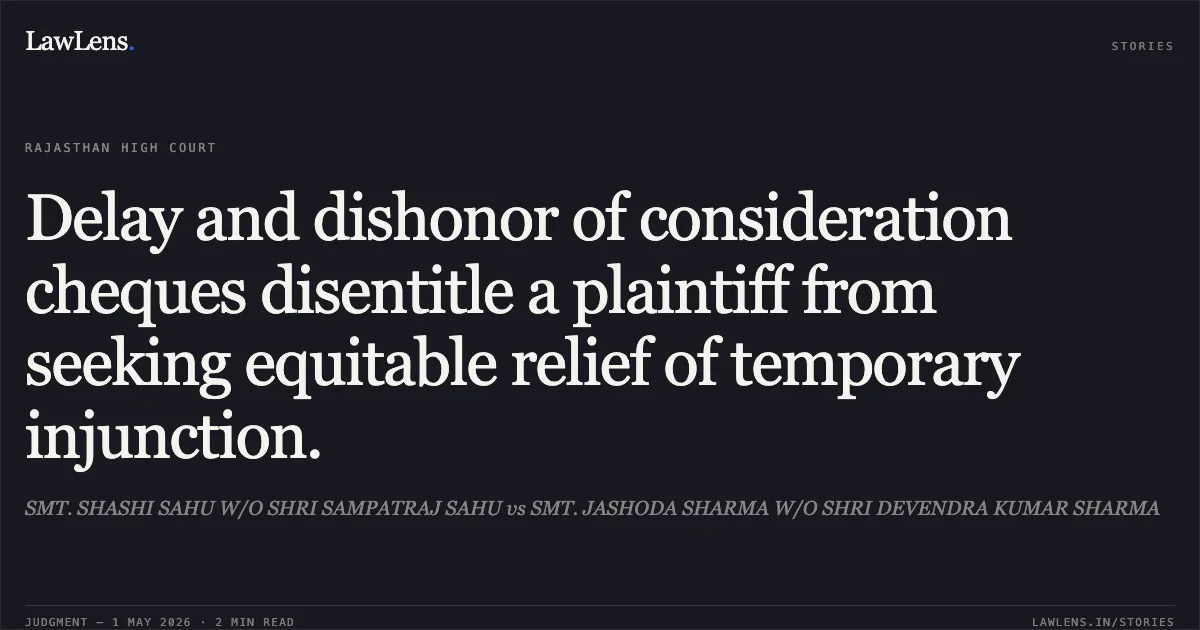
Source reference: para 6.4, 6.62. Whether the conduct of the plaintiff, specifically regarding the delay in filing the suit and the dishonor of payment cheques, disentitles her to equitable relief
Source reference: para 6.5, 6.8Law Applied
The court applied Order 39 of the Code of Civil Procedure, 1908, governing interim injunctions, emphasizing the three-pillar test: prima facie case, balance of convenience, and irreparable loss
Source reference: para 6.4The court relied on Seema Arshad Zaheer v. Municipal Corpn. of Greater Mumbai, which mandates that TI is an equitable relief requiring the plaintiff to approach the court with "clean hands"
Source reference: para 6.4The court invoked principles from Motilal Jain v. Ramdasi Devi regarding the impact of delay and the acquisition of third-party rights on discretionary relief
Source reference: para 6.7The court applied Gujarat Bottling Co. Ltd. v. Coca Cola Co., establishing that a party's conduct must be free from blame for equitable interference
Source reference: para 6.8Section 52 of the Transfer of Property Act, 1882, regarding the doctrine of lis pendens
Source reference: para 9Reasoning
The court found that the appellant failed to meet the threshold for interim relief due to her conduct and laches; the prima facie case was weakened by the admitted dishonor of substantial cheques (Rs. 3.79 Crores) and the lack of explanation for the failure to maintain sufficient funds, which indicated a lack of readiness and willingness
Source reference: para 6.1, 6.2The court highlighted an "inordinate delay" of over three years between the cancellation of the agreement (2022) and the filing of the suit (2025)
Source reference: para 6.3, 6.5Applying Ambalal Sarabhai Enterprise Ltd. v. KS Infraspace LLP, the court reasoned that such delay, coupled with the intervening creation of third-party rights, tilts the balance of convenience in favor of the defendants
Source reference: para 6.6, 6.9The court concluded that because the appellant was responsible for the circumstances complained of, she was not entitled to equitable protection
Source reference: para 6.8Holding
The court held that no prima facie case or balance of convenience existed in favor of the appellant due to her conduct and the long delay
The High Court dismissed the appeal and upheld the Trial Court's order dated 27.01.2026, refusing the temporary injunction, but directed respondents to disclose any further sale to ensure transparency under the doctrine of lis pendens
Source reference: para 11, 9Original Court PDF
SMT. SHASHI SAHU W/O SHRI SAMPATRAJ SAHUvsSMT. JASHODA SHARMA W/O SHRI DEVENDRA KUMAR SHARMA
Click to open original judgment
Original judgment, available to read, download and summarize on LawLens.in