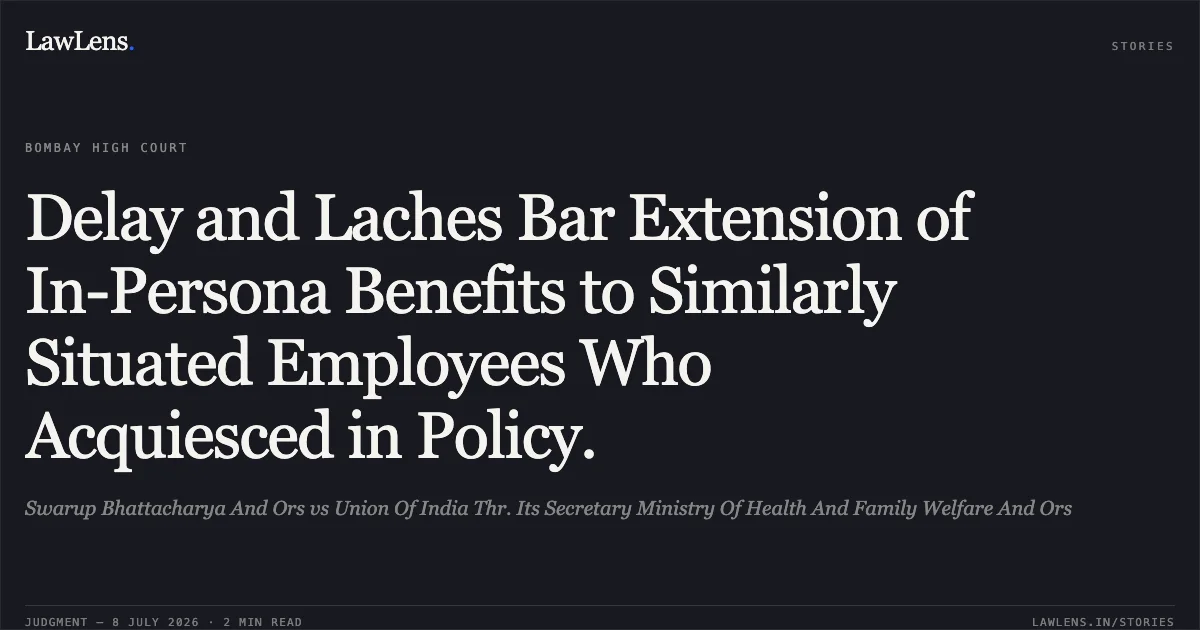
Facts
The Petitioners, qualified Medical Officers (MBBS, MD, MS, etc.) employed by the Nuclear Power Corporation of India Ltd. (NPCIL), sought the implementation of the Dynamic Assured Career Progression (DACP) Scheme as recommended by the 5th, 6th, and 7th Central Pay Commissions
Source reference: p. 1-4They relied on a Supreme Court judgment dated August 24, 2023 (Union of India v. Deepak Sen), which granted DACP benefits to doctors in the Department of Atomic Energy (DAE)
Source reference: p. 3, 5The Respondents rejected the Petitioners' representations via communications dated April 9, 2025, and July 9, 2025, contending that NPCIL is a Public Sector Undertaking (PSU) following a "Merit Promotion Scheme" (MPS) rather than DACP, and that the Deepak Sen judgment was in personam
Source reference: p. 8-10Issues
1. Whether the judgment of the Supreme Court in Union of India v. Deepak Sen is a judgment in rem applicable to all similarly situated doctors or a judgment in personam
Source reference: para. 8, 142. Whether the Petitioners are barred from seeking relief due to the principles of delay, laches, and acquiescence
Source reference: para. 11, 15Law Applied
The court primarily applied the principles governing the extension of judicial benefits to non-litigants as settled in State of Uttar Pradesh and Ors. v. Arvind Kumar Srivastava and Ors. (2015)
Source reference: para. 9, 13This precedent establishes that while "similarly situated persons" should generally receive equal treatment under Article 14, this is subject to the exception of "laches, delays, and acquiescence"
Source reference: para. 13Specifically, if a judgment is in personam (intended only for the parties before the court), third parties seeking its extension must prove their claim is not hit by delay. Conversely, if a judgment is in rem (touching upon policy for all), the authorities must extend benefits regardless of whether individuals approached the court
Source reference: para. 13Reasoning
The Court observed that the DACP Scheme recommendations were accepted as far back as 2008, yet the Petitioners only approached the Court in 2025 after the Deepak Sen verdict
Source reference: para. 5, 15The Court characterized the Deepak Sen judgment as in personam in the context of the present Petitioners
Source reference: para. 14It reasoned that the Petitioners had slept over their rights for over 15 years, during which they accepted the benefits of the Merit Promotion Scheme (MPS)
Source reference: para. 15Following Arvind Kumar Srivastava, the Court held that the Petitioners acted as "fence-sitters" who only "jumped upon the bandwagon" after successful litigation by others
Source reference: para. 13, 15The failure to provide any explanation for this decade-long delay constituted acquiescence, negating their right to claim parity
Source reference: para. 15-16Holding
The Court dismissed the Writ Petition, answering both issues against the Petitioners
It held that the Petitioners were not entitled to the DACP benefits because their claim was severely hit by unexplained delay and laches
Source reference: para. 15, 17Furthermore, the Deepak Sen judgment could not be automatically applied to the Petitioners as they failed to satisfy the threshold of timely pursuit of legal remedies required for the extension of an in personam judgment
Source reference: para. 14, 16Rule discharged
Source reference: para. 18Original Court PDF
Swarup Bhattacharya And OrsvsUnion Of India Thr. Its Secretary Ministry Of Health And Family Welfare And Ors
Click to open original judgment
Original judgment, available to read, download and summarize on LawLens.in


