Facts
The parties married in 1992 and have lived separately since 2005. An ex parte divorce decree obtained by the husband in 1994 was later set aside.
Source reference: p. 1–3, 5–6The wife’s earlier petition for restitution of conjugal rights was withdrawn in 2015 following a compromise, but the contemplated divorce proceedings did not proceed. In 2022, the wife filed a fresh petition under Section 9 of the Hindu Marriage Act, 1955 (HMA).
Source reference: p. 1–3, 5–6The husband sought rejection of that petition under Order VII Rule 11 of the Code of Civil Procedure, arguing that the 17-year separation and delay barred the claim under Section 23(1)(d) HMA. The Family Court dismissed his application and directed him to pay the wife ad interim maintenance of Rs. 10,000 per month. The husband appealed.
Source reference: p. 1–3, 5–6Issues
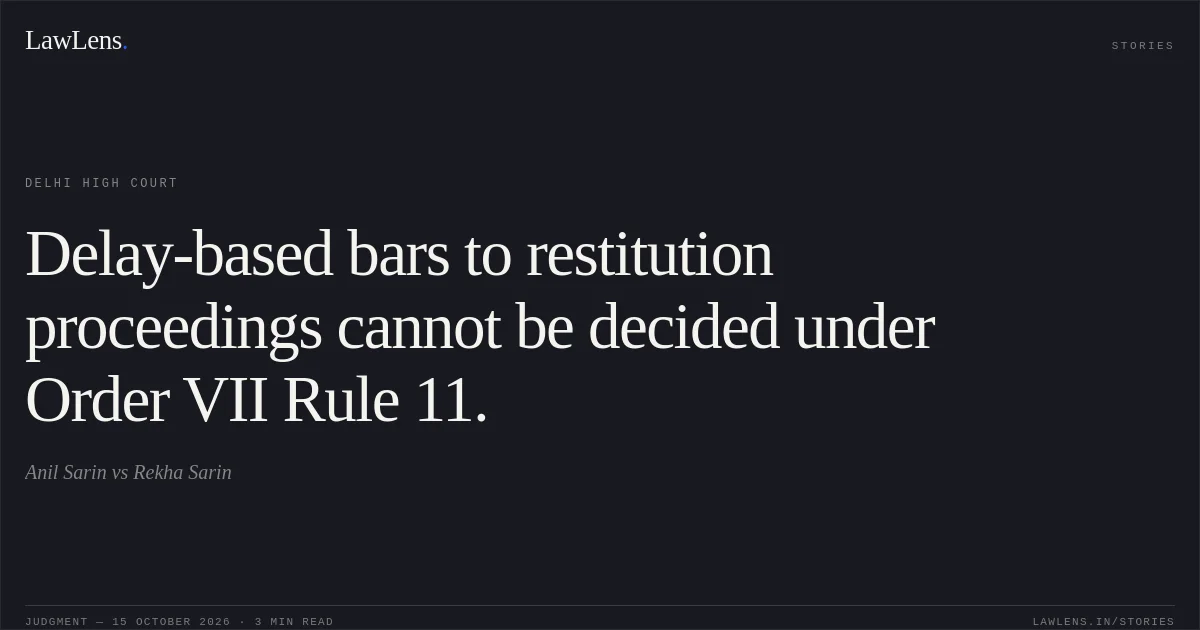
Whether the wife’s Section 9 HMA petition could be rejected under Order VII Rule 11 CPC as barred by delay or limitation, based on the alleged 17-year separation.
Source reference: p. 3–5Whether the Family Court’s ad interim maintenance direction warranted appellate interference.
Source reference: p. 6Law Applied
Order VII Rule 11 CPC permits rejection of a plaint only on the basis of its averments and documents; the defence is not considered at that stage.
Source reference: p. 4In Liverpool & London S.P. & I Assn. Ltd. v. M.V. Sea Success I & Anr., (2004) 9 SCC 512, the Supreme Court held that the plaint’s averments must be read as a whole and taken as correct when assessing whether it discloses a cause of action.
Source reference: p. 4Vinod Infra Developers Ltd. v. Mahaveer Lunia, 2025 SCC OnLine SC 1208, reiterates that rejection under Order VII Rule 11 is appropriate only where the plaint itself discloses a statutory bar, among other specified grounds; triable issues preclude summary rejection.
Source reference: p. 5Under Section 23(1)(d) HMA, a court must be satisfied that there has been no unnecessary or improper delay before granting matrimonial relief. The court treated whether delay or laches bars relief as a mixed question of fact and law.
Source reference: p. 6Reasoning
The wife’s petition, read on its face, alleged that the marriage remained subsisting because the ex parte divorce decree had been set aside, and sought restitution after the parties’ compromise failed.
Source reference: p. 5–6The husband’s allegations about the length of separation and the wife’s conduct were matters of defence and could not be relied on to reject the petition under Order VII Rule 11 CPC.
Source reference: p. 5–6Whether the delay was unnecessary or improper, and whether the wife was taking advantage of her own wrong, required evidence and could be determined only at trial.
Source reference: p. 5–6The appellate court also declined to disturb the maintenance direction, noting that amounts paid would be relevant when maintenance was fixed under Section 24 HMA.
Source reference: p. 6Holding
The court held that the alleged delay and related conduct could not be resolved at the Order VII Rule 11 stage and dismissed the appeal, leaving the Section 9 petition to proceed before the Family Court.
It also declined to interfere with the direction to pay ad interim maintenance of Rs. 10,000 per month, while observing that payments made would be relevant to the subsequent determination of maintenance under Section 24 HMA.
Source reference: p. 6Acts & Sections Cited
6 provisions across 3 statutes referred to in this judgment. Each provision opens on LawLens.
Family Courts Act, 19841
Indian Penal Code, 18602
Hindu Marriage Act, 19553
Original Court PDF
Anil SarinvsRekha Sarin
Click to open original judgment
Original judgment, available to read, download and summarize on LawLens.in