Facts
M/s. Sri Ram Transport Finance Company alleged that Sabud Ansari issued a cheque for ₹3,40,000 towards outstanding vehicle-loan dues.
Source reference: para. 2–9The cheque was dishonoured with the endorsement “Account Closed”; the company sent a demand notice dated 21 September 2013.
Source reference: para. 2–9Its initial complaint was filed at Ranchi on 11 November 2013, returned for presentation before the competent court, and a fresh complaint was filed at Lohardaga on 6 February 2015.
Source reference: para. 2–9The trial court convicted Ansari under Section 138 of the Negotiable Instruments Act, 1881 (“NI Act”), and the Sessions Court affirmed the conviction while modifying the sentence.
Source reference: para. 2–9Issues
1. Whether the complaint under Section 138 of the NI Act was time-barred and, if so, whether the delay had been lawfully condoned.
Source reference: para. 13(i)2. Whether the cheque was issued in discharge, wholly or partly, of a legally enforceable debt or liability.
Source reference: para. 13(ii)3. Whether the conviction and sentence suffered from material illegality or infirmity warranting revision.
Source reference: para. 13(iii)Law Applied
Section 138 of the NI Act requires, among other things, a demand notice and failure to pay within 15 days of its receipt; Section 142(1)(b) requires a complaint within one month of the cause of action, while its proviso permits cognizance after that period if the complainant establishes sufficient cause for delay.
Source reference: para. 14The Court relied on Section 3 of the Limitation Act, 1963, under which a time-barred proceeding must be dismissed even if limitation is not pleaded.
Source reference: para. 20It also applied the presumption of service of a correctly addressed registered notice under Section 27 of the General Clauses Act, 1897, as discussed in C.C. Alavi Haji v. Palapetty Muhammed, (2007) 6 SCC 555.
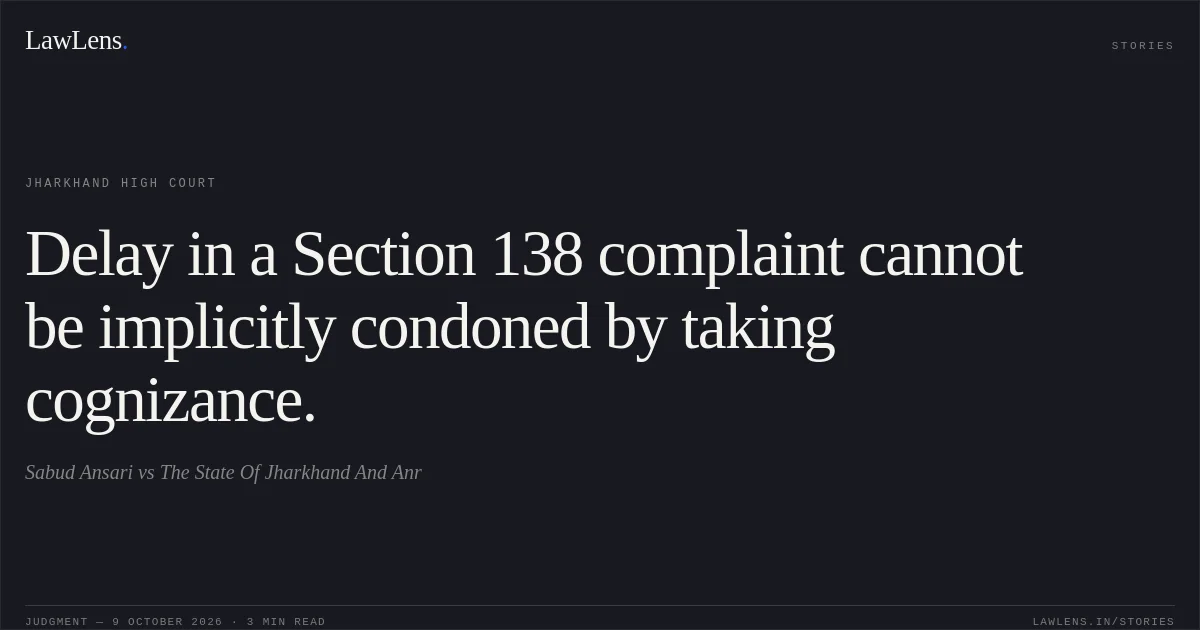
Source reference: para. 15Relying on Subodh S. Salaskar v. Jayprakash M. Shah, (2008) 13 SCC 689, the Court held that filing a delayed complaint or an application for condonation does not itself condone the delay; the court must address the delay in accordance with law.
Source reference: para. 16, 21On the debt issue, the Court relied on Sections 118 and 139 of the NI Act and Krishna Janardhan Bhat v. Dattatraya Hegde, (2008) 4 SCC 54, reasoning that the complainant must establish foundational facts concerning the legally enforceable debt before the presumptions can assist its case.
Source reference: para. 23–24Reasoning
The Court treated the registered notice as served, at the latest, within 30 days of its dispatch on 21 September 2013. On that calculation, the 15-day payment period expired on 5 November 2013, but the original complaint was filed on 11 November 2013.
Source reference: para. 17Although the lower courts referred to a delay-condonation application and court holidays, the record disclosed no specific order condoning the delay; taking cognizance or issuing summons could not amount to implied condonation.
Source reference: para. 18–22Independently, the complainant’s witness lacked personal knowledge of the loan transaction, and the loan or hire-purchase agreement and evidence establishing the outstanding amount were not produced. The Court therefore found the foundational proof of legally enforceable debt deficient.
Source reference: para. 24Holding
The High Court held that the complaint was time-barred and that the delay had not been lawfully condoned.
It also found the evidence insufficient to establish the legally enforceable debt underlying the cheque.
Source reference: para. 22, 24–25The revision was allowed; the trial court’s conviction and sentence, as affirmed and modified by the appellate court, were set aside. The petitioner was discharged from his bail bond and the sureties were discharged.
Source reference: para. 25–28Acts & Sections Cited
31 provisions across 5 statutes referred to in this judgment. Each provision opens on LawLens.
Negotiable Instruments Act, 18816
Indian Penal Code, 18601
Limitation Act, 1963
Code of Criminal Procedure, 19731
General Clauses Act, 18971
Original Court PDF
Sabud AnsarivsThe State Of Jharkhand And Anr
Click to open original judgment
Original judgment, available to read, download and summarize on LawLens.in