01Facts
The plaintiff filed a suit concerning partition, inheritance and title rights.
Summons were issued to the defendants on 29 November 2023, and Defendant No. 1’s written statement, along with his affidavit of admission/denial of documents, was taken on record on 19 March 2024.
¶ 3(a)–(b)The plaintiff filed a replication along with an affidavit of admission/denial of the defendant’s documents on 9 May 2024, allegedly with a delay of five days beyond the 45-day period prescribed for filing a replication.
p. 3 · ¶ 4Since the replication was filed beyond the permissible period, the Joint Registrar, relying on Ram Sarup Lugani v. Nirmal Lugani, refused to take the replication on record by order dated 10 February 2025.
¶ 3(c)–(d), 18The plaintiff thereafter sought, under Section 151 CPC, to place on record the affidavit of admission/denial independently of the rejected replication.
The Joint Registrar dismissed that application on 6 May 2026, holding that such affidavit could not be taken on record beyond 45 days.
¶ 3(e)–(f)The plaintiff challenged that order by the present Chamber Appeal under Chapter II Rule 5 of the Delhi High Court (Original Side) Rules, 2018.
¶ 102Issues
i.Whether the plaintiff’s affidavit of admission/denial of the defendant’s documents could be taken on record despite the replication itself having been filed beyond the maximum 45-day period and consequently rejected.
¶ 11–15, 18–22ii.Whether Chapter VII Rule 7 of the Delhi High Court (Original Side) Rules, 2018 prescribes an inflexible time-limit for filing the affidavit of admission/denial, thereby excluding the Court’s power to condone delay.
¶ 13–17, 21–23iii.Whether the inherent jurisdiction under Section 151 CPC could be invoked to permit the filing or formal recognition of the affidavit of admission/denial.
¶ 6, 25 · pp. 21–2303Law Applied
Chapter VII Rule 5 of the Delhi High Court (Original Side) Rules requires a replication to be filed within 30 days of receipt of the written statement, with a possible extension of up to 15 days for sufficient cause, “but not thereafter”; thus, the 45-day outer limit for a replication is mandatory.
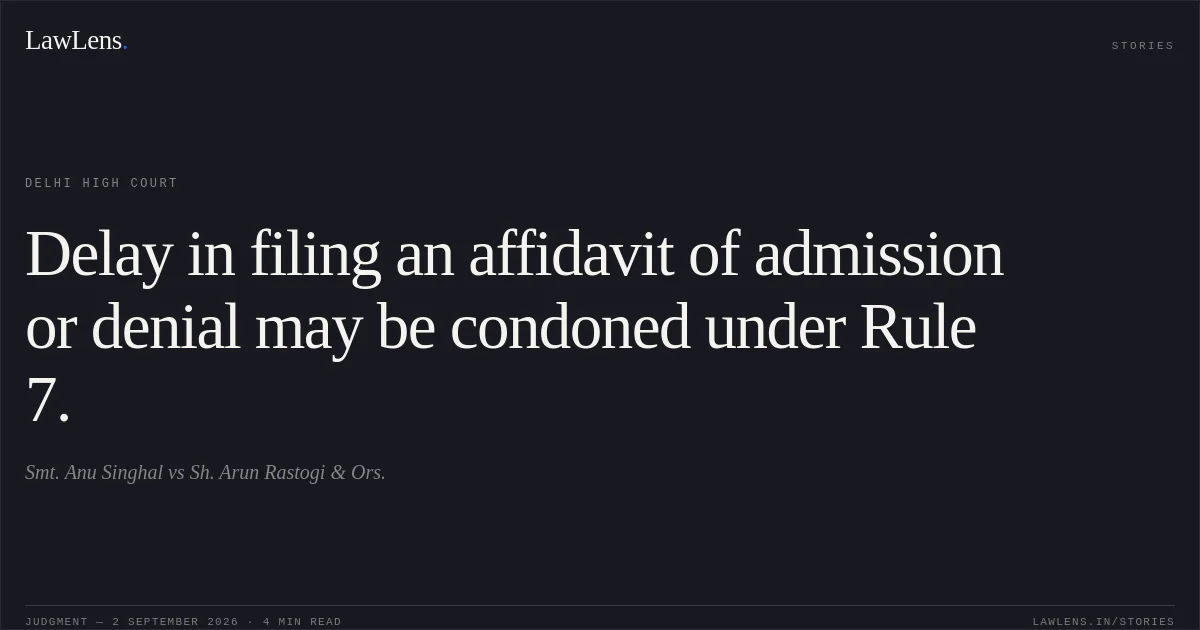
p. 5 · ¶ 11, 18, 21–24Rule 6 requires the plaintiff to file an affidavit of admission/denial along with the replication, failing which the replication is not taken on record.
p. 6 · ¶ 12Rule 7 independently requires the plaintiff to file an affidavit of admission/denial whether or not a replication is filed, and provides that, in its absence, the defendant’s documents are deemed admitted.
p. 7 · ¶ 13The Court held that Rule 7 contains no express outer limit or phrase equivalent to “but not thereafter,” and therefore does not exclude the Court’s power to condone delay in filing the affidavit.
¶ 14–15, 21–23It considered Ram Sarup Lugani v. Nirmal Lugani, 2020 SCC OnLine Del 1355, on the mandatory 45-day limit for replications.
¶ 18, 20–24It applied State of U.P. v. Roshan Singh, (2008) 2 SCC 488, for the principle that Section 151 CPC may supplement but cannot override or circumvent an express statutory or procedural scheme.
pp. 21–23 · ¶ 25Provisions in the judgment · 28 · Linked ones open on LawLens
Code of Civil Procedure, 1908 Section 151
Arbitration and Conciliation Act, 1996 Section 34Section 36
Limitation Act, 1963 22 provisions
Section 4Section 5Section 6Section 7Section 8Section 9Section 10Section 11Section 12Section 13Section 14Section 15Section 16Section 17Section 18Section 19Section 20Section 21Section 22Section 23Section 24Section 29Central Excise Act, 1944 Section 35
Companies Act, 2013 Section 421Section 433
04Reasoning
The Court treated the replication and the affidavit of admission/denial as distinct procedural requirements.
¶ 14–17, 21–22Although Rule 5 expressly bars acceptance of a replication after 45 days, Rule 7 merely mandates filing of the affidavit and specifies the consequence of non-filing—deemed admission of the defendant’s documents—without prescribing an equivalent outer limit.
¶ 14–17, 21–22The affidavit could also be filed independently because Rule 7 expressly operates “irrespective of whether the plaintiff files the replication or not”.
p. 7 · ¶ 13Accordingly, rejection of the delayed replication under Ram Sarup Lugani did not automatically entail rejection of the accompanying affidavit, nor did the order dated 10 February 2025 expressly determine the affidavit’s status.
¶ 18–20The Court further reasoned that treating the affidavit as incapable of being filed or recognised after 45 days would expose the plaintiff to automatic admission of the defendant’s documents without an opportunity to dispute them, with potentially serious consequences in a title and inheritance dispute.
¶ 21Since Rule 7 did not contain the mandatory exclusion found in Rule 5, the Court held that the delay in filing the affidavit could be considered and condoned in accordance with the applicable procedural discretion.
¶ 23–25However, because the plaintiff had not filed a separate application explaining the delay in curing the filing defects, the Court did not itself finally condone the delay.
¶ 23–2505Holding
The appeal was allowed.
The Court held that the power to condone delay in filing the plaintiff’s affidavit of admission/denial was not excluded by Chapter VII Rule 7 of the Delhi High Court (Original Side) Rules, notwithstanding the rejection of the delayed replication under Rule 5.
¶ 21–23The Joint Registrar’s order dated 6 May 2026 was set aside.
¶ 26The matter was remanded to the Joint Registrar to consider whether the delay in curing the defects and bringing the affidavit on record should be condoned; the plaintiff was permitted to file an appropriate application explaining that delay.
¶ 24–25The matter was directed to be listed before the Joint Registrar on 30 October 2026 and before the Court on 26 November 2026.
¶ 27Original Court PDF
Smt. Anu SinghalvsSh. Arun Rastogi & Ors.
Click to open original judgment
Original judgment, available to read, download and summarize on LawLens.in