Facts
The appellant-workman was a permanent Heavy Vehicle Driver for the Gujarat State Road Transport Corporation
Source reference: para. 1On 11.10.1995, while driving a bus from Udaipur to Rajkot, he handed the steering to a co-driver (Suleman Sumarbhai) who was traveling in the same bus, due to sudden, unbearable stomach pain
Source reference: para. 2The Corporation deemed this "major misconduct" and issued a charge sheet
Source reference: para. 3Following an inquiry and subsequent appeals, a penalty of stoppage of two increments with future effect was imposed
Source reference: paras. 4-5In 2013, the workman raised a dispute before the Industrial Tribunal
Source reference: para. 6In 2015, the Tribunal quashed the punishment as disproportionate but denied back-arrears due to a 15-year delay in raising the dispute
Source reference: para. 7The Corporation challenged this in a Writ Petition; the learned Single Judge set aside the Tribunal’s award, holding that the 16-year delay was fatal to the workman's case
Source reference: paras. 8-9Issues
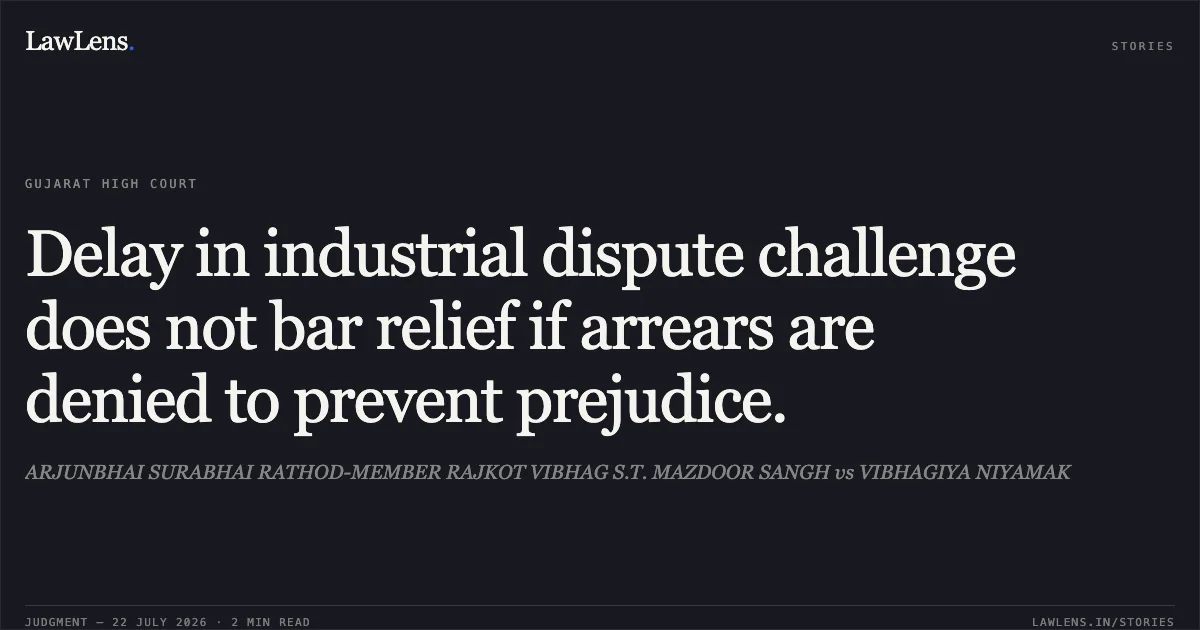
Whether the inordinate delay of 16 years in raising an industrial dispute over the penalty was fatal to the workman’s claim despite the merits of the case
Source reference: para. 9Whether the act of handing over a vehicle to a qualified co-driver under medical necessity constitutes such major misconduct as to warrant a permanent reduction in pay
Source reference: paras. 11-12Law Applied
The court applied the principle of proportionality in disciplinary matters and the judicial discretion to condone delay under the Industrial Disputes Act to subserve the interest of justice
Source reference: para. 13It further relied on the doctrine that if any delay is balanced by the denial of back-wages or arrears (moulding of relief), it causes no serious prejudice to the employer
Source reference: para. 10Reasoning
The Court reasoned that the delay did not prejudice the Corporation because the Industrial Tribunal had already protected the employer's interests by denying the workman arrears for the past period
Source reference: para. 10On the merits, the Court observed that the workman did not entrust the vehicle to a stranger, but to a qualified fellow driver of the same Corporation due to a medical emergency
Source reference: para. 11This action ensured that neither the Corporation nor the passengers were put at risk
Source reference: para. 11Consequently, the Court found the punishment of withholding two increments with future effect—which resulted in a permanent reduction of basic pay—to be "indeed disproportionate" given the absence of loss to the Corporation
Source reference: para. 12The Court concluded that the delay was rightly condoned by the Tribunal to achieve the ultimate interest of justice
Source reference: para. 13Holding
The Division Bench allowed the appeal and set aside the judgment of the learned Single Judge
The Court held that the Industrial Tribunal’s decision to quash the punishment was correct and restored the award
Source reference: para. 14The relief remains restricted as per the Tribunal's original order: the workman's pay is to be fixed notionally without entitlement to any arrears for the past period
Source reference: para. 7Acts & Sections Cited
1 provisions across 1 statute referred to in this judgment. Linked provisions open on LawLens.
Industrial Disputes Act, 19471
Original Court PDF
ARJUNBHAI SURABHAI RATHOD-MEMBER RAJKOT VIBHAG S.T. MAZDOOR SANGHvsVIBHAGIYA NIYAMAK
Click to open original judgment
Original judgment, available to read, download and summarize on LawLens.in