Facts
Respondent No. 1 sought mutation on the basis of a registered sale deed dated 9 February 1996.
Source reference: p. 1–3The Tehsildar initially rejected the claim on 18 November 2022; following a remand dated 3 July 2024, the appellate authority allowed mutation on 24 January 2025. The petitioners’ second appeal was dismissed by the Additional Commissioner on 29 May 2026.
Source reference: p. 1–3They challenged that dismissal under Article 226, alleging, among other things, an unexplained delay of about 27 years, non-compliance with the six-month period said to be prescribed by Section 109 of the Madhya Pradesh Land Revenue Code, 1959, and uncertainty about the property’s identity because the sale deed did not specify its survey number.
Source reference: p. 1–3Issues
1. Whether the Additional Commissioner’s dismissal of the second appeal disclosed a jurisdictional infirmity, perversity, or patent illegality warranting interference under Article 226.
Source reference: p. 4–62. Whether the delay in seeking mutation and the objection to the sale deed’s property description justified setting aside the revenue authorities’ orders in writ jurisdiction.
Source reference: p. 3–5Law Applied
Article 226 permits judicial review of an administrative or quasi-judicial order where a relevant jurisdictional infirmity, perversity, or patent illegality is demonstrated; it does not ordinarily permit the High Court to substitute its factual assessment for that of the competent authority merely because another view may be possible.
Source reference: p. 2–5The Court treated the ultimate validity, genuineness, or enforceability of the sale transaction, if seriously disputed, as a matter for determination by a competent forum in appropriate proceedings, rather than for conclusive resolution in mutation proceedings.
Source reference: p. 2–5The petitioners invoked Section 109 of the Madhya Pradesh Land Revenue Code, 1959, asserting a six-month reporting period, but the Court did not determine the provision’s applicability or decide a separate question of statutory limitation.
Source reference: p. 2–5Reasoning
The Court found that the mutation claim had been considered through the revenue hierarchy and that the petitioners’ objections concerning delay and the sale deed’s description required assessment of the underlying document and the property’s identity.
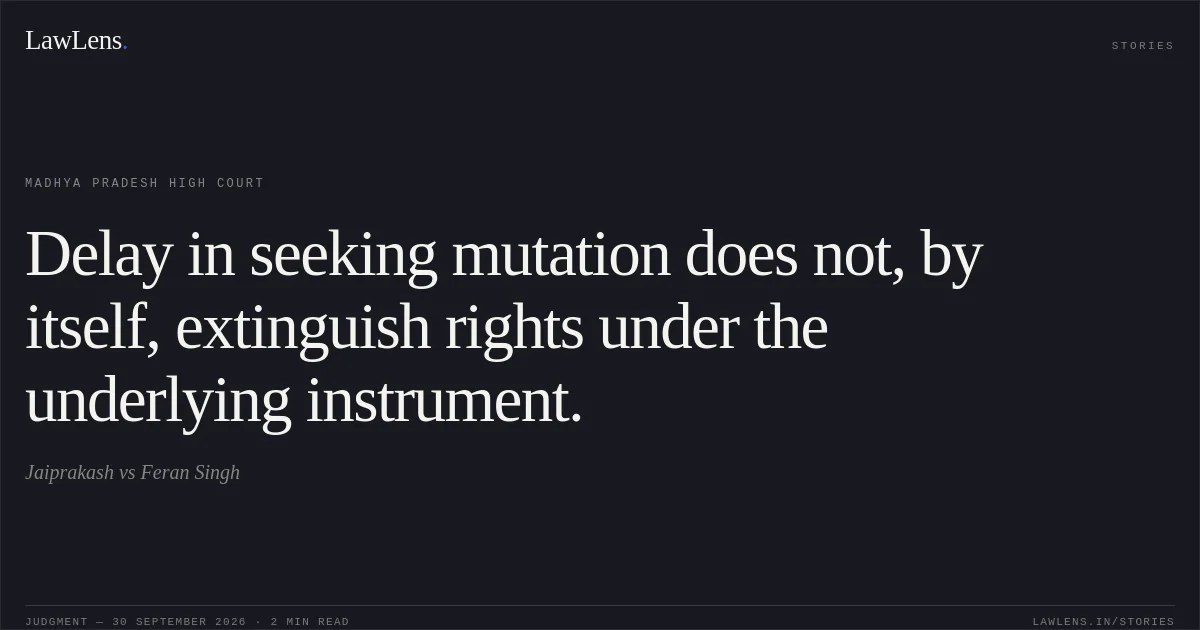
Source reference: p. 3–5It held that the lapse of time, by itself, did not extinguish the right claimed under the sale deed, while disputes about the transaction’s validity could be pursued before the competent forum.
Source reference: p. 3–5Because resolving the property-identification objection would require reassessing facts, and the petitioners had not established jurisdictional error, perversity, or patent illegality, the Court declined to reappreciate the revenue authorities’ findings under Article 226.
Source reference: p. 3–5Holding
The Court held that no ground for interference under Article 226 had been established and dismissed the writ petition as devoid of merit.
The Additional Commissioner’s order dated 29 May 2026 was not disturbed.
Source reference: p. 5–6Acts & Sections Cited
1 provisions across 1 statute referred to in this judgment. Each provision opens on LawLens.
MP Land Revenue Code 19591
Original Court PDF
JaiprakashvsFeran Singh
Click to open original judgment
Original judgment, available to read, download and summarize on LawLens.in
![Termination founded on impersonation is punitive and requires an inquiry and an opportunity to respond.. SUNIL KUMAR vs COMPTROLLER AND AUDITOR-GENERAL OF INDIA. CAT - ['Chandigarh']. LawLens](/stories/thumbnails/termination-founded-on-impersonation-is-punitive-and-requires-an-inquiry-and-an-opportunit-273dc59ea6dc43d39c6e48275fd09246.webp)
![Tribunal upholds removal of Chandigarh teachers named as beneficiaries in recruitment paper-leak probe, despite their not being charge-sheeted in the case. Sonia vs Education Deptt., Ut Chandigarh. CAT - ['Chandigarh']. LawLens](/stories/thumbnails/tribunal-upholds-removal-of-chandigarh-teachers-named-as-beneficiaries-in-recruitment-pape-3f061884a7cc4bab9996e2cb58c5b0db.webp)
![A decades-late challenge to alternative absorption and pay fixation is barred by limitation.. PRANAB KUMAR GHOSH vs EAST CENTRAL RAILWAY. CAT - ['Kolkata']. LawLens](/stories/thumbnails/a-decades-late-challenge-to-alternative-absorption-and-pay-fixation-is-barred-by-limitatio-4687b7e84bf84893a401e61b221dcaa7.webp)