Facts
An ex parte decree was passed against the appellant on 5 December 2011. The appellant filed an application under Order IX Rule 13 of the Code of Civil Procedure, 1908, on 4 September 2015, accompanied by an application under Section 5 of the Limitation Act, 1963, seeking condonation of the delay in filing that application
Source reference: paras. 1–2The condonation application was dismissed by the trial court on 1 March 2024, resulting in dismissal of the Order IX Rule 13 application. The appellant’s appeal, FMA 722 of 2024, was dismissed on 5 March 2025, and the subsequent Special Leave Petition and review petition before the Supreme Court were also dismissed
Source reference: para. 3Thereafter, the appellant filed the present first appeal under Section 96(2) CPC against the original ex parte decree, with an approximately 4,938-day delay, contending that the period spent pursuing the Order IX Rule 13 proceedings constituted sufficient cause for condonation
Source reference: paras. 1, 4–8Issues
1. Whether an appeal under Section 96(2) CPC against an ex parte decree is maintainable after dismissal of an application under Order IX Rule 13 CPC.
Source reference: paras. 10–12, 14–162. Whether the grounds and period of delay previously considered and rejected in proceedings under Order IX Rule 13 CPC could be reconsidered in a subsequent application for condonation of delay in filing the first appeal.
Source reference: paras. 13, 20–253. Whether the pendency of proceedings under Order IX Rule 13 CPC constituted sufficient cause, or attracted Section 14 of the Limitation Act, for condoning the delay in filing the present appeal.
Source reference: paras. 26–30Law Applied
The Court applied Order IX Rule 13 CPC, which permits setting aside an ex parte decree where summons were not duly served or the defendant was prevented by sufficient cause from appearing, and Section 96(2) CPC, which confers an independent statutory right of appeal against an ex parte decree
Source reference: paras. 10–12Relying on N. Mohan v. R. Madhu, (2020) 20 SCC 302, and the principles stated in Bhivchandra Shankar More and Bhanu Kumar Jain v. Archana Kumar, the Court held that the remedies under Order IX Rule 13 CPC and Section 96(2) CPC are distinct and may be pursued simultaneously or consecutively; however, the delay in filing an appeal remains subject to scrutiny for bona fides, absence of dilatory conduct and sufficient cause
Source reference: paras. 10, 14–18The Court further applied Section 5 of the Limitation Act, the doctrine of res judicata and constructive res judicata, and the doctrine of issue estoppel, holding that an issue concerning condonation of an overlapping period of delay, once finally rejected up to the Supreme Court, cannot be reopened in subsequent proceedings merely because the later application arises in an appeal rather than under Order IX Rule 13 CPC
Source reference: paras. 20–25The Court also held that Section 14 of the Limitation Act was inapplicable because the two remedies were parallel and not proceedings prosecuted in a forum lacking jurisdiction
Source reference: para. 29Reasoning
The Court accepted that dismissal of an Order IX Rule 13 application does not, by itself, extinguish the statutory right to file an appeal under Section 96(2) CPC
Source reference: paras. 10–12, 20However, the appellant’s difficulty was not maintainability but limitation. The initial period—from the ex parte decree dated 5 December 2011 until the filing of the Order IX Rule 13 application on 4 September 2015—was the same period for which condonation had already been refused by the trial court, the High Court and the Supreme Court
Source reference: paras. 20, 24–25Since condonation is a common procedural issue whether sought for a miscellaneous application or an appeal, the appellant could not reargue that period on different grounds; such reopening was barred by res judicata, constructive res judicata and issue estoppel
Source reference: paras. 22–25Further, the appellant could have filed the appeal simultaneously with the Order IX Rule 13 application. The prolonged pursuit of the earlier remedy, followed by the filing of the appeal after approximately 4,938 days, demonstrated lack of bona fides and amounted to dilatory conduct rather than sufficient cause
Source reference: paras. 16–18, 27–29Consequently, once the foundational period of delay was incapable of being condoned, the subsequent delay also could not be excused
Source reference: para. 26Holding
The Court held that although the present appeal under Section 96(2) CPC was legally maintainable after dismissal of the Order IX Rule 13 application, the appellant failed to establish sufficient cause for the approximately 4,938-day delay in filing it
The previously rejected explanation for the overlapping period of delay could not be reopened, and the pendency of the Order IX Rule 13 proceedings did not attract Section 14 of the Limitation Act
Source reference: paras. 25–30Accordingly, CAN 1 of 2025, seeking condonation of delay, was dismissed on contest without costs; consequently, FAT 264 of 2025 was dismissed as time-barred, and CAN 2 of 2025, CAN 3 of 2025, CAN 4 of 2025 and CAN 5 of 2025 were also dismissed
Source reference: paras. 32–35Acts & Sections Cited
3 provisions across 2 statutes referred to in this judgment. Each provision opens on LawLens.
Code of Civil Procedure, 19081
Limitation Act, 19632
Original Court PDF
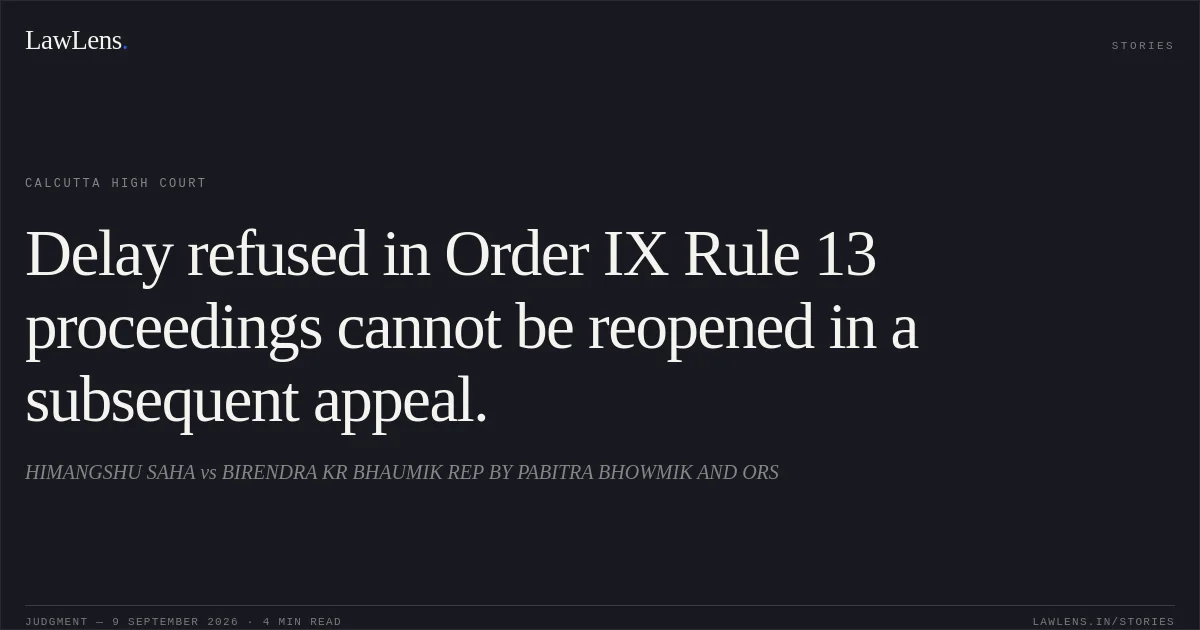
HIMANGSHU SAHAvsBIRENDRA KR BHAUMIK REP BY PABITRA BHOWMIK AND ORS
Click to open original judgment
Original judgment, available to read, download and summarize on LawLens.in